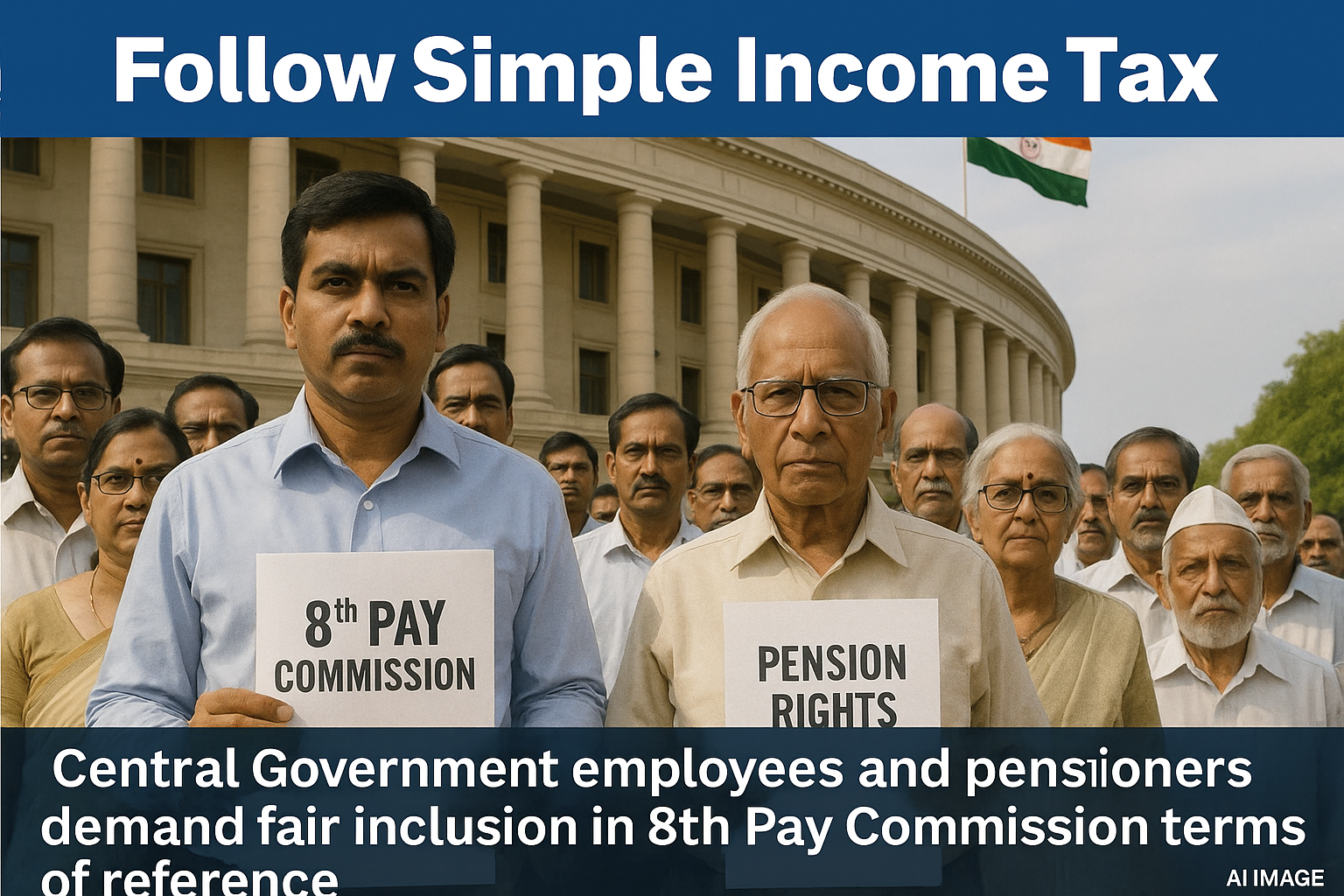

The Government of India has recently notified the formation of the 8th Central Pay Commission (8th CPC), charged with reviewing pay, pension and benefits for central government employees. The notification raised hope of major salary and pension upgrades. However, the All India Defence Employees’ Federation (AIDEF) has issued a strong objection, pointing out that the Terms of Reference (ToR) of the 8th CPC exclude about 69 lakh pensioners and family pensioners from its coverage.
🔍 What is the ToR – and why it matters
The ToR (Terms of Reference) is the document that sets out what the Pay Commission will examine, who will be included, what benefits will be reviewed, and what the timeline is. If something is left out of the ToR, the Commission cannot recommend it. In this case, AIDEF says the ToR of the 8th CPC differs significantly from that of the 7th CPC – especially around pension and pre-retirement service revisions.
✅ Key Objections by AIDEF
Here are the major points raised by AIDEF:
- The ToR for 8th CPC talk about “attracting talent”, “promoting efficiency, accountability and responsibility”. But the comparable clause for the 7th CPC also included “with due regard to expectations of stakeholders” (i.e., employees and pensioners). AIDEF contends that the omission of “expectations of stakeholders” is a significant downgrade.
- About 69 lakh pensioners and family pensioners — who served the nation for decades — are allegedly kept out of the purview of the 8th CPC. AIDEF calls this “most unfortunate” and “discriminatory”. AIDEF argues that pension is a right, not a charity, and excluding pensioners undermines that right.
- AIDEF points out that the 7th CPC ToR included explicit wording:
“To examine the principles which should govern the structure of pension and other retirement benefits, including revision of pension in the case of employees who have retired prior to the date of effect of these recommendations…”This clause is missing in the 8th CPC ToR.
- AIDEF also demands the following be added:
- Restoration of commuted pension after 11 years (rather than 15)
- A 5% increase in pension every 5 years from retirement – a measure earlier recommended by a Parliamentary Standing Committee.
🔔 Why this is a big deal
- By excluding pensioners and family pensioners, the 8th CPC may leave out a large group of beneficiaries who already served the country and are now living on a fixed income.
- Pensioners, especially older ones, are vulnerable to inflation and rising costs. Ignoring them may affect morale of public service and lead to unrest.
- The exclusion may set precedent for future pay-commissions: the “once in ten years” major revision cycle might shift or shrink in coverage.
- Employee unions view this as an erosion of their bargaining rights and of past precedent (7th CPC). Inclusion of “expectation of stakeholders” is seen as a symbolic as well as substantive gap.
What AIDEF is asking for
In its letter to the Finance Minister (Smt. Nirmala Sitharaman), AIDEF has requested:
- Issuance of an amendment to the 8th CPC ToR so that they include pensioners and family pensioners (those retired before 1 January 2026).
- Inclusion of wording similar to 7th CPC: revision of pension and other retirement benefits for those already retired.
- Fixing the implementation date of the new pay structure as 01 January 2026, consistent with past pay commissions (4th, 5th, 6th, 7th).
- Restoration of commuted value of pension after 11 years, and regular increases in pension every 5 years by 5%.
What could happen next
- The Government may decide to amend the ToR, issuing a notification to expand coverage.
- If the Government does not amend the ToR, there may be:
- Protests or strikes by employee unions and pensioner groups.
- Legal challenges by pensioners who feel excluded.
- The timeline of implementation may be affected: if the date of effect is delayed, both employees and pensioners will lose out on retroactive benefits.
The 8th CPC presents a major opportunity for revision of pay and pension in the central government. Yet, as the AIDEF has highlighted, the Terms of Reference currently appear to exclude a very large group of pensioners – those who retired before the date of effect. This exclusion has raised credible concerns of fairness and equity.
If the ToR remains unamended, the implementation of the 8th CPC risks leaving behind many who served the nation, and could open the door to industrial action or litigation. It is therefore critical that the Government respond promptly – either by commitment to amend the ToR, or by a clear explanation of how pensioners will be handled.
View AIDEF Letter here
About the Author