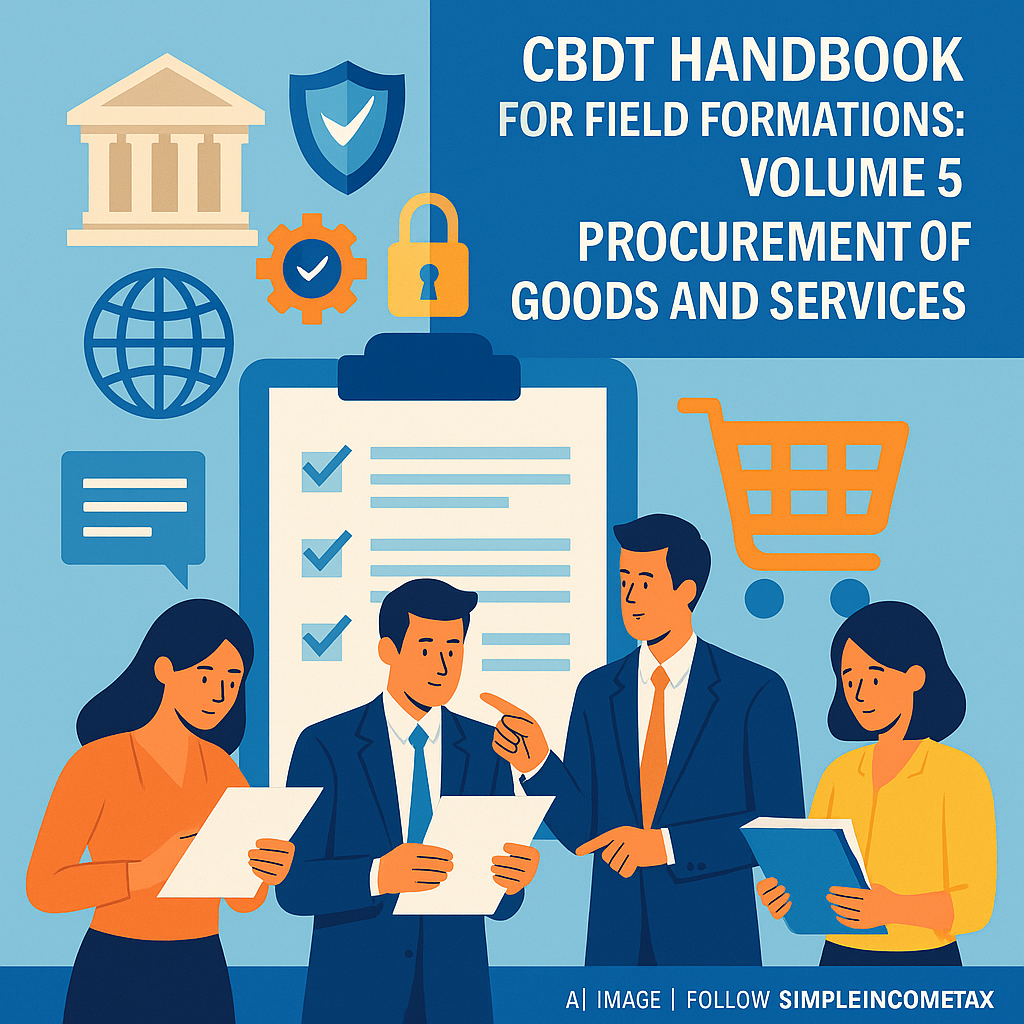

Procurement of goods and services is a vital responsibility in government functioning, especially in departments like Income Tax that utilize public funds. To ensure transparency, fairness, and efficiency, the Central Board of Direct Taxes (CBDT) has provided detailed procedures in Module-V: Procurement of Goods and Services under the Handbook for Field Formations.
This module draws its foundation from the General Financial Rules (GFR), 2017, Manual for Procurement of Goods, 2022, and GeM (Government e-Marketplace) guidelines.
It prescribes Do’s and Don’ts for every stage — from assessing needs to final contract award — ensuring ethical and accountable use of government resources.
🔹 Chapter 1: Need Assessment for Procurement
Procurement begins with a clear and justified need.
Officers must obtain Administrative Approval from the competent authority before initiating any process.
✅ Do’s
- Conduct proper need assessment based on prior consumption and actual requirements.
- Record detailed justification for quality, quantity and specifications of goods.
- Use objective, measurable, and trade-recognized terminology to describe items.
- Maintain transparency, competition and value for money as guiding principles.
- Keep detailed stock registers, updated regularly and verified by another officer.
🚫 Don’ts
- Don’t initiate procurement without prior approval.
- Avoid exaggerating needs or inflating quantities.
- Don’t reference specific brand names or catalog numbers to favour particular vendors.
- Never procure goods far in advance of actual requirement to avoid inventory costs.
The handbook stresses formulating precise and neutral technical specifications preferably aligned with Bureau of Indian Standards (BIS) and BEE star-rating norms for energy efficiency and sustainability.
🔹 Chapter 2: Conduct and Ethics in Procurement
Public servants play a critical role in maintaining trust in the procurement process.
✅ Officers must:
- Uphold the highest standards of integrity and impartiality.
- Refrain from accepting gifts, rewards, or any material benefits.
- Avoid collusion, fraudulent practices or splitting bills to bypass financial limits.
- Disclose any conflict of interest—personal, financial or professional.
🚫 Strictly prohibited:
- Bid rigging, anti-competitive behaviour, or favouritism.
- Soliciting hospitality or favours from vendors.
- Engaging in personal financial dealings with suppliers.
Ethical conduct ensures credibility and public confidence in government operations.
🔹 Chapter 3: Mandatory Procurement through GeM
The Government e-Marketplace (GeM) is the primary platform for purchasing goods and services.
✅ Procurement thresholds on GeM:
- Up to Rs.50,000: Direct purchase from any available seller meeting quality standards.
- Rs.50,000–Rs.10,00,000: Purchase from the seller offering the lowest price among at least three manufacturers on GeM.
- Above Rs.10,00,000: Use online bidding or reverse auction tools on GeM.
Additional Do’s
- Use Business Analytics (BA) tools and Last Purchase Price features on GeM to assess rate reasonableness.
- Maintain non-availability certificates for any item not listed on GeM before offline procurement.
🚫 Don’ts
- Never bypass GeM for readily available items.
- Avoid splitting demand to keep procurement below thresholds.
- Don’t ignore discrepancies between online specifications and supplied goods.
🔹 Chapter 4–5: Direct Procurement (Without or With Purchase Committee)
When items are not available on GeM, procurement may be done offline with proper justification.
✅ Direct Purchase (Up to Rs. 50,000):
- Only for simple, standard “off-the-shelf” goods.
- Generate a GeM Availability Report before purchase.
✅ Through Purchase Committee (Rs. 50,000–Rs.5,00,000):
- Purchase must be approved by a duly constituted committee.
- Committee must conduct market survey, assess rate reasonableness and record findings jointly.
- Display Notice Inviting Quotations (NIQ) publicly to ensure fair competition.
🚫 Don’ts
- Avoid repeated dealings with the same vendors.
- Do not split demands or bypass approval authority.
- Avoid mechanical collection of quotations or fake vendor participation.
- Rotate staff involved in such procurements periodically to prevent collusion.
🔹 Chapter 6–7: Tender-Based Procurement (OTE & LTE)
For larger procurements, tenders ensure wider competition and transparency.
✅ Open Tender Enquiry (OTE):
- Mandatory for procurements above Rs.50 lakh.
- Publish tenders on CPPP (www.eprocure.gov.in), GeM and departmental websites.
- Allow a minimum of 21 days for bid submission.
✅ Limited Tender Enquiry (LTE):
- For procurements between Rs.5 lakh–Rs.50 lakh.
- Invite more than three suppliers; maintain a list of registered vendors.
- Publicize tenders through email and web publication for wider response.
🚫 Don’ts
- Don’t artificially split procurements to avoid OTE.
- Don’t exclude qualified vendors without written justification.
- Ensure E-procurement mode and adequate response time.
🔹 Chapter 8: Evaluation of Bids and Award of Contract
Tender evaluation must be transparent, documented, and based solely on tender conditions.
✅ Do’s
- Evaluate both technical and financial bids strictly per tender terms.
- Include qualified technical experts on the Tender Committee.
- Keep evaluation proceedings confidential and maintain written records.
- Select the lowest (L1) bidder meeting all eligibility criteria.
- Publish award details on CPPP and departmental websites.
🚫 Don’ts
- Don’t manipulate criteria or reject bids arbitrarily.
- Avoid re-bidding without valid justification.
- Don’t delay approvals or alter contract scope post-award.
Module-V of the CBDT Handbook ensures that public procurement within the Income Tax Department remains transparent, competitive, and accountable.
From identifying a genuine need to awarding a contract, each step demands documentation, diligence, and integrity.
By adhering to these Do’s and Don’ts, officers not only comply with financial propriety but also strengthen public trust in the department’s administrative processes.
About the Author