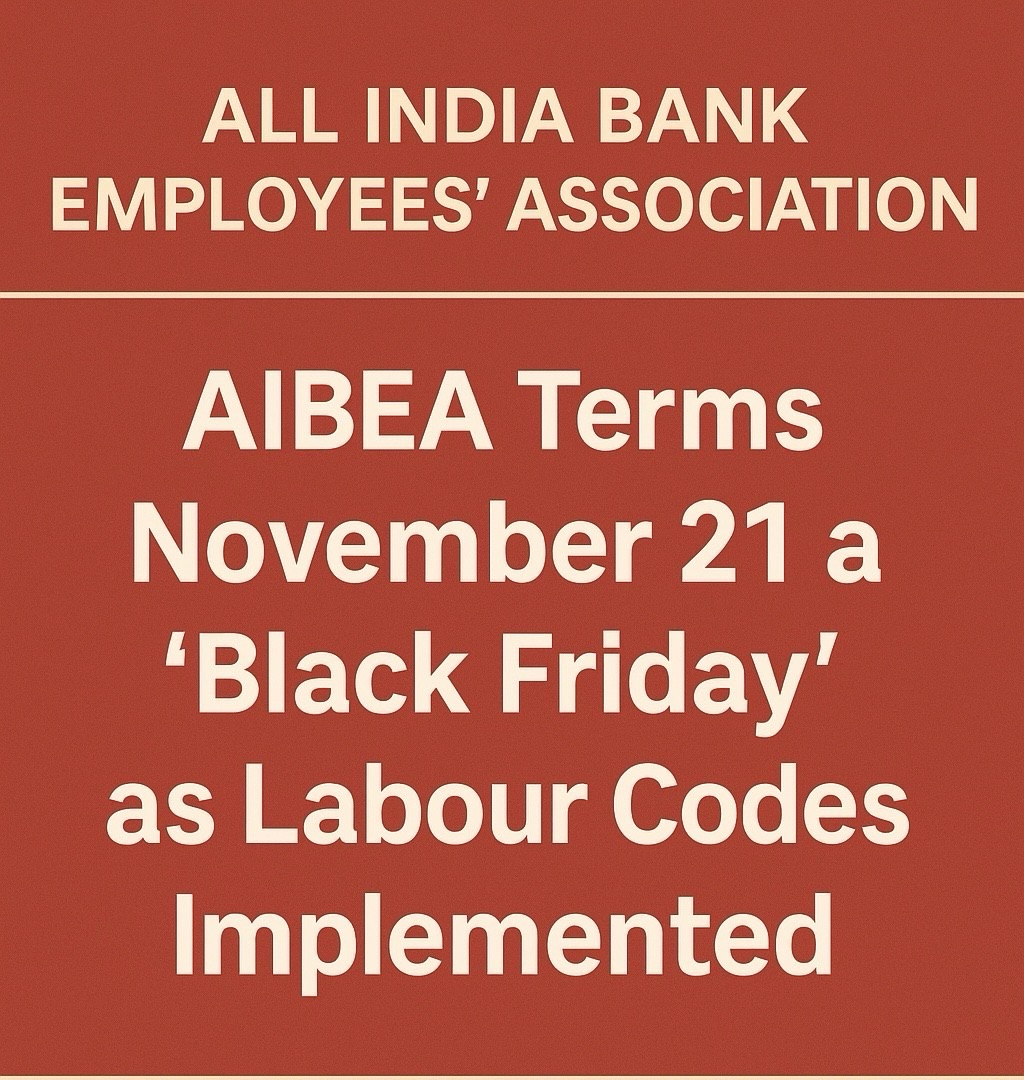

The All India Bank Employees’ Association (AIBEA) has strongly opposed the implementation of India’s Four Labour Codes from 21 November 2025, describing the day as a “Black Friday for the Indian working class.” In a press release issued by the association, AIBEA expressed concern that the new labour framework may weaken several rights that workers have secured over decades through trade union movements.
While the Central Government has maintained that the labour reforms are intended to simplify compliance, improve ease of doing business and extend social security coverage, AIBEA believes that the new legal framework reduces existing protections available to employees.
What Are the Four Labour Codes?
To simplify India’s labour legislation, the Government consolidated 29 central labour laws into the following four codes:
- Code on Wages
- Industrial Relations Code
- Code on Social Security
- Occupational Safety, Health and Working Conditions Code
According to the Government, this consolidation is intended to modernise labour laws, reduce compliance burdens for employers and improve the overall labour administration system.
However, several trade unions, including AIBEA, have opposed various provisions of these codes.
Why Is AIBEA Opposing the Labour Codes?
According to AIBEA General Secretary C.H. Venkatachalam, the association believes that the new labour laws shift the balance in favour of employers while reducing protections available to employees.
The association argues that labour rights such as collective bargaining, union recognition and employment security were achieved after decades of organised labour movements and should not be diluted.
AIBEA has urged the Government to reconsider certain provisions before implementing the new framework.
AIBEA’s Major Concerns
In its press release, AIBEA highlighted several issues that it believes may affect workers.
1. Replacement of Existing Labour Laws
The association stated that replacing 29 labour laws with four consolidated codes may reduce several statutory protections currently available to workers.
2. Employment Security
According to AIBEA, the new framework provides greater operational flexibility to employers, which may encourage increased reliance on contract and gig workers instead of regular employment.
The association fears this could affect long-term job security.
3. Collective Bargaining
AIBEA also expressed concern that trade unions may face greater challenges while negotiating employment conditions under the new legal framework.
4. Women Workers
The association noted that allowing women to work night shifts under specified conditions may require stronger safeguards to ensure workplace safety and security.
5. Growing Income Inequality
AIBEA believes that while businesses may benefit from easier compliance, workers may experience reduced bargaining power, potentially widening income disparities.
A Century of Labour Movement
AIBEA recalled that India’s organised labour movement has evolved over more than a century.
The association referred to milestones such as:
- Formation of the All India Trade Union Congress (AITUC) in 1920.
- Enactment of the Trade Unions Act, 1926.
- Progressive expansion of labour rights through various labour legislations over several decades.
According to AIBEA, these developments laid the foundation for workers’ rights relating to wages, working conditions and trade union activities.
Previous Protests by Trade Unions
The association pointed out that several central trade unions have opposed the labour reforms since their introduction.
According to AIBEA, nationwide protests were organised on multiple occasions, including:
- January 2019
- January 2020
- November 2020
- March 2022
- July 2025
AIBEA stated that it actively participated in these demonstrations and has consistently requested the Government to reconsider the reforms.
Government’s Perspective
The Central Government has consistently maintained that the Four Labour Codes are intended to:
- Simplify labour law compliance.
- Promote ease of doing business.
- Encourage formal employment.
- Extend social security benefits to more workers, including those engaged in the unorganised sector.
- Reduce multiplicity of labour laws through a consolidated legal framework.
The Government has stated that the reforms seek to balance the interests of both employers and employees while supporting economic growth.
What Could Be the Impact?
The actual impact of the Four Labour Codes will depend upon their implementation by the Central and State Governments.
Supporters of the reforms believe they may improve business efficiency and encourage investment, while trade unions argue that certain provisions require further safeguards to adequately protect workers’ rights.
As the new framework is implemented, its practical effect on permanent employees, contract workers, gig workers and women employees is likely to remain a subject of public discussion and judicial interpretation.
Our Analysis
The implementation of the Four Labour Codes represents one of the most significant labour law reforms in recent decades. While the objective of simplifying compliance is widely acknowledged, concerns raised by employee organisations regarding job security, collective bargaining and worker protections also merit careful consideration.
The long-term success of these reforms will largely depend on how the provisions are implemented in practice and whether an appropriate balance is maintained between improving business efficiency and safeguarding employees’ rights.
Frequently Asked Questions (FAQs)
1. What are the Four Labour Codes?
They are four consolidated labour laws replacing 29 existing central labour legislations relating to wages, industrial relations, social security and workplace safety.
2. Why has AIBEA opposed these reforms?
AIBEA believes the reforms may reduce worker protections, weaken collective bargaining and increase job insecurity.
3. What is the Government’s objective behind these reforms?
The Government has stated that the reforms aim to simplify labour law compliance, improve ease of doing business and modernise India’s labour law framework.
4. Do the Four Labour Codes affect only bank employees?
No. The codes apply across various sectors, subject to their respective provisions and the rules notified by the Central and State Governments.
5. Have the reforms been challenged by trade unions?
Yes. Several trade unions, including AIBEA, have organised protests and expressed concerns regarding certain provisions of the new labour framework.
Conclusion
The implementation of the Four Labour Codes marks a significant shift in India’s labour law landscape. While the Government views the reforms as a step towards modernisation and simplified compliance, trade unions such as AIBEA continue to express concerns regarding their impact on workers’ rights and employment security.
As the new legal framework takes effect, employers, employees and labour organisations will closely watch its implementation and practical outcomes. Future amendments or judicial interpretations may further shape the evolving labour law regime in India.
Source : AIBEA
Related Article on Simple Income Tax
CBIC Plans Faceless GST Assessment & Refund System: What It Means for Businesses and Taxpayers
About the Author