
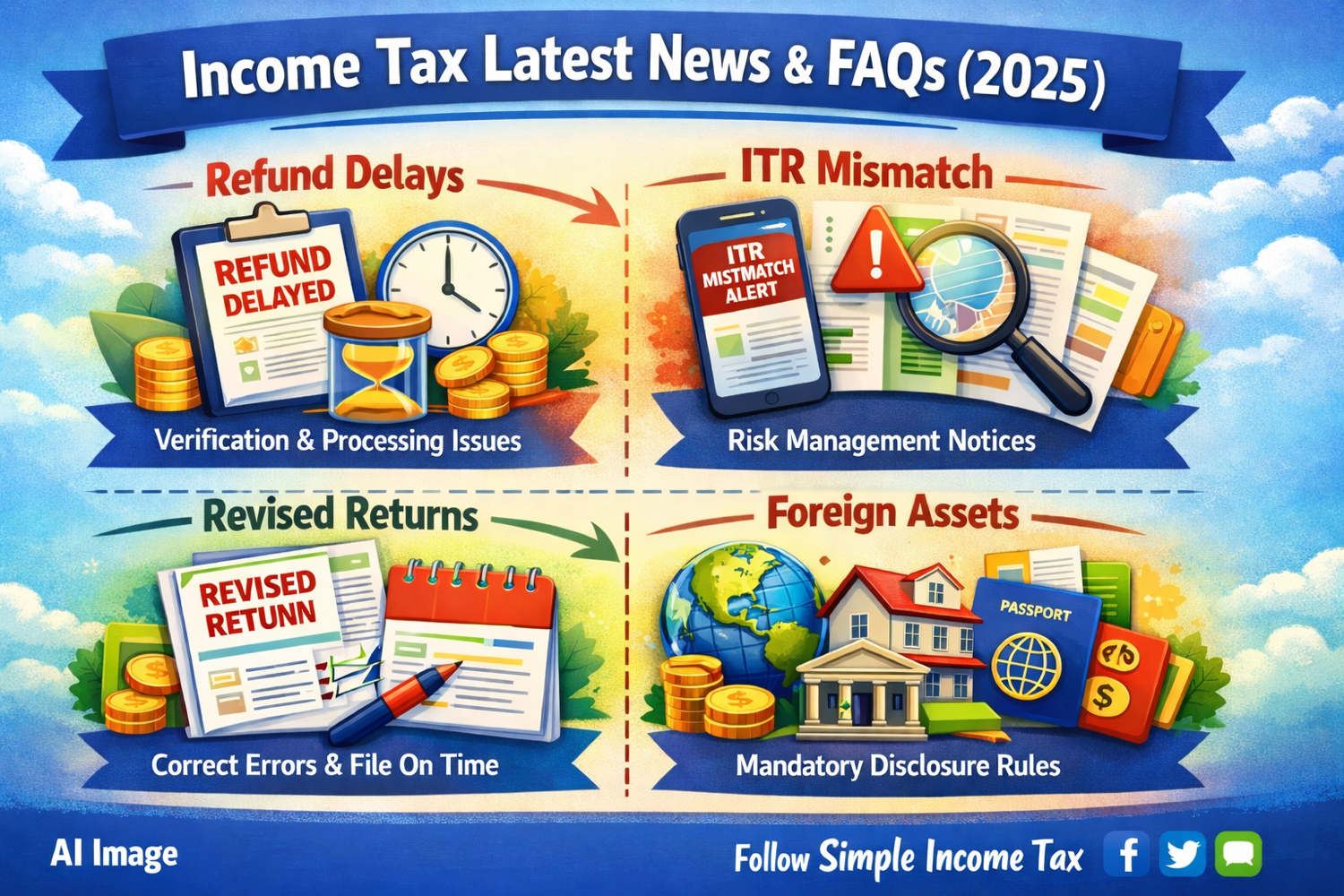

The Income-tax ecosystem in India is undergoing a significant compliance-driven shift. A large number of taxpayers are currently facing income tax refund delays, receiving ITR mismatch or risk-management messages and being advised to file revised or updated returns especially in cases involving foreign assets or income. This comprehensive post explains all these interlinked developments in one place with practical guidance for taxpayers.
1. Income Tax Refund Delays in 2025: What Is Really Happening?
In Assessment Year 2025–26, refund processing has slowed down for many taxpayers. The primary reason is enhanced risk-based verification adopted by the Income Tax Department. Returns involving high refund claims or data inconsistencies are being subjected to additional checks before refunds are released.
Common Reasons for Refund Hold
- Excessive deductions or exemptions claimed
- Mismatch between ITR, AIS and Form 26AS
- Interest income or capital gains not properly reported
- Incorrect section quoted for exemption
- Past compliance issues or pending demands
Refunds are generally released only after the taxpayer rectifies errors or files a revised return where required.
2. ITR Mismatch / “Under Risk Management” Messages Explained
Many taxpayers are receiving SMS or email alerts stating that their ITR is under risk management or that a mismatch has been detected. These messages are not penalty notices and do not automatically mean scrutiny.
Such alerts are triggered through automated data analytics when inconsistencies are found between:
- ITR and AIS
- ITR and TDS returns
- Income reported and deductions claimed
What Should Taxpayers Do?
Taxpayers should carefully recheck their computation, reconcile all information with AIS and Form 26AS, and voluntarily correct mistakes through a revised return wherever necessary. Early correction significantly reduces the risk of further proceedings.
3. Income Tax ‘Nudge Campaign’: Voluntary Compliance in Focus
The Nudge Campaign is a soft-compliance initiative under which taxpayers are gently alerted about possible inaccuracies in their returns instead of being issued formal notices. Under this campaign:
- Alerts are sent for probable incorrect deductions or under-reported income
- Taxpayers are encouraged to self-correct errors
- Over 15 lakh revised returns have already been filed
Why This Matters
Voluntary correction under the nudge mechanism helps taxpayers:
- Avoid scrutiny proceedings
- Minimise penalties
- Enable faster refund processing
- Ignoring such alerts may result in formal notices at a later stage.
4. Revised and Updated Returns: Why 31 December 2025 Is Critical
Taxpayers who have received mismatch alerts, refund holds or nudge communications should note that 31 December 2025 is a crucial deadline.
Relevant Provisions
Section 139(5) – Revised Return (to correct mistakes)
Section 139(8A) – Updated Return (even after the time for revised return has expired)
Failure to correct genuine mistakes within the prescribed timeline may lead to:
- Adjustment or denial of refunds
- Issuance of notices under the Income-tax Act
- Initiation of penalty proceedings
- Timely revision is therefore strongly advisable.
5. Foreign Assets & Income: Mandatory Disclosure and Serious Consequences
The Income-tax Department has placed special emphasis on foreign asset and foreign income disclosure. Taxpayers holding any foreign assets must disclose them accurately in Schedule FA, even if:
- The asset is dormant
- Income is exempt or already taxed abroad
- The value of the asset is small
Examples of Reportable Foreign Assets
- Foreign bank accounts
- Shares, mutual funds or ESOPs held abroad
- Crypto assets on foreign platforms
- Overseas income from freelancing or employment
Consequences of Non-Disclosure
- Penalty up to Rs. 10,00,000 per default
- Prosecution under the Black Money Act
- Extended time limits for reassessment
NRIs returning to India and employees receiving foreign ESOPs should be particularly careful.
Key Takeaway for Taxpayers
All these developments—refund delays, mismatch alerts, nudge communications, revised return deadlines and foreign asset scrutiny—are part of a unified approach focused on data accuracy and voluntary compliance. Taxpayers should not ignore alerts or delays but should proactively review and correct their returns wherever required.
Staying compliant today can prevent litigation, penalties and prolonged refund issues tomorrow.
About the Author




1 thought on “Income Tax Latest News & FAQs (2025): Refund Delays, ITR Mismatch, Revised Returns & Foreign Assets”
Comments are closed.