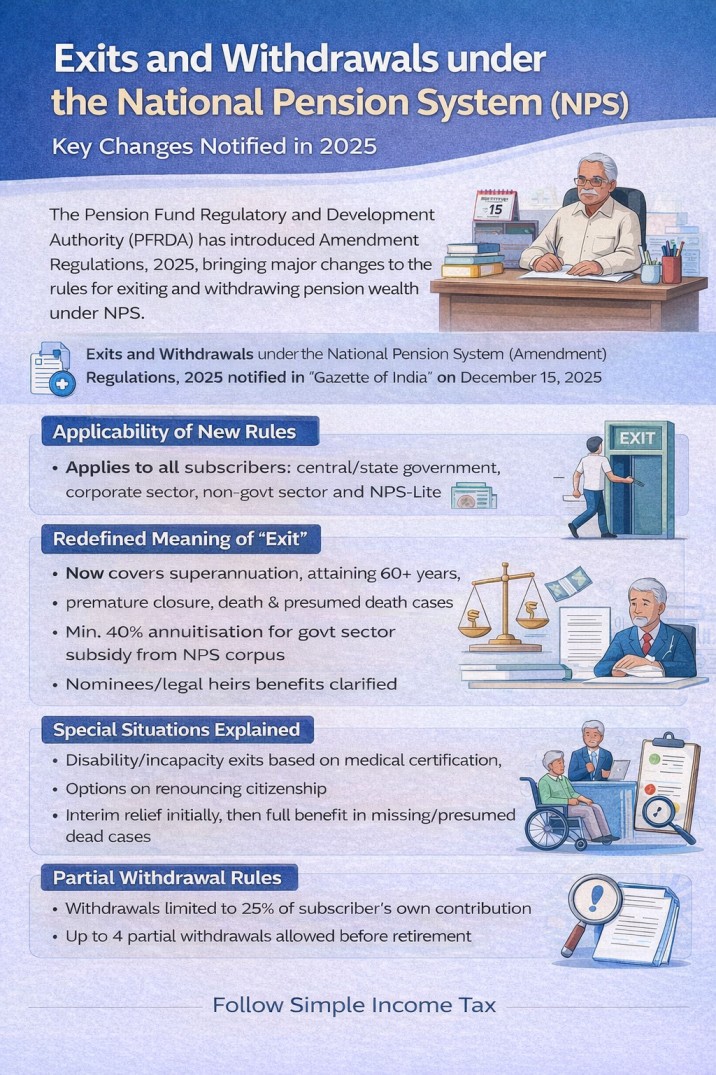

The Pension Fund Regulatory and Development Authority (PFRDA) has notified the PFRDA (Exits and Withdrawals under the NPS (National Pension System) (Amendment) Regulations, 2025, bringing significant changes to the rules governing exit, withdrawal, deferment and annuity purchase under the National Pension System (NPS). The amended regulations were published in the Gazette of India on 15 December 2025 and came into force from the date of publication.
These amendments impact Central Government employees, State Government employees, corporate sector subscribers, all-citizen model subscribers, and NPS-Lite subscribers, and aim to provide greater clarity and flexibility in withdrawal options while redefining key concepts under NPS.
PFRDA Expands NPS Options for Central Govt Employees 2025
Applicability of the Amended Regulations
The amended rules explicitly clarify that they apply to exits and withdrawals from all pension schemes under the National Pension System, covering:
- Government sector subscribers
- Non-government sector subscribers
- Corporate sector subscribers
- All Citizen Model subscribers
- NPS-Lite and Swavalamban subscribers
This clarification removes earlier ambiguities regarding the scope of the exit and withdrawal regulations.
Redefinition of “Exit” under NPS
One of the most important changes is the expanded and clearer definition of “Exit”. Exit now means the exercise of choice by a subscriber to close the individual pension account or opt out of an NPS scheme in the following situations:
- On superannuation or retirement, or on attaining 60 years of age or thereafter
- After completing at least 15 years of subscription (where applicable)
- On premature closure of the NPS account
- On death of the subscriber or when a subscriber is missing and presumed dead under law
Where a subscriber has multiple NPS accounts, each account will be treated independently for exit and closure purposes.
Key Provisions for Government Sector Subscribers
For Central and State Government employees, the amended regulations reaffirm and detail the exit benefits:
- On retirement or superannuation, at least 40% of the accumulated pension wealth must be utilised for purchase of annuity, with the remaining amount payable as lump sum or through structured withdrawals.
- If the total accumulated corpus is ₹8 lakh or less, the subscriber may withdraw 100% as lump sum.
- If the corpus exceeds ₹8 lakh but is up to ₹12 lakh, withdrawal is allowed up to ₹6 lakh as lump sum, with the balance used for annuity or structured withdrawals.
- In case of resignation, removal or dismissal, at least 80% of the corpus must be annuitised, subject to threshold limits.
- In the event of death, at least 80% of the corpus is mandatorily annuitised, unless the total amount is within the prescribed lower limits.
The regulations also allow deferment of lump sum withdrawal or annuity purchase up to the age of 85 years, providing flexibility in retirement planning.
Exit Rules for Non-Government and Corporate Sector Subscribers
For non-government sector and corporate subscribers, the amended rules specify:
- On exit at 60 years or after completing the prescribed subscription period, at least 20% of the corpus must be annuitised, with the balance payable as lump sum or structured withdrawals.
- If the accumulated corpus does not exceed ₹12 lakh, the subscriber may opt for full lump sum withdrawal.
- In case of premature exit, a higher annuitisation requirement (generally 80%) applies.
- On death, the entire accumulated pension wealth is payable to nominees or legal heirs, either as lump sum or through annuity, depending on the option exercised.
Special Provisions: Disability, Citizenship Change and Missing Subscribers
The amended regulations introduce clarity in special situations:
- Disability or incapacitation: Exit is permitted based on medical certification, with benefits determined as per applicable exit category.
- Renunciation of Indian citizenship: A subscriber who ceases to be an Indian citizen is permitted to close the NPS account and withdraw the accumulated pension wealth as per PFRDA directions.
- Missing and presumed dead subscribers: Nominees or legal heirs are entitled to 20% interim relief, with final settlement after legal declaration of death under the Bharatiya Sakshya Adhiniyam, 2023.
Partial Withdrawals and Frequency Limits
The amendment also rationalises partial withdrawal provisions:
- Partial withdrawals are permitted up to 25% of the subscriber’s own contribution.
- Withdrawals are allowed up to four times before retirement, with a minimum gap of four years between withdrawals.
- After retirement or attaining 60 years, partial withdrawals are permitted with a reduced minimum gap, subject to limits.
Removal and Substitution of Certain Provisions
Several outdated or ambiguous clauses in the 2015 regulations have been deleted or substituted, including:
- Removal of mandatory language relating to immediate annuity purchase in all cases
- Replacement of the term “Permanent Retirement Account” with “individual pension account”
- Alignment of terminology with newer laws, including the Bharatiya Sakshya Adhiniyam, 2023
These changes aim to modernise the regulatory framework and ensure legal consistency.
Why These Amendments Matter
The 2025 amendment regulations are significant because they:
- Provide greater flexibility and clarity in exit and withdrawal options
- Address practical issues faced by retirees, nominees and legal heirs
- Balance retirement security with liquidity needs
- Standardise exit treatment across government and non-government sectors
For NPS subscribers, especially government employees nearing retirement, understanding these changes is crucial for effective retirement planning and informed decision-making.
Frequently Asked Questions (FAQs) on Unified Pension Scheme (UPS) 2025
The PFRDA (Exits and Withdrawals under NPS) (Amendment) Regulations, 2025 mark an important regulatory update to the National Pension System. By redefining exit conditions, expanding deferment options, and clarifying benefits across categories of subscribers, the amendments seek to make NPS more transparent, flexible and subscriber-friendly, while retaining its core objective of long-term retirement security.
About the Author