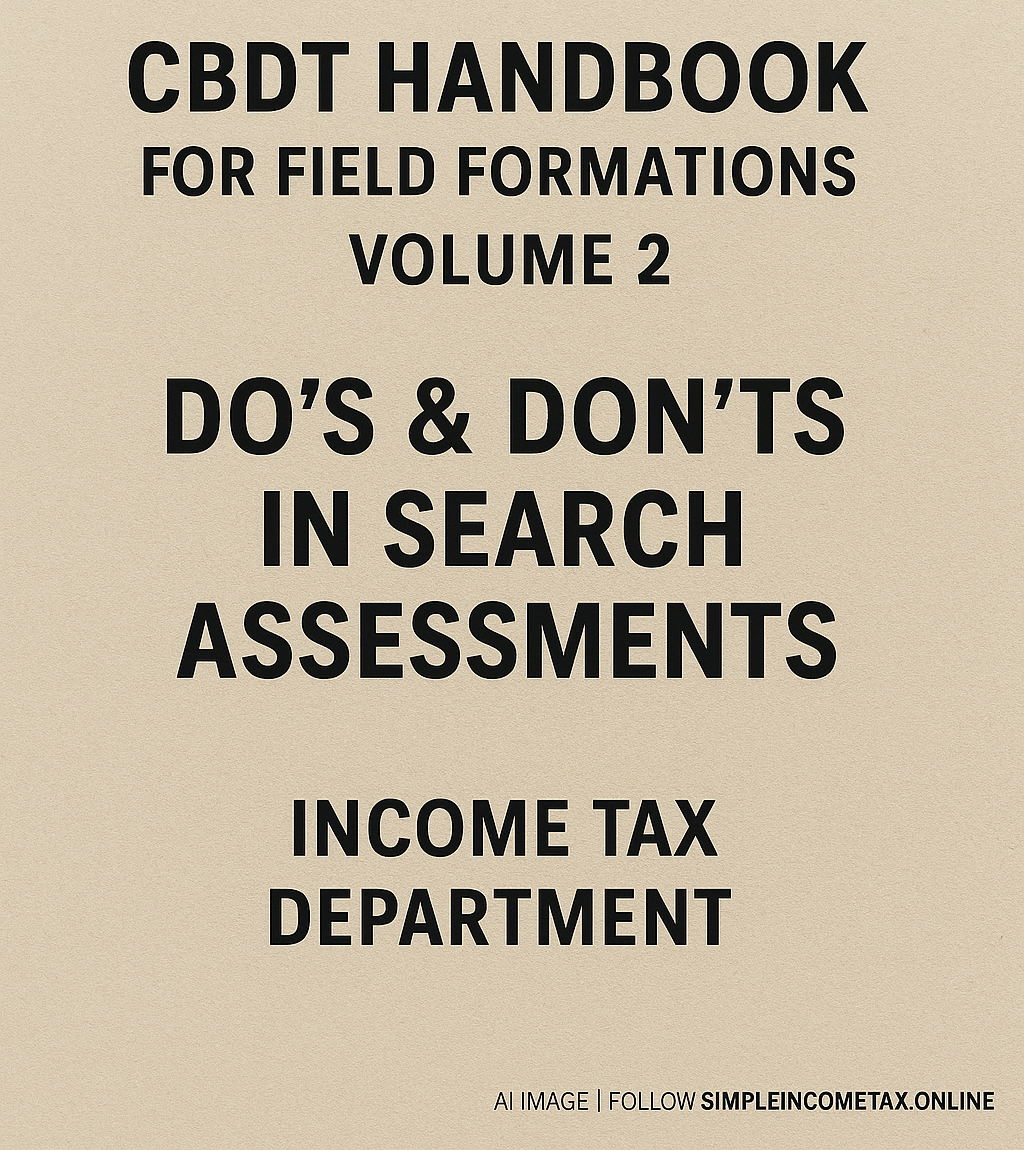

The CBDT Handbook of Do’s & Don’ts for Field Formations serves as a practical guide for officers handling search and seizure assessments. Module-II focuses on the Search Assessment Process (Chapters 1–8) — from receipt of seized material to final penalty proceedings. This module emphasizes procedural discipline, data integrity, timely supervision, and adherence to statutory provisions. Here’s a concise and clear summary of the Do’s and Don’ts officers must follow during Search Assessments.
🔹 Chapter 1: Preliminary Stage of Search Assessments
✅ Do’s
- Use e-assessment mode wherever possible.
- Maintain chain of custody for seized records.
- Treat Appraisal Report as confidential and for internal use only.
- Communicate with the assessee or third parties only through DIN-numbered notices.
- Keep RSA tokens and departmental passwords confidential.
- Record detailed order-sheet entries for every stage of scrutiny.
- Ensure timely receipt and verification of seized materials from the Investigation Wing.
- Create a Control Chart summarizing issues, cases, and timelines.
- Follow Section 63 of Bharatiya Sakshya Adhiniyam, 2023 for handling digital evidence.
- Use photocopies or working digital copies for assessment work — not originals.
🚫 Don’ts
- Never compromise the integrity of seized material.
- Avoid communications without a valid DIN.
- Don’t delay receipt of seized material or appraisal reports.
- Don’t fail to plan time-barring work using Control Chart monitoring.
- Don’t share seized materials with unauthorized persons.
- Avoid any tampering, forgery or backdating in assessment records.
- Don’t neglect to centralize PANs or transfer time-barring cases timely.
🔹 Chapter 2: Issuance of Notices for Search Assessment
✅ Do’s
- Issue notices for all group cases simultaneously for uniform treatment.
- Ensure returns filed in response to notice are verified before next action.
- Follow correct provisions of the Income Tax Act, 1961 / 2025 based on search initiation date.
- Obtain Range Head’s approval before issuing notices and final orders.
- Maintain principles of natural justice — give sufficient time and fair hearing.
- Pass one consolidated order for the entire block period.
🚫 Don’ts
- Don’t apply incorrect provisions of the Act.
- Never skip approval of the competent authority.
- Don’t delay case submission till limitation period’s end.
- Avoid errors in service of notices — verify latest addresses through ITBA.
🔹 Chapter 3: Inquiry & Investigation in Search Cases
✅ Do’s
- Issue a comprehensive questionnaire after analyzing all data sources:
- Appraisal Report, seized documents, ITRs, audit reports, CASS data, FT&TR/DVO info, etc.
- Make references to TPO, FT&TR, DVO or Special Audit wherever required with due approval.
- Conduct third-party inquiries to validate seized material findings.
- Cross-check digital evidence paths with working copies.
- Seek help from DIAL (Digital Intelligence & Analytics Lab) for forensic analysis.
🚫 Don’ts
- Never quote or refer to the Appraisal Report in assessee communications.
- Don’t share passwords, tokens, or credentials.
- Avoid gaps in order-sheet documentation.
- Don’t mishandle digital evidence—ensure compliance under Section 63 of Bharatiya Sakshya Adhiniyam.
- Never deny reasonable response time to the assessee.
🔹 Chapter 4: Deviation from Appraisal Report
✅ Do’s
- Immediately inform Range Head of any differences with Investigation Wing findings.
- Prepare a Deviation Note or Clarification Note and seek written feedback.
- Maintain a clear Office Note explaining reasons for deviation and final decision.
- Escalate unresolved issues to PCIT (Central) if required.
🔹 Chapter 5: Final Show Cause Notice & Assessment Order
✅ Do’s
- Consider all assessee replies and evidence before issuing final SCN.
- Ensure conformity with CBDT circulars, case law and departmental stand.
- SCN should clearly mention:
- Grounds of addition
- Evidence relied upon
- Legal provisions and opportunity of reply
- Draft detailed, speaking assessment orders quoting correct sections.
- Record Office Notes for issues where additions proposed in the Appraisal Report are dropped.
- Initiate relevant penalties and ensure all approvals are taken timely.
🚫 Don’ts
- Don’t make high-pitched assessments without material evidence.
- Don’t delay submission of draft orders to Range Head.
- Avoid mechanical approvals — ensure proper application of mind.
- Don’t ignore deviations; always record and justify them.
🔹 Chapter 6: Supervisory Authority in Central Charges
✅ Do’s
- Grant timely approvals as per statutory requirement.
- Maintain close supervision from Control Chart to final order.
- Keep a confidential folder for internal communications with AO and Investigation Wing.
- Monitor progress to avoid last-minute lapses.
- Record speaking approvals with details of discussions held.
🚫 Don’ts
- Don’t issue combined blanket approvals for multiple cases.
- Avoid mechanical or backdated approvals.
- Don’t fail to maintain an updated Inter-Communication File.
🔹 Chapter 7: Remand Proceedings
✅ Do’s
- Examine admissibility of additional evidence filed before CIT(A).
- Conduct thorough fact-finding and third-party verifications.
- Re-examine assessment records and comment on each addition made.
- In significant cases, attend hearings before CIT(A) to protect revenue.
🚫 Don’ts
- Don’t accept additional evidence blindly without verification.
- Don’t ignore enquiry directions from CIT(A).
- Avoid perfunctory or generic reports — give specific factual comments.
🔹 Chapter 8: Penalty Proceedings
✅ Do’s
- Record clear satisfaction in assessment order before initiating penalty.
- Issue proper Show Cause Notices with opportunity to reply.
- Seek supervisory approval before passing penalty orders.
- Ensure correct section invocation and accurate computation of penalty.
- Maintain consistency in levying or dropping penalties across similar cases.
- Keep records and notes when penalty is dropped.
🚫 Don’ts
- Don’t levy penalty without mentioning clear grounds.
- Avoid penalties on presumption or estimates.
- Don’t fail to transfer penalty proposals before limitation.
Module-II of the CBDT Handbook provides a structured roadmap for handling search assessments efficiently, legally and ethically.
It ensures that every officer – from AO to Range Head – operates with clarity, consistency, and procedural discipline.
Adherence to these Do’s & Don’ts strengthens:
- Transparency in handling seized material,
- Accountability in assessment decisions, and
- Integrity in public service.
Together, they form the backbone of fair and credible search assessments under the Income Tax Department.
About the Author


3 thoughts on “Do’s & Don’ts in Search Assessments : Volume 2”