
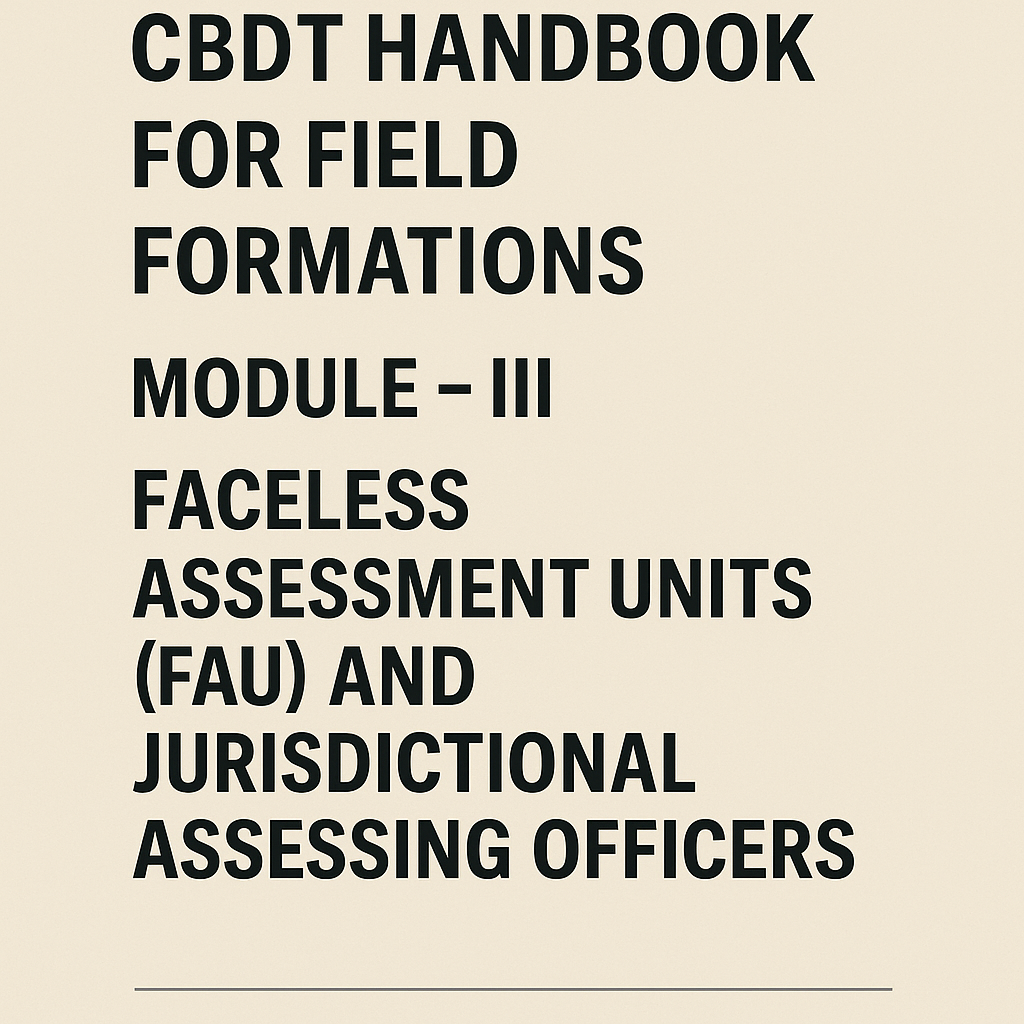

The CBDT Handbook of Do’s & Don’ts for Field Formations serves as a practical and ethical reference for Income Tax Department officers.
Module-III focuses on two key pillars of modern tax administration:
- Faceless Assessment Units (FAU) — enabling transparency, efficiency, and reduced interface between taxpayer and officer.
- Jurisdictional Assessing Officers (JAO) — ensuring procedural discipline, effective coordination, and fairness in re-openings, grievance handling, and scrutiny assessments.
This volume summarizes the core operational Do’s and Don’ts to ensure uniform compliance with CBDT’s Faceless Assessment Scheme (FAS) and related Standard Operating Procedures (SOPs).
For earlier posts in this series, you can check below;
Do’s & Don’ts for Field Formations (Income Tax Department) – Volume 1
Do’s & Don’ts in Search Assessments – Volume 2
🔹 Chapter 1: Faceless Assessment Units (FAU)
✅ Do’s — Best Practices and Compliance
1. General Protocols
- Follow all CBDT guidelines for faceless functioning — no physical or direct communication with taxpayers.
- Use E-Proceedings mode exclusively for assessments.
- Maintain strict confidentiality about the case and taxpayer identity.
- Never share RSA Token, PIN or passwords with anyone.
2. Procedural Discipline
- Verify CASS reasons against ITR and perform a 360° profile analysis using INSIGHT and e-Filing portals.
- Issue comprehensive and case-specific questionnaires covering all CASS reasons.
- Avoid seeking information already available in departmental databases.
- For limited scrutiny, restrict queries only to issues selected.
- In set-aside or reopened cases issue focused questionnaires limited to relevant grounds.
- Check historical additions and appeal status to maintain consistency with departmental positions.
3. Use of Supporting Units
- Seek assistance from:
- Verification Unit (VU) – for physical verifications or third-party checks.
- Technical Unit (TU) – for references to TPO, DVO, FT&TR, or for Special Audit proposals (with PCIT approval).
- Ensure fair opportunity and video-conference personal hearing if requested.
- Adhere to timelines fixed by courts and CBDT instructions.
- Spread out disposal of cases — avoid “last month rush.”
4. Range Head Supervision
- Approval from Range Head (Addl./Jt. CIT) is mandatory for all communications.
- Supervision should be continuous, not ceremonial.
- Evaluate draft assessment orders carefully to ensure conformity with law and facts.
- Approvals must be reasoned and time-bound not mass-signed at the end.
🚫 Don’ts — Actions to Avoid
- Do not communicate with taxpayers directly or disclose identities.
- Avoid issuing notices at the fag-end of limitation leaving no time for reply.
- Don’t extend CASS scope in limited scrutiny or conduct fishing enquiries.
- Don’t miss out verifying Section 115BBE / 195 (new Act) implications on unexplained incomes.
- Don’t forget to check capital gains classification and MAT/AMT impact.
- Don’t delay references to TPO or DVO or fail to pass draft orders post-TPO proceedings.
- Avoid bunching of approvals or ignoring computational checks before submission.
🔹 Chapter 2: Jurisdictional Assessing Officer (JAO)
✅ Do’s — Essential Responsibilities
1. Procedural Adherence
- Follow CBDT SOPs and conduct all assessments through E-Proceedings.
- Every communication must carry a Document Identification Number (DIN).
- Comply strictly with RSA Token Policy, 2016.
- After reopening a case, ensure timely transfer of pendency to FAU via NeFAC.
- Respond promptly to inter-unit queries and upload required records or clarifications.
2. Handling Re-Openings
- Issue proper show-cause notice with reasons for income escaping assessment.
- Give adequate opportunity for reply and ensure recorded satisfaction before approval.
- Apply mind while considering taxpayer’s response before seeking sanction from the competent authority.
3. Managing Writ Petitions
- Monitor all writ petitions against reassessment notices.
- Upload court orders to FAU immediately through the Inter-Unit Communication (IUC) system.
4. Grievance Redressal
- Resolve grievance petitions promptly and electronically.
- Ensure rectification and appeal effect orders are accompanied by consequential actions.
- Escalate unresolved technical issues through supervisory channels to Systems Directorate.
- Keep taxpayers informed about delays caused by system issues.
5. Rectification and Appeal Effects
- Pass rectification orders within 6 months of application receipt.
- Give hearing before adverse rectifications.
- Pass suo moto rectification where excess refund/credit is detected.
- Ensure Order Giving Effect (OGE) is passed promptly after appellate orders, and refunds issued timely.
- Don’t withhold refund or adjust demand without approval or prior intimation.
6. Scrutiny Assessments
- Verify CASS reasons vs ITR data and gather insights from departmental portals.
- Issue specific, concise questionnaires addressing all relevant issues.
- Provide adequate opportunity and personal hearing if sought.
- Follow ITBA alerts/messages diligently.
- Ensure correct invocation of penalty sections and issue notices before completion.
🚫 Don’ts — Strictly Prohibited
- Don’t communicate outside the e-Assessment module.
- Don’t issue any notice without DIN.
- Never share login credentials or RSA tokens.
- Don’t delay grievance, rectification, or appeal effect actions.
- Avoid “last-minute” notices near limitation deadlines.
- Don’t exceed limited scrutiny scope or raise irrelevant queries.
- Don’t finalize orders without examining all CASS reasons and show-cause responses.
This Module-III of the CBDT Handbook reiterates the Department’s commitment to transparency, uniformity and accountability in the assessment process. Faceless Assessments (FAU) and Jurisdictional AOs (JAO) form the twin engines of a modern, technology-driven tax system.
By following these Do’s & Don’ts, officers can ensure:
- Proper coordination between FAU and JAO,
- Timely and error-free assessments,
- Protection of taxpayer rights, and
- Strengthened public trust in the Income Tax Department.
This concludes Volume 3 of the series. Stay tuned for Volume 4.
For earlier posts in this series, you can check below;
Do’s & Don’ts for Field Formations (Income Tax Department) – Volume 1
Do’s & Don’ts in Search Assessments – Volume 2
About the Author


1 thought on “Do’s & Don’ts for FAO & JAO : Volume 3”