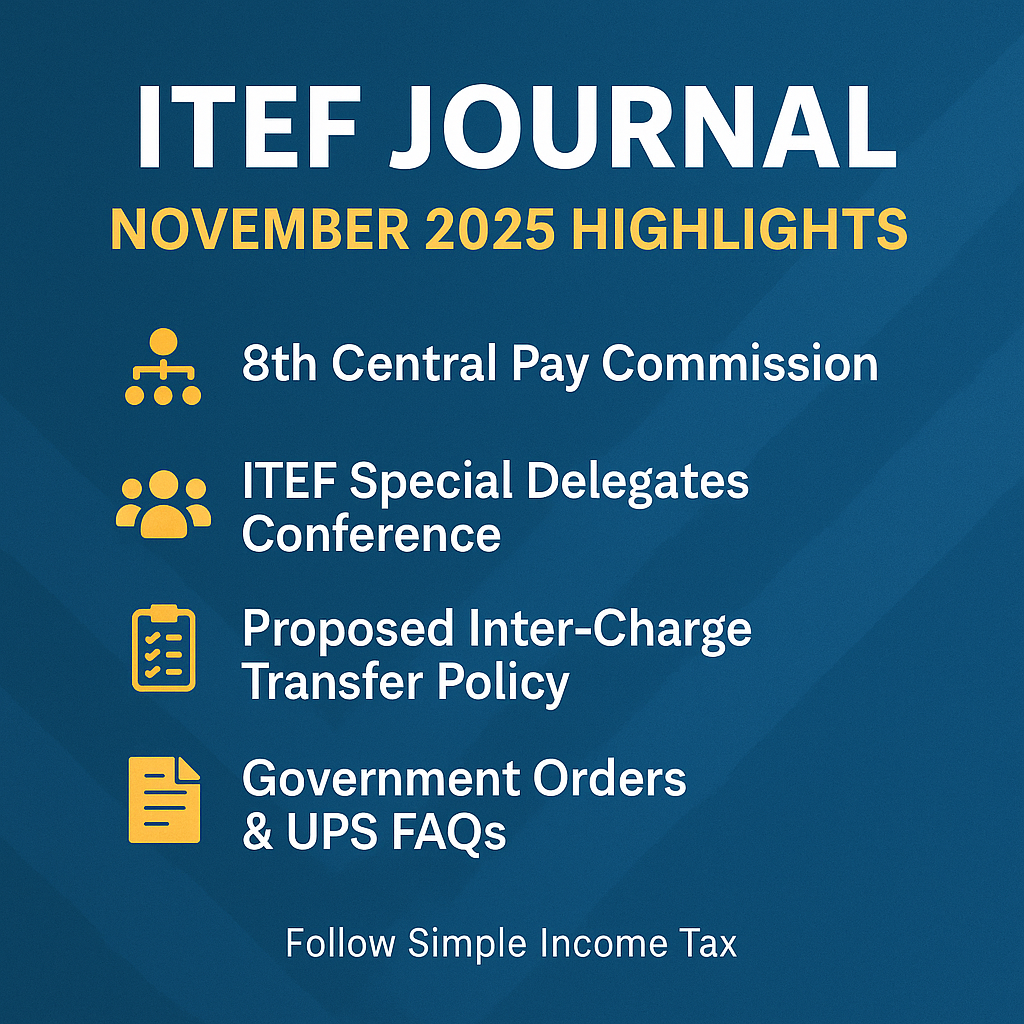

The November 2025 edition of The Journal of the Income Tax Employees Federation covers major developments impacting Central Government employees and pensioners. The 8th Central Pay Commission (CPC) has been formally notified chaired by Justice Ranjana Prakash Desai with an 18-month timeline to submit its report. However, concern has been raised over the ToR’s language on pension “review” and “unfunded cost” seen as a possible move to weaken the Old Pension Scheme (OPS).
The ITEF Special Delegates Conference at Agra (1–2 Nov 2025) brought together senior leaders and delegates from across India after nearly two decades while the Federation submitted fresh proposals for a transparent and employee-friendly Inter-Charge Transfer (ICT) Policy for Group B and C officials. The Confederation of Central Govt. Employees & Workers also urged the Prime Minister to amend the 8th CPC ToR seeking clear pension revision, 20% interim relief and OPS restoration.
Other key updates include new CGA instructions for timely pension processing and the issue of detailed Unified Pension Scheme (UPS) FAQs clarifying payouts, withdrawals and family benefits.
Highlights from ITEF Journal – November 2025
The November 2025 issue of The Journal of the Income Tax Employees Federation brings together several important developments concerning Central Government employees and pensioners. From the constitution of the 8th Central Pay Commission to the Agra Special Delegates Conference and the long-awaited proposal for a new Inter-Charge Transfer (ICT) policy this edition reflects a period of intense discussion and anticipation within the Income Tax fraternity.
- 8th Central Pay Commission – Between Promise and Prudence
Although the Government had announced the constitution of the 8th Central Pay Commission (CPC) on 16 January 2025 the formal notification along with the Terms of Reference (ToR) came only on 3 November 2025. The Commission, chaired by Justice Ranjana Prakash Desai with Prof. Pulak Ghosh as Part-Time Member and Shri Pankaj Jain as Member-Secretary has been given 18 months to submit its report.
A point of concern among employees and pensioners is the shift in language from “revision” to “review” of pension, coupled with the phrase “unfunded cost of non-contributory pension schemes.” Many perceive this as a potential move towards restricting or diluting benefits under the Old Pension Scheme (OPS). The editorial stresses that such wording when read alongside the recent Pension Validation Act may open the door for merging OPS employees into the Unified Pension Scheme (UPS). The real question remains whether pay and pension revisions will take effect retrospectively from 1 January 2026 or only from the date of notification.
While the 7th CPC had granted only a 14% rise — the lowest ever — employees are hoping that better revenue collection and fiscal growth will justify a more meaningful revision this time. However, the editorial warns that “fiscal prudence” should not become a pretext for fiscal injustice.
- ITEF Special Delegates Conference at Agra
After nearly two decades, the Special Delegates Conference of the Income Tax Employees Federation (ITEF) was held on 1–2 November 2025 at Agra hosted by the UP East and Uttarakhand Circles. The event began with the flag hoisting and the song Hum Honge Kamyab followed by the inaugural session presided over by Com. M.S. Vengatesan, President, ITEF.
Distinguished guests including Smt. Mona Singh, Pr. DGIT (HRD), Dr. Satpal Singh Meena, ADG-II (HRD) and Shri Sanjay Kumar, DDIT (HRD) attended the conference and shared valuable updates on various HRD matters. Leaders from ITGOA and the Income Tax Pensioners’ Federation also participated. Delegates from all circles actively discussed organizational and service-related issues with special appreciation for the excellent arrangements by the host units.
- Proposal for New Inter-Charge Transfer (ICT) Policy
The ITEF Central Headquarters has submitted a detailed proposal to the CBDT Committee constituted for framing a new ICT Policy for non-Gazetted Group ‘B’ and Group ‘C’ officials.
Key suggestions include:
- ICT to be allowed only for posts having a direct recruitment quota.
- The employee must have completed three years of service in the current cadre before applying.
- Transfer to be considered against a clear vacancy in the recipient region and only after consent of both CCAs.
- Priority categories to include unmarried/widow/divorcee women employees, spouse cases, physically challenged officials, extreme medical grounds and ex-servicemen.
- Employees transferred on ICT will be placed at the bottom of seniority in the direct recruitment quota of the new region and will not get credit of previous service for promotion.
- Applications to be processed on a first-come-first-served basis through HRMS, with ICTs finalized once every year before SSC notifications.
- Special consideration to be given to cases pending before 22 December 2020, when the earlier policy was withdrawn.
The Federation has urged that the final policy be uniformly adopted across all regions and framed in a fair, transparent and employee-friendly manner.
- Confederation Decisions and Representation to Prime Minister
The Confederation of Central Government Employees and Workers (CCGEW) held its National Executive Committee meeting on 25 October 2025 through virtual mode under the chairmanship of Com. Rupak Sarkar. The meeting reviewed participation in the July strike and August demonstrations and decided to launch phase-wise agitational programmes to push pending demands.
The Confederation has also written to the Prime Minister (letter dated 15 November 2025) urging key amendments in the 8th CPC Terms of Reference, notably:
- The date of effect to be 1 January 2026.
- Inclusion of pension revision and deletion of the term “unfunded cost of non-contributory schemes.”
- Consideration of restoration of the Old Pension Scheme for post-2004 recruits.
- Extension of 8th CPC benefits to Autonomous Bodies and Gramin Dak Sevaks.
- Grant of 20% interim relief pending implementation of CPC recommendations.
- Expansion of CGHS facilities and reform of CGEGIS for better coverage.
- Government Orders – Efficiency and Pension Reforms
The Controller General of Accounts (CGA) issued an order on 23 October 2025 emphasizing timely disposal of bills and pension cases. All PAOs have been directed to avoid piecemeal objections, ensure accountability, and act as facilitators to departments. Pensionary benefits must be released promptly and recorded accurately in service books.
In addition, the CGA circulated an important FAQ document (dated 17 September 2025) on the Unified Pension Scheme (UPS) to clarify operational issues. Some of the highlights include:
- Assured payout for employees completing at least 10 years of service or retiring under FR 56(j) or VRS with 25 years of service.
- Option to withdraw up to 60% of corpus at retirement with Dearness Relief applicable on monthly payouts.
- Partial withdrawals allowed three times (up to 25% of self-contribution) for specific purposes such as education, marriage, housing, or medical needs.
- Family payout available only to the legally wedded spouse as on the date of retirement.
- Detailed provisions for resignation, absorption, or disciplinary cases under UPS Rules, 2025.
- Clarifications on gratuity entitlement, tax treatment, and the role of NPS Trust and PAOs in authorizing payouts.
The November 2025 issue of the ITEF Journal captures both optimism and anxiety among government employees. While the constitution of the 8th CPC brings hope of long-awaited revisions in pay and pension, the cautious tone of the Terms of Reference calls for alertness and collective effort. The Agra Conference reaffirmed the unity and resolve of Income Tax employees while the ICT policy proposals and Confederation’s initiatives reflect a determined push for fairness, transparency and social justice in service matters.
The coming months will be crucial as discussions around the 8th CPC, ICT reforms, and Unified Pension Scheme evolve. Central Government employees must stay informed, organized and ready to uphold their rights through democratic and united means.
Source: www.itefcentral.org
About the Author