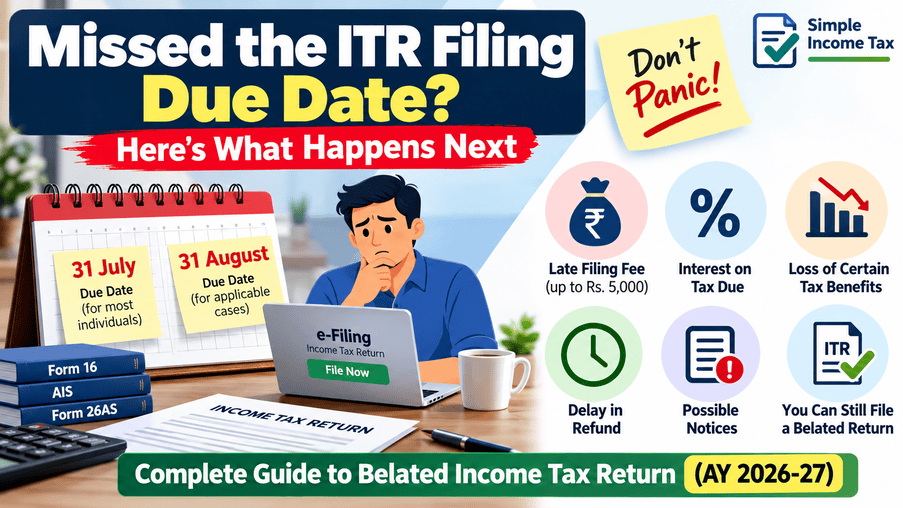

Filing your Income Tax Return (ITR) on time is one of the most important tax compliances for every taxpayer. However, every year thousands of taxpayers miss the due date because of work commitments, lack of information, technical issues, illness, or simply assuming that they are not required to file a return. If you have missed ITR due date of 31 July 2026 or 31 August 2026 (as applicable), don’t panic. Missing the due date does not necessarily mean you have lost the opportunity to file your return. However, delaying further can result in additional costs and other consequences.
This article explains everything you need to know in simple language.
Can I Still File My Income Tax Return?
Yes.
If you missed ITR Due Date i.e. the original due date, you may still be eligible to file a Belated Return, provided it is filed within the time prescribed under the Income Tax Act.
A belated return allows taxpayers to comply even after the due date, although certain consequences may follow.
What Happens If You Miss the ITR Due Date?
1. Late Filing Fee May Be Payable
One of the first consequences of filing a belated return is the levy of a late filing fee under the Income Tax Act.
Generally,
- Total income up to Rs. 5 lakh – Late fee up to Rs. 1,000
- Total income exceeding Rs. 5 lakh – Late fee up to Rs. 5,000
The exact amount depends upon the provisions applicable to your return.
2. Interest on Outstanding Tax
If you have tax payable after adjusting TDS, advance tax, and self-assessment tax, interest may be charged for the delay.
The longer the delay, the higher the interest liability may become.
Therefore, filing early even after the due date can reduce your overall tax burden.
3. Delay in Receiving Income Tax Refund
Many taxpayers believe that since they are expecting a refund, they can file the return anytime.
This is a misconception.
The Income Tax Department processes refunds only after the return is filed and verified.
Late filing generally results in delayed processing of the refund.
4. Loss of Certain Tax Benefits
One of the biggest disadvantages of filing a belated return is that certain losses may not be allowed to be carried forward to future years.
These may include:
- Business Loss
- Capital Loss
- Certain other eligible losses
However, some losses are governed by specific provisions of the Act.
Therefore, timely filing is always advisable.
5. Increased Chances of Departmental Notices
When a taxpayer does not file the return despite being liable to do so, the Income Tax Department may issue notices seeking information or initiate proceedings in accordance with law.
Ignoring such notices may lead to further compliance requirements.
6. Additional Compliance Burden
Delayed filing often means:
- Collecting financial documents again
- Calculating additional interest
- Paying late fees
- Responding to departmental communications
- Delay in loan processing due to non-availability of ITR acknowledgement
Timely filing saves both money and effort.
Common Reasons Why People Miss the Due Date
Some of the most common reasons include:
- Waiting for Form 16
- Bank interest not reconciled
- AIS or Form 26AS mismatch
- Salary change during the year
- Medical emergencies
- Technical issues during filing
- Assuming TDS deduction means return filing is not required
Most of these situations can be managed with proper planning.
Should You Ignore the Return If There Is No Tax Payable?
No.
Many taxpayers believe that if no tax is payable, filing the return is unnecessary.
However, depending upon your income, transactions, and statutory requirements, filing the return may still be mandatory.
Additionally, an Income Tax Return serves as an important financial document for:
- Home loans
- Education loans
- Visa applications
- Financial credibility
- Income proof
Steps to Take If You Missed ITR Due Date
Instead of worrying, follow these steps:
Step 1
Check whether you are eligible to file a belated return.
Step 2
Collect all necessary documents such as:
- Form 16
- Form 26AS
- Annual Information Statement (AIS)
- Salary details
- Bank interest certificates
- Capital gain statements
- Investment proofs
Step 3
Calculate your correct tax liability.
Step 4
Pay any self-assessment tax, if required.
Step 5
File and verify the Income Tax Return immediately.
The sooner you file, the fewer complications you may face.
Frequently Asked Questions (FAQs)
Can I still file my return after the due date?
Yes, subject to the provisions relating to belated returns under the Income Tax Act.
Will I have to pay a penalty?
A late filing fee may apply depending upon your total income and the applicable provisions.
Will I receive my refund?
Yes, if you are eligible. However, filing late may delay the processing of your refund.
Can I revise a belated return?
Yes, subject to the conditions and timelines prescribed under the Income Tax Act.
Is filing ITR compulsory even if TDS has already been deducted?
Deduction of TDS alone does not determine whether return filing is mandatory. Eligibility depends upon the provisions of the Income Tax Act applicable to your case.
Tips to Avoid Missing the Due Date Next Year
✔ Maintain all financial records throughout the year.
✔ Download AIS and Form 26AS well before filing.
✔ Verify salary, bank interest, and capital gains.
✔ Avoid waiting until the last day.
✔ File the return as soon as all required information is available.
Final Thoughts
Missing the Income Tax Return due date is not the end of the road, but it should not be ignored either.
Every day of delay can increase compliance costs and create unnecessary complications. If you have missed the due date, complete the filing process as early as possible.
Timely tax compliance not only helps avoid late fees and interest but also ensures quicker refunds, smoother financial transactions, and peace of mind.
Disclaimer
This article is intended solely for educational and informational purposes. The provisions applicable to a taxpayer depend upon the facts of each case, the relevant Assessment Year, and the applicable provisions of the Income Tax Act, rules, notifications and circulars. Readers are advised to consult the official Income Tax Department portal or seek professional advice before taking any action.
Related Article on Simple Income Tax
Common Income Tax Mistakes Every Taxpayer Should Avoid
ITR-U (Updated Return) – Frequently Asked Questions (FAQs) Every Taxpayer Should Know
Visit Official website of Income Tax Department
About the Author