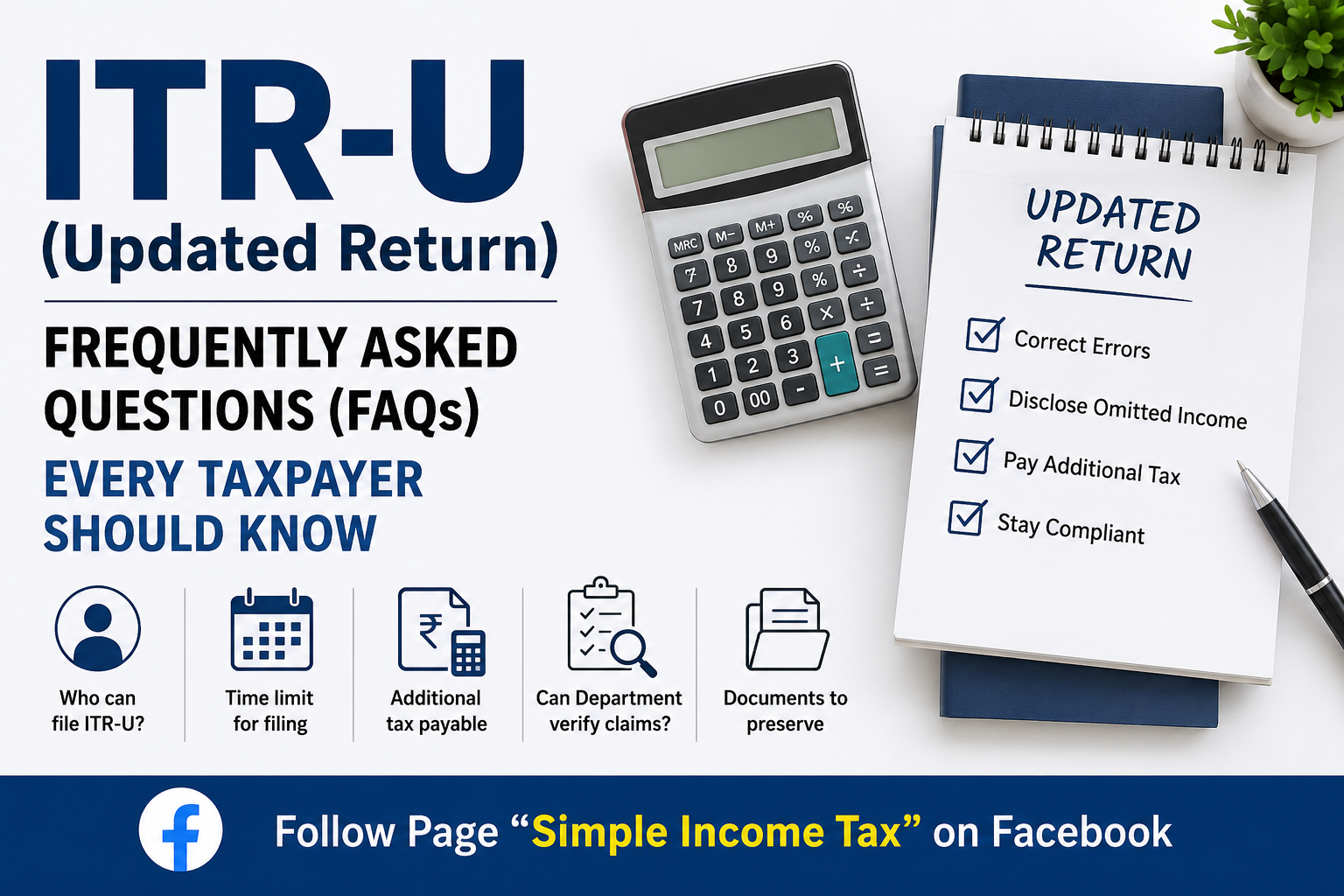

The Income Tax Department introduced the concept of Updated Return (ITR-U) through Section 139(8A) of the Income Tax Act, 1961 to encourage voluntary tax compliance. ITR-U allows taxpayers to correct mistakes, disclose omitted income, and pay the due taxes even after the time for filing the original, belated, or revised return has expired. Here is ITR-U (Updated Return) – Frequently Asked Questions (FAQs).
However, many taxpayers have misconceptions regarding ITR-U. Some believe that filing an Updated Return automatically protects them from scrutiny, while others assume that any mistake can be corrected through ITR-U. This article answers some of the most common questions regarding ITR-U in simple language.
1. What is ITR-U?
ITR-U stands for Updated Return. It is a return filed under Section 139(8A) to correct errors or omissions in an earlier return or to disclose income that was not reported earlier.
2. Who can file ITR-U?
Any eligible taxpayer can file an Updated Return if:
- Income was omitted in the original return.
- Wrong deductions or exemptions were claimed.
- Incorrect income was reported.
- Tax liability was understated.
- Return was not filed earlier.
3. What is the time limit for filing ITR-U?
Presently, an Updated Return can generally be filed within 48 months from the end of the relevant assessment year, subject to the conditions prescribed under the Act.
4. Can ITR-U be filed if no return was filed earlier?
Yes. A taxpayer who has not filed any return for the relevant assessment year may also file an Updated Return, subject to statutory conditions.
5. Can I file ITR-U to claim an additional refund?
No. An Updated Return cannot be filed:
- To claim a refund.
- To increase an existing refund.
- To reduce tax liability.
ITR-U is intended only for declaring additional income and paying additional tax.
6. Can ITR-U be filed to reduce taxable income?
No. An Updated Return cannot be used to reduce previously declared income.
7. Can ITR-U be filed after receiving a notice from the Income Tax Department?
It depends on the nature and timing of the notice. Certain proceedings may restrict the filing of ITR-U. Taxpayers should carefully verify eligibility before filing.
8. Does filing ITR-U automatically close assessment or reassessment proceedings?
No. This is one of the most common misconceptions. Filing ITR-U does not automatically require the Department to drop proceedings. The Department can still verify:
- Income declared.
- Deductions retained.
- Exemptions retained.
- Supporting documents.
9. If tax, interest and additional tax have been paid through ITR-U, can the Department still ask for documents?
Yes. Payment of tax does not automatically establish that the claims made in the Updated Return are correct. The Department may seek evidence in support of:
- HRA claims.
- Housing loan deductions.
- Section 80C investments.
- NPS contributions.
- Medical insurance deductions.
- Other exemptions and deductions.
10. Does filing ITR-U mean the Department accepts all deductions claimed in the Updated Return?
No. Every deduction or exemption retained in ITR-U remains subject to verification.
11. Can the Department verify HRA claimed in ITR-U?
Yes. Taxpayers should maintain:
- Rent agreement.
- Rent receipts.
- Proof of rent payment.
- HRA computation.
12. Can the Department verify deductions under Section 80C claimed in ITR-U?
Yes. Documents such as:
- LIC receipts.
- PLI receipts.
- PF statements.
- Tuition fee receipts.
- Housing loan principal repayment certificates.
may be required.
13. Can the Department verify NPS deductions claimed in ITR-U?
Yes. Taxpayers should maintain:
- NPS statement.
- PRAN details.
- Contribution records.
14. What happens if supporting documents are not available?
Claims may be disallowed if the taxpayer fails to substantiate them with proper evidence.
15. Is Form 16 sufficient proof of all deductions?
Not always. Many employers consider declarations made by employees while preparing Form 16. Detailed verification of admissibility under the Income Tax Act may not always be undertaken.
Therefore, taxpayers should independently preserve supporting documents.
16. If a tax consultant filed my return incorrectly, am I relieved from responsibility?
No. The legal responsibility for the correctness of the return remains with the taxpayer.
17. Can ITR-U be filed multiple times for the same assessment year?
Generally, only one Updated Return can be filed for a particular assessment year.
18. What additional tax is payable while filing ITR-U?
Apart from normal tax and interest, an additional amount is payable as prescribed under Section 140B. The amount depends on the timing of filing the Updated Return.
19. What documents should be preserved after filing ITR-U?
Taxpayers should preserve:
- Updated Return acknowledgement.
- Computation of income.
- Tax challans.
- Form 16.
- Investment proofs.
- Housing loan certificates.
- NPS statements.
- Medical insurance receipts.
- Rent records.
20. Can ITR-U be filed after receiving information from AIS or third-party sources?
Yes, subject to eligibility conditions.
Many taxpayers voluntarily file ITR-U after noticing mismatches in AIS, bank transactions, TDS records, or other information.
21. Can ITR-U be filed if a wrong refund was claimed earlier?
Yes. Many taxpayers use ITR-U to correct excessive refund claims and pay the resulting tax and additional amount.
22. What are the common mistakes made while filing ITR-U?
Some common mistakes are:
- Retaining unsupported deductions.
- Claiming HRA without proper evidence.
- Claiming housing loan deductions without certificates.
- Claiming NPS deductions without statements.
- Uploading incorrect or damaged documents.
- Assuming that tax payment alone resolves all issues.
23. What happens if I ignore a notice and do not respond?
Failure to respond may result in:
- Adverse inference.
- Disallowance of claims.
- Reassessment proceedings.
- Additional tax and interest.
- Penalty proceedings, wherever applicable.
24. Does filing ITR-U guarantee immunity from future verification?
No. The Department can examine the correctness of the information furnished in the Updated Return and seek supporting evidence whenever required under law.
25. What is the most important thing taxpayers should remember about ITR-U?
ITR-U is a facility to voluntarily correct mistakes, but it is not a substitute for documentary evidence.
Every deduction, exemption, allowance, or relief claimed in the Updated Return should be supported by proper records. Filing an Updated Return and paying tax is important, but maintaining documentary evidence is equally important.
Conclusion
The Updated Return scheme is a valuable opportunity for taxpayers to voluntarily correct errors and improve tax compliance. However, taxpayers should understand that filing ITR-U does not automatically validate all claims made in the return. Proper documentation, accurate reporting of income, and careful verification of deductions and exemptions remain essential. Maintaining complete records and responding promptly to departmental notices can help avoid unnecessary disputes and ensure smooth compliance with the Income Tax Act.
You can also view relevant posts Section 148A Notice Guide: HRA, 80C, NPS & Tax Deductions
Income Tax Latest News & FAQs (2025): Refund Delays, ITR Mismatch, Revised Returns & Foreign Assets
Bogus Deduction Claims – CBDT Warns Taxpayers
Always refer Income Tax Act from official website of Income Tax Department.
Disclaimer: This article is intended solely for educational and informational purposes and should not be construed as legal, tax, or professional advice; taxpayers are advised to consult a qualified tax professional for guidance specific to their individual circumstances.
About the Author