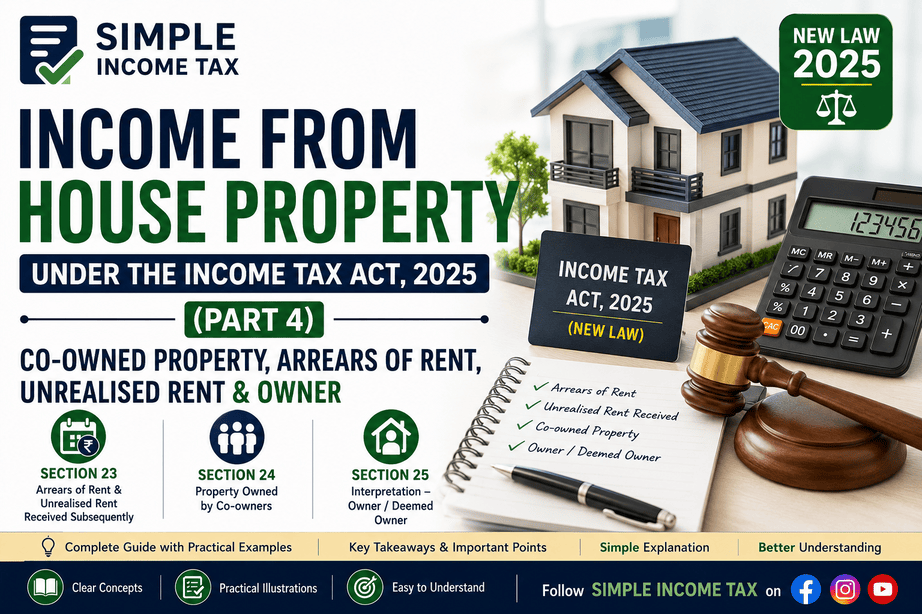

In the first three parts of this series, we discussed the chargeability of Income from House Property, determination of Annual Value and deductions available from such income. This final part covers the remaining provisions of the House Property chapter under the Income Tax Act, 2025, namely Section 23, Section 24 and Section 25. These provisions deal with arrears of rent, unrealised rent subsequently recovered, co-owned property and the meaning of “owner” for the purposes of house-property taxation.
Provisions Covered in Part 4
| Income Tax Act, 2025 | Corresponding provision under Income-tax Act, 1961 | Subject |
| Section 23 | Section 25A | Arrears of Rent and Unrealised Rent Received Subsequently |
| Section 24 | Section 26 | Property Owned by Co-owners |
| Section 25 | Section 27 | Interpretation – Owner / Deemed Owner |
Arrears of Rent and Unrealised Rent
Section 23 of the Income Tax Act, 2025
Section 23 of the Income Tax Act, 2025 (corresponding to Section 25A of the Income-tax Act, 1961) deals with arrears of rent and unrealised rent that are subsequently received or realised.
Where an assessee subsequently receives:
- arrears of rent from a tenant; or
- unrealised rent that was subsequently realised,
the amount is deemed to be Income from House Property in the tax year in which it is received or realised.
Importantly, this taxation applies even if the assessee is not the owner of the property in that tax year.
30% Deduction
Section 23(3) provides a deduction equal to 30% of the arrears of rent or unrealised rent deemed to be income.
Therefore:
Taxable amount = Arrears/Unrealised Rent received – 30% deduction
Example
Mr. A receives Rs. 2,00,000 in Tax Year 2026-27 towards arrears of rent relating to an earlier period.
| Particulars | Amount |
| Arrears of rent received | Rs. 2,00,000 |
| Less: 30% deduction | Rs. 60,000 |
| Taxable Income from House Property | Rs. 1,40,000 |
The Rs. 1,40,000 is taxable in the tax year in which the arrears are received.
Property Owned by Co-owners
Section 24 of the Income Tax Act, 2025
Section 24 of the Income Tax Act, 2025 (corresponding to Section 26 of the Income-tax Act, 1961) deals with property owned by co-owners.
Where a property is co-owned and the shares of the co-owners are definite and ascertainable, the co-owners are not assessed as an Association of Persons merely because they jointly own the property.
Instead, the income from the property is computed separately in the hands of each co-owner according to his or her respective share.
Example
A house is jointly owned by A and B in the ratio of 60:40.
If the income from the property is Rs. 5,00,000:
| Co-owner | Share | Income |
| A | 60% | Rs. 3,00,000 |
| B | 40% | Rs. 2,00,000 |
| Total | 100% | Rs. 5,00,000 |
Each co-owner will include his or her respective share in total income.
Self-Occupied Property and Co-owners
Section 24(2) specifically provides that the relief available under Section 21(6) is to be provided as if each co-owner is individually entitled to that relief.
Thus, the treatment of self-occupied property needs to be examined separately for each eligible co-owner.
Who is Treated as an Owner?
Section 25 of the Income Tax Act, 2025
Section 25 of the Income Tax Act, 2025 (corresponding to Section 27 of the Income-tax Act, 1961) provides an inclusive definition of “owner” for the purposes of Sections 20 to 24.
The provision covers several situations where a person may be treated as an owner for Income Tax purposes even though conventional legal ownership may not be the determining factor.
Important Categories
| Situation | Person treated as owner |
| Property transferred without adequate consideration to spouse, subject to the statutory exception | Transferor |
| Property transferred without adequate consideration to a minor child, other than a married daughter | Transferor |
| Holder of an impartible estate | Holder of the estate |
| Building allotted or leased under a house-building scheme of a co-operative society, company or AOP | Relevant member |
| Possession obtained or retained under a contract covered by Section 53A of the Transfer of Property Act, 1882 | Person in possession |
| Certain long-term rights in a building or part thereof | Person acquiring such rights |
These categories are specifically incorporated in Section 25.
Transfer to Spouse or Minor Child
Section 25 includes an individual who transfers property without adequate consideration to:
- his or her spouse, except under an agreement to live apart; or
- a minor child, other than a married daughter.
The transferor continues to be treated as the owner for the purposes of Sections 20 to 24.
Practical Example
Mr. A transfers a house to his spouse without adequate consideration and there is no agreement to live apart.
The transferor may continue to be treated as the owner for the purposes of house-property taxation under Section 25.
Property Allotted by a Co-operative Society
A member of a co-operative society, company or other association of persons may be treated as the owner where a building or part thereof is allotted or leased to the member under a house-building scheme.
Therefore, formal legal title is not always decisive for determining ownership under the House Property provisions.
Possession Under Part Performance
Section 25 also covers a person who is allowed to take or retain possession of a building or part thereof in part performance of a contract of the nature referred to in Section 53A of the Transfer of Property Act, 1882.
This provision is important in cases where possession has been handed over under an agreement even though the formal transfer of title may not have been completed.
Long-Term Rights in Property
Section 25 further covers a person acquiring specified rights in or with respect to a building or part thereof.
This includes rights arising through:
- sale;
- exchange;
- original or extendible lease for a term of not less than twelve years; or
- certain transactions involving membership, shares, agreements or arrangements that enable enjoyment of the property.
Leases from month to month or for a period not exceeding one year are specifically excluded from the relevant provision.
Practical Computation – Complete Example
Suppose a let-out property has:
- Gross Annual Value: Rs. 6,00,000
- Municipal taxes actually paid: Rs. 30,000
- Interest on borrowed capital: Rs. 1,50,000
Computation
| Particulars | Amount (Rs.) |
| Gross Annual Value | 6,00,000 |
| Less: Municipal Taxes | (30,000) |
| Net Annual Value | 5,70,000 |
| Less: Standard Deduction @ 30% | (1,71,000) |
| Less: Interest on borrowed capital | (1,50,000) |
| Income from House Property | 2,49,000 |
The computation follows the provisions discussed in Parts 2 and 3 of this series.
Important Practical Points
1. Arrears are taxed on receipt
Arrears of rent are not necessarily taxed in the year to which the rent relates. Section 23 taxes the amount in the tax year in which it is received.
2. 30% deduction is available
A 30% deduction is available from arrears of rent or subsequently realised unrealised rent.
3. Co-ownership is different from AOP
Where shares are definite and ascertainable, each co-owner is separately assessed on his or her share.
4. Legal title is not the only consideration
Section 25 specifically treats certain persons as owners for house-property taxation.
5. Documentation is important
Co-owners should maintain:
- Ownership documents
- Shareholding/ownership agreement
- Loan documents
- Municipal tax receipts
- Rent agreements
- Evidence of rent receipts
- Documents relating to transfer or possession
House Property Series – Complete Section Mapping
| Income Tax Act, 2025 | Income-tax Act, 1961 | Key Subject |
| Section 20 | Section 22 | Chargeability of Income from House Property |
| Section 21 | Section 23 | Determination of Annual Value |
| Section 22 | Section 24 | Deductions from Income from House Property |
| Section 23 | Section 25A | Arrears of Rent and Unrealised Rent Received Subsequently |
| Section 24 | Section 26 | Property Owned by Co-owners |
| Section 25 | Section 27 | Interpretation – Owner / Deemed Owner |
The official Income Tax Act, 2025 places the complete House Property chapter in Sections 20 to 25. Section 26 begins the subsequent chapter dealing with Profits and Gains of Business or Profession.
Key Takeaways
- Section 23 deals with arrears of rent and unrealised rent subsequently realised.
- Such amounts are taxable in the year of receipt or realisation.
- A 30% deduction is available from such amount.
- Section 24 deals with co-owned property where shares are definite and ascertainable.
- Each co-owner is separately assessed according to his or her share.
- Section 25 provides an inclusive definition of owner for Sections 20 to 24.
- Certain persons without conventional legal title may nevertheless be treated as owners for Income Tax purposes.
Conclusion
The House Property provisions under the Income Tax Act, 2025 largely retain the familiar framework of the earlier law while reorganising the provisions into Sections 20 to 25.
For taxpayers, the most important practical steps are to correctly determine the annual value, identify the person taxable as owner, compute permissible deductions, and separately account for arrears or unrealised rent subsequently recovered.
With this Part 4, the basic Income from House Property series under the Income Tax Act, 2025 is complete.
Disclaimer
This article is intended solely for educational and informational purposes. Every effort has been made to ensure the accuracy of the content; however, readers are advised to refer to the official provisions of the Income Tax Act, 2025, the rules made thereunder and the latest notifications, circulars and instructions issued by the Income Tax Department before taking any decision. In case of any discrepancy, the official law shall prevail. For authentic and updated information, please visit the official website of the Income Tax Department: Income Tax Department.
Related Article on Simple Income Tax
1. Income Tax Act 2025 Explained
2. Salary Provisions Under Income Tax Act 2025 – Part 1
3. Salary Allowances & Perquisites Under Income Tax Act 2025
4. Salary TDS & Deductions Under Income Tax Act 2025
5. Salary Computation Under Income Tax Act 2025
8. TDS Under the Income Tax Act, 2025 (Part 3) : TDS on Business Payments
Always refer official website of Income Tax Department
About the Author