
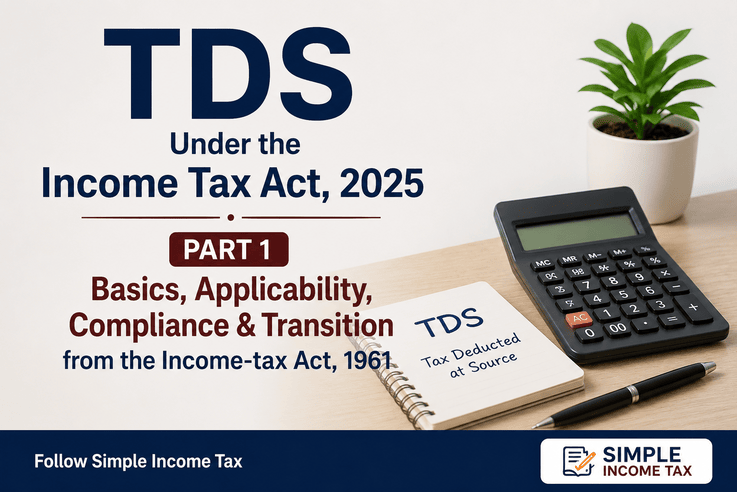

Tax Deducted at Source (TDS) is one of the most important mechanisms under the Indian direct tax system. Instead of collecting tax only at the time of filing the Income Tax Return, the Government collects tax at the time certain payments are made. This system ensures a regular flow of revenue to the Government, improves tax compliance, and reduces tax evasion.
With the implementation of the Income Tax Act, 2025 from 1 April 2026, taxpayers, deductors, employers, Drawing and Disbursing Officers (DDOs), banks, companies and tax professionals need to understand the revised statutory framework governing TDS. Although the concept of TDS remains substantially unchanged, the new Act reorganises and simplifies the provisions, including introducing new section numbers.
This article, the first in a four-part series, explains the fundamentals of TDS, its objectives, applicability, responsibilities of deductors and deductees, compliance requirements, and the transition from the Income-tax Act, 1961 to the Income Tax Act, 2025.
What is Tax Deducted at Source (TDS)?
Tax Deducted at Source (TDS) is a mechanism under which a specified percentage of tax is deducted by the payer (known as the deductor) while making certain payments to the recipient (known as the deductee). The deducted tax is deposited with the Central Government on behalf of the deductee.
The deductee receives credit for the tax deducted while filing the Income Tax Return.
Objectives of TDS
The TDS system has been introduced with the following objectives:
- Ensure regular collection of tax throughout the year.
- Prevent tax evasion.
- Reduce the burden of paying tax at one time.
- Widen the tax base.
- Improve voluntary tax compliance.
- Create a transparent tax reporting mechanism.
- Facilitate faster processing of Income Tax Returns and refunds.
Why is TDS Important?
TDS is important for both the Government and taxpayers.
For the Government, it provides a continuous inflow of revenue instead of waiting until the end of the financial year.
For taxpayers, TDS distributes the tax burden across the year and reduces the chances of a large tax payment at the time of filing the return.
Important Terms Every Taxpayer Should Know
Deductor
A deductor is the person responsible for deducting tax at source before making a specified payment.
Examples include:
- Employers
- Banks
- Companies
- Partnership Firms
- Government Departments
- Co-operative Societies
- Individuals liable to deduct TDS under specified provisions
Deductee
The deductee is the person whose income is subject to TDS.
The deductee receives credit of the tax deducted while filing the Income Tax Return.
TAN (Tax Deduction and Collection Account Number)
Every person responsible for deducting TDS is generally required to obtain a Tax Deduction and Collection Account Number (TAN) before deducting tax.
TAN is mandatory in most TDS-related transactions, except where specifically exempted by law.
PAN (Permanent Account Number)
The deductee should furnish a valid PAN to the deductor.
Failure to provide PAN may result in deduction of tax at a higher rate as prescribed under the Income Tax Act.
Difference Between PAN and TAN
| Particulars | PAN | TAN |
| Purpose | Identification of taxpayer | Identification of deductor |
| Mandatory For | Every taxpayer | Persons responsible for deducting TDS |
| Issued By | Income Tax Department | Income Tax Department |
| Used For | Filing Income Tax Return | TDS compliance |
When is TDS Deducted?
TDS is generally deducted:
- At the time of credit of income to the account of the payee, or
- At the time of actual payment,
whichever is earlier, unless the relevant provision provides otherwise.
Common Payments Covered Under TDS
The Income Tax Act requires deduction of tax on various payments, including:
- Salary
- Interest
- Dividend
- Commission
- Brokerage
- Professional fees
- Technical service fees
- Rent
- Contractor payments
- Purchase of immovable property
- Winning from lottery and games
- Certain online transactions
- Other specified payments
The detailed provisions relating to these payments will be discussed in the subsequent parts of this series.
Responsibilities of the Deductor
Every deductor should:
- Obtain TAN, wherever required.
- Deduct TDS at the correct rate.
- Deduct tax at the appropriate time.
- Deposit TDS within the prescribed due date.
- File TDS statements within the prescribed time.
- Issue TDS certificates to deductees.
- Maintain proper books and supporting records.
- Rectify errors in TDS statements, wherever necessary.
Responsibilities of the Deductee
Every deductee should:
- Provide a valid PAN to the deductor.
- Verify TDS credit in Form 26AS and AIS.
- Verify the TDS certificate issued by the deductor.
- Report the correct income while filing the Income Tax Return.
- Claim only the TDS actually deducted and reflected in the prescribed records.
Difference Between TDS and TCS
Many taxpayers confuse TDS with Tax Collected at Source (TCS).
| Basis | TDS | TCS |
| Meaning | Tax deducted while making payment | Tax collected while receiving payment |
| Responsibility | Deductor | Seller/Collector |
| Deducted/Collected | Before payment | At the time of sale/receipt |
| Governing Provision (Income Tax Act, 2025) | Sections 392 & 393 | Section 394 |
TDS Under the Income-tax Act, 1961 vs Income Tax Act, 2025
One of the major structural changes under the Income Tax Act, 2025 is the consolidation and renumbering of TDS provisions.
| Income-tax Act, 1961 | Income Tax Act, 2025 | Subject |
| Section 192 | Section 392 | TDS on Salary |
| Sections 193 to 194T | Section 393 | TDS on Specified Non-Salary Payments |
| Section 206C | Section 394 | Tax Collected at Source (TCS) |
The objective of this restructuring is to make the legislation simpler and reduce the need to refer to numerous individual TDS sections.
Compliance Requirements
A deductor is generally required to comply with the following obligations:
- Deduct tax correctly.
- Deposit the tax within the prescribed time.
- File quarterly TDS statements.
- Issue Form 16 or Form 16A, as applicable.
- Maintain proper documentation.
- Respond to notices, if any.
- Correct errors through revised TDS statements where necessary.
Consequences of Non-Compliance
Failure to comply with TDS provisions may result in:
- Interest for late deduction or late payment.
- Late filing fee.
- Penalty under the applicable provisions.
- Prosecution in specified cases.
- Disallowance of expenditure, where applicable.
The detailed provisions relating to interest, penalty and prosecution will be discussed in a separate article.
Transition to the Income Tax Act, 2025
Since Tax Year 2026–27 is the first year of implementation of the Income Tax Act, 2025, many taxpayers and deductors may continue referring to the old section numbers such as Sections 192, 194A, 194C and 194J.
However, deductors should gradually adopt the new statutory references, particularly Sections 392, 393 and 394, in professional correspondence, internal manuals and training material.
Practical Illustrations
Practical Illustration 1: Employer Deducting TDS on Salary
Situation
ABC Ltd. pays monthly salary to Mr. A. Before making the salary payment, the employer estimates Mr. A’s annual taxable salary and deducts tax under Section 392 of the Income Tax Act, 2025.
Explanation
The employer acts as the deductor, while Mr. A is the deductee. The tax deducted is deposited with the Central Government, and Mr. A receives credit for the TDS while filing his Income Tax Return.
Practical Illustration 2: Bank Deducting TDS on Interest
Situation
Mrs. B has a Fixed Deposit with a bank. During the Tax Year, the interest exceeds the prescribed threshold, and the bank deducts TDS before crediting the interest to her account.
Explanation
The bank acts as the deductor. Mrs. B should verify the TDS credit in Form 26AS and AIS before filing her Income Tax Return.
Practical Illustration 3: Contractor Receiving Payment
Situation
XYZ Ltd. makes a payment to a contractor for execution of a works contract.
Explanation
Before releasing the payment, XYZ Ltd. is required to examine whether tax is deductible under the applicable provisions of the Income Tax Act, 2025. The contractor receives credit for the tax deducted.
Practical Illustration 4: Non-Furnishing of PAN
Situation
Mr. C receives professional fees but does not furnish his Permanent Account Number (PAN) to the deductor.
Explanation
In such cases, the deductor may be required to deduct tax at a higher rate as prescribed under the Income Tax Act. Therefore, every deductee should furnish a valid PAN to avoid higher TDS.
Practical Illustration 5: Transition to the Income Tax Act, 2025
Situation
A Drawing and Disbursing Officer (DDO) prepares internal office correspondence during Tax Year 2026–27 and refers to Section 192 while discussing TDS on salary.
Explanation
Although many professionals are familiar with the old section numbers, it is advisable to gradually adopt the corresponding provisions under the Income Tax Act, 2025, such as Section 392 for TDS on salary, to ensure consistency with the new law.
Frequently Asked Questions (FAQs)
1. What is Tax Deducted at Source (TDS)?
Tax Deducted at Source (TDS) is a system under which tax is deducted by the payer while making specified payments to the recipient and deposited with the Central Government on behalf of the recipient.
2. Why was the TDS system introduced?
The TDS system was introduced to ensure regular collection of tax, reduce tax evasion, widen the tax base and distribute the tax burden throughout the year instead of collecting it only at the time of filing the Income Tax Return.
3. Which sections govern TDS under the Income Tax Act, 2025?
Under the Income Tax Act, 2025:
- Section 392 deals with TDS on salary.
- Section 393 covers TDS on specified non-salary payments.
- Section 394 deals with Tax Collected at Source (TCS).
4. What is the difference between a deductor and a deductee?
A deductor is the person responsible for deducting tax before making a specified payment, whereas the deductee is the person whose income is subject to TDS and who receives credit for the tax deducted.
5. Is TAN mandatory for deducting TDS?
Yes. A person responsible for deducting TDS is generally required to obtain a Tax Deduction and Collection Account Number (TAN), except in cases where the Income Tax Act specifically provides otherwise.
6. What happens if the deductee does not furnish PAN?
If the deductee fails to furnish a valid PAN, the deductor may be required to deduct TDS at a higher rate in accordance with the provisions of the Income Tax Act.
7. When is TDS generally deducted?
TDS is generally deducted at the time of credit of income to the account of the payee or at the time of actual payment, whichever is earlier, unless the relevant provision provides otherwise.
8. What is the difference between TDS and TCS?
TDS is deducted by the payer while making specified payments, whereas TCS is collected by the seller from the buyer on specified transactions. Under the Income Tax Act, 2025, TDS is governed by Sections 392 and 393, while TCS is governed by Section 394.
9. How can a taxpayer verify the TDS deducted?
A taxpayer should verify the TDS reflected in Form 26AS, Annual Information Statement (AIS), Taxpayer Information Statement (TIS) and the TDS certificate (such as Form 16 or Form 16A, as applicable) before filing the Income Tax Return.
10. What are the responsibilities of a deductor?
A deductor should obtain TAN, deduct TDS at the correct rate, deposit the tax within the prescribed time, file TDS statements, issue TDS certificates and maintain proper records.
11. What are the responsibilities of a deductee?
The deductee should furnish a valid PAN, verify TDS credit, report the correct income in the Income Tax Return and claim only the TDS actually deducted and reflected in the Income Tax Department’s records.
12. What happens if TDS is not deducted or deposited?
Failure to deduct or deposit TDS may result in interest, late filing fee, penalty, prosecution or other consequences under the Income Tax Act, depending upon the nature of the default.
13. Has the concept of TDS changed under the Income Tax Act, 2025?
No. The concept of TDS remains substantially the same. The Income Tax Act, 2025 mainly reorganises and simplifies the provisions by consolidating them into a more structured framework.
14. Why should taxpayers learn the new section numbers under the Income Tax Act, 2025?
Since Tax Year 2026–27 is the first year under the new Act, understanding the revised section numbers will help taxpayers, employers, DDOs and tax professionals comply with the new law and avoid confusion arising from references to the repealed Income-tax Act, 1961.
15. What topics will be covered in Part 2 of this series?
Part 2 will explain TDS on Salary under Section 392, TDS on interest, dividends, lottery and online gaming winnings, practical examples, common mistakes, FAQs and a comparison with the corresponding provisions of the Income-tax Act, 1961.
Key Takeaways
- TDS is a system of collecting tax at the source of income.
- The deductor is responsible for deducting and depositing tax.
- The deductee receives credit for the tax deducted.
- TAN and PAN play an important role in TDS compliance.
- The Income Tax Act, 2025 has simplified the TDS framework by consolidating the provisions.
- Deductors and taxpayers should familiarise themselves with the new section numbers applicable from Tax Year 2026–27.
Related Article in Simple Income Tax
- Income Tax Act 2025 Explained
- Salary Provisions Under Income Tax Act 2025 – Part 1
- Salary Allowances & Perquisites Under Income Tax Act 2025
- Salary TDS & Deductions Under Income Tax Act 2025
- Salary Computation Under Income Tax Act 2025
Readers are advised to refer to the official Income Tax Act, 2025 resources published by the Income Tax Department for the latest provisions, FAQs, forms and guidance.
About the Author





4 thoughts on “TDS Under the Income Tax Act, 2025 (Part 1): Basics, Applicability, Compliance & Transition from the Income-tax Act, 1961”