
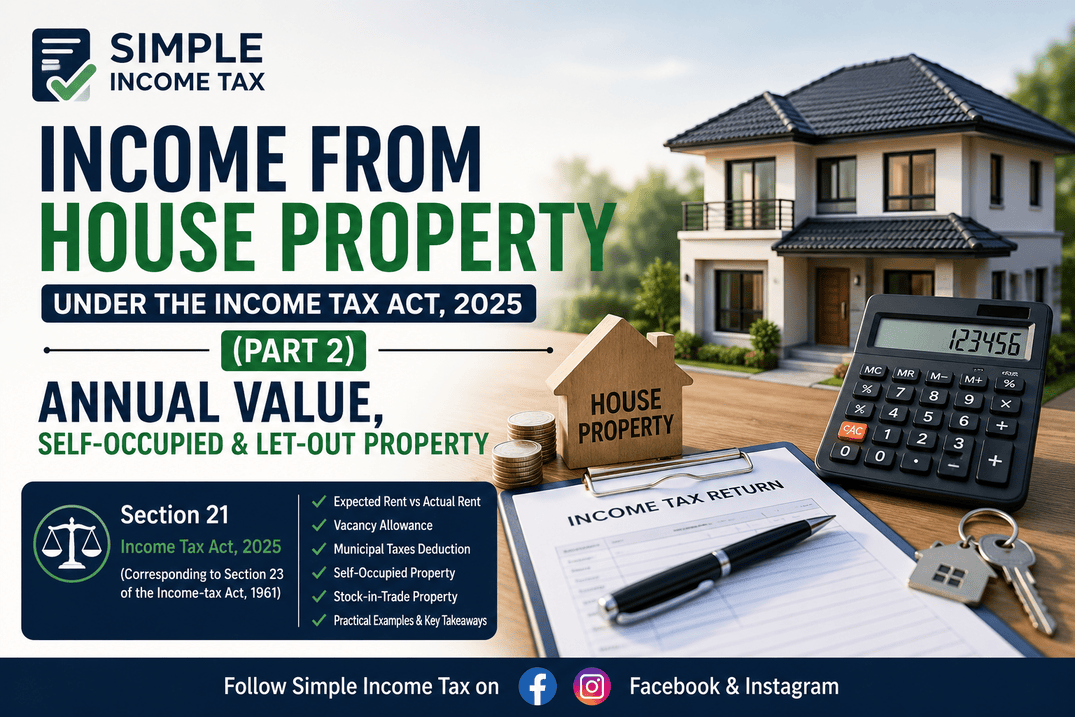

In Part 1 of this series, we discussed the scope of taxation under the head Income from House Property, including the chargeability provisions contained in Section 20 of the Income Tax Act, 2025 (corresponding to Section 22 of the Income-tax Act, 1961), ownership, deemed ownership and the types of house property.
The next step in computing taxable income is the determination of the Annual Value of the property. Section 21 of the Income Tax Act, 2025 (corresponding to Section 23 of the Income-tax Act, 1961) prescribes the manner of determining the annual value for self-occupied properties, let-out properties, vacant properties and properties held as stock-in-trade.
This article explains these provisions with practical illustrations to help taxpayers understand the computation of income from house property.
Provisions Covered in this Article
| Income Tax Act, 2025 | Corresponding Provision under the Income-tax Act, 1961 | Subject Matter |
| Section 21 | Section 23 | Determination of Annual Value, Self-Occupied Property, Let-Out Property, Vacancy Allowance and Property Held as Stock-in-Trade |
What is Annual Value?
The concept of Annual Value forms the foundation for computing income from house property.
Under Section 21 of the Income Tax Act, 2025 (corresponding to Section 23 of the Income-tax Act, 1961), the annual value is the value determined in accordance with the provisions of the Act for the purpose of computing income chargeable under the head “Income from House Property.”
Depending upon the nature and use of the property, the annual value may be:
- Based on the reasonable expected rent;
- Based on the actual rent received or receivable;
- Reduced because of vacancy during the year; or
- Taken as Nil, where the statutory conditions relating to self-occupied property or stock-in-trade are satisfied.
The determination of annual value is therefore the first step before allowing deductions under Section 22 of the Income Tax Act, 2025.
Gross Annual Value (GAV)
Gross Annual Value (GAV) represents the annual value of the property before allowing deductions such as municipal taxes.
While determining GAV, the following factors are generally relevant:
- Reasonable expected rent;
- Actual rent received or receivable;
- Vacancy during the tax year, if applicable.
The Gross Annual Value is subsequently reduced by municipal taxes actually paid by the owner to arrive at the Net Annual Value (NAV).
Net Annual Value (NAV)
Net Annual Value is computed as follows:
Gross Annual Value (GAV)
Less: Municipal Taxes actually paid by the owner during the tax year
= Net Annual Value (NAV)
The Net Annual Value forms the basis for claiming deductions under Section 22.
Expected Rent
Expected Rent refers to the reasonable rent that a property may be expected to fetch if let from year to year.
While determining the Expected Rent, the following factors are generally considered:
- Municipal valuation;
- Fair rental value of similar properties;
- Standard rent under the applicable Rent Control legislation, wherever applicable.
Expected Rent represents the notional earning capacity of the property and may differ from the actual rent received.
Actual Rent Received or Receivable
Where a property is actually let out, the actual rent received or receivable becomes an important factor in determining the annual value.
Actual rent generally includes:
- Monthly rent;
- Rent receivable but not yet received;
- Advance rent relating to the relevant tax year.
Security deposits that are refundable and do not represent rent are generally not treated as rental income merely because they are received.
Vacancy Allowance
A property may remain vacant during the whole or part of the tax year despite genuine efforts to let it out.
Where the actual rent received or receivable is lower than the expected rent solely because of such vacancy, Section 21 provides relief by permitting the annual value to be determined with reference to the actual rent, subject to the prescribed conditions.
This provision ensures that taxpayers are not taxed on hypothetical rental income that could not be earned because the property remained vacant.
Self-Occupied Property
A house used by the owner for his or her own residence is generally treated as a self-occupied property.
Subject to the conditions specified in Section 21, the Annual Value of a self-occupied property is taken as Nil.
The benefit is generally available where:
- the property is occupied by the owner for residential purposes; or
- the owner cannot actually occupy the property owing to employment, business or profession at another place and resides elsewhere in a building not belonging to him or her;
provided the prescribed conditions are fulfilled.
The Act also permits the assessee to treat up to two residential properties as self-occupied, subject to the statutory provisions. The benefit is not available where the property is actually let out or any other benefit is derived from the property.
Let-Out Property
A property that is actually let out during the tax year is treated as a let-out property.
The annual value of such property is determined after considering:
- Expected Rent;
- Actual Rent received or receivable;
- Vacancy allowance, wherever applicable.
Municipal taxes actually paid by the owner are deducted from the Gross Annual Value to determine the Net Annual Value.
Deemed Let-Out Property
Where an assessee owns more residential properties than those eligible to be treated as self-occupied under the Act, the remaining property or properties are generally treated as deemed let-out properties.
Even if no actual rent is received, their annual value is determined in accordance with Section 21, and income is computed accordingly.
Municipal Taxes
Municipal taxes are allowable as a deduction while computing the Net Annual Value only if:
- they are borne by the owner; and
- they are actually paid during the relevant tax year.
Taxes merely becoming due but remaining unpaid are not deductible.
Property Held as Stock-in-Trade
Special provisions apply where a house property is held as stock-in-trade by a builder or developer.
Where such property is not let out during the specified period after obtaining the completion certificate, the annual value may be taken as Nil for the period prescribed under Section 21, subject to fulfilment of the statutory conditions.
Taxpayers engaged in the real estate business should carefully examine these provisions while computing taxable income.
Practical Illustrations
Illustration 1 – Self-Occupied House
Mr. A owns one residential house in which he resides throughout the tax year.
Result: Subject to the prescribed conditions under Section 21, the Annual Value = Nil.
Illustration 2 – Let-Out House
| Particulars | Amount (Rs.) |
| Expected Rent | 4,80,000 |
| Actual Rent Received | 5,40,000 |
| Municipal Taxes Paid | 20,000 |
Computation
Gross Annual Value = Rs. 5,40,000
Less: Municipal Taxes = Rs. 20,000
Net Annual Value = Rs. 5,20,000
Illustration 3 – Vacancy During the Year
Expected Rent = Rs. 4,80,000
Actual Rent (after vacancy) = Rs. 3,90,000
Since the reduction is solely because the property remained vacant, the annual value may be determined with reference to the actual rent, subject to the conditions prescribed under Section 21.
Illustration 4 – Builder Holding Unsold Flats
A builder receives a completion certificate but certain flats remain unsold and are held as stock-in-trade.
The annual value of such flats shall be determined in accordance with the special provisions of Section 21, subject to fulfilment of the statutory conditions.
Common Mistakes
- Assuming Annual Value always equals actual rent.
- Claiming deduction of municipal taxes that have not actually been paid.
- Treating every vacant property as having Nil annual value.
- Incorrectly claiming more than the permissible number of self-occupied houses.
- Ignoring vacancy allowance where the statutory conditions are satisfied.
- Overlooking the special provisions applicable to unsold stock-in-trade.
Key Takeaways
- Section 21 governs the determination of annual value.
- Annual Value forms the basis for computing income from house property.
- Gross Annual Value and Net Annual Value are distinct concepts.
- Expected Rent, Actual Rent and Vacancy Allowance all influence the computation.
- Self-occupied properties enjoy the benefit of Nil annual value, subject to statutory conditions.
- Municipal taxes are deductible only when actually paid.
- Special rules apply to properties held as stock-in-trade.
Suggested Article on Simple Income Tax
Departmental Examination 2026 Study Materials
Visit Official website of Income Tax Department
About the Author




3 thoughts on “Income from House Property Under the Income Tax Act, 2025 (Part 2): Annual Value, Self-Occupied & Let-Out Property”