In the previous two parts of this series, we discussed the incomes chargeable under the head “Profits and Gains of Business or Profession” as provided in Section 26 of the Income Tax Act, 2025. However, merely identifying business income is not sufficient for determining the tax liability. The next step is to compute the taxable business income after allowing the deductions specifically permitted under the Act.
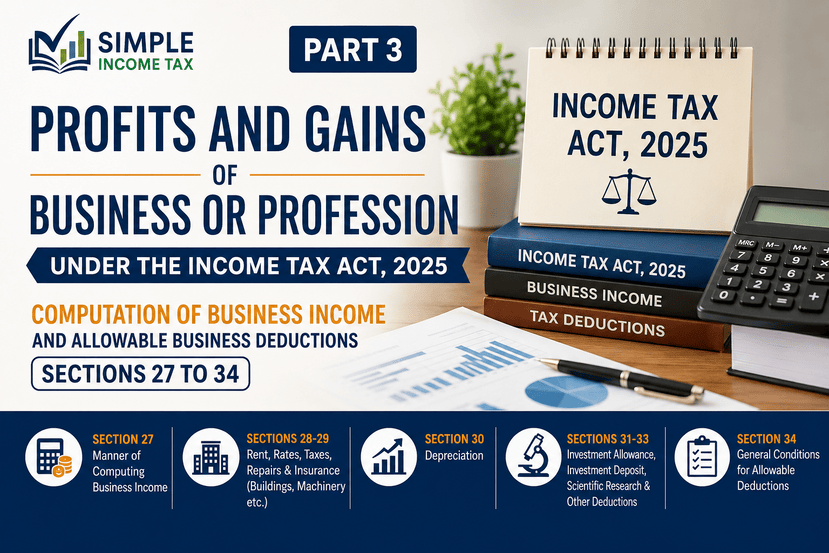
The Income Tax Act, 2025 contains a structured mechanism for computing business income. While business receipts form the starting point, only those expenditures which satisfy the prescribed conditions are allowed as deductions. Sections 27 to 34 lay down the framework for this computation by prescribing the method of computation and the principal categories of allowable expenditure. This article provides a simplified overview of these provisions without going into the detailed computation rules, which will be covered separately in later articles.
Overview of Sections 27 to 34
| Section | Corresponding Provision of the Income-tax Act, 1961 | Subject |
| 27 | Section 29 | Manner of computation of business income |
| 28 | Section 30 | Rent, rates, taxes, repairs and insurance of buildings |
| 29 | Section 31 | Repairs and insurance of machinery, plant and furniture |
| 30 | Section 32 | Depreciation |
| 31 | Section 32AC/32AD (where applicable) | Investment-related deductions (where applicable under the Act) |
| 32 | Section 33AB/33ABA | Specified business deductions |
| 33 | Section 35 | Scientific research and specified expenditure |
| 34 | Section 37 | General conditions for allowable deductions |
Section 27 – Manner of Computing Business Income
After determining that a receipt is taxable under the head “Profits and Gains of Business or Profession” in accordance with Section 26, the next step is to compute the taxable income. This is where Section 27 becomes relevant.
Section 27 provides that the income chargeable under the head “Profits and Gains of Business or Profession” shall be computed in accordance with the provisions of Sections 28 to 60 (except Section 58). Thus, it acts as the starting point for the computation of business income.
Although Section 27 does not itself prescribe any deduction or allowance, it lays down the framework for computing taxable business income by referring to the subsequent provisions of the Act. These provisions deal with various deductions such as rent, repairs, insurance, depreciation, scientific research expenditure and other allowable business expenses.
In simple terms, Section 27 serves as a bridge between the chargeability provisions under Section 26 and the detailed computation provisions that follow, ensuring that tax is levied on the net profits of the business or profession rather than on the gross receipts.
Section 28 – Rent, Rates, Taxes, Repairs and Insurance of Buildings
Businesses often operate from offices, factories, warehouses or commercial establishments. Section 28 permits deduction of specified expenditure relating to such buildings, including:
- Rent paid for business premises.
- Municipal taxes, where allowable.
- Repairs to the business premises.
- Insurance premium paid for business buildings.
The deduction is available only where the expenditure relates to business or professional use of the property.
Section 29 – Repairs and Insurance of Machinery, Plant and Furniture
Machinery and equipment require regular maintenance for efficient business operations.
Accordingly, Section 29 allows deduction for:
- Current repairs to machinery.
- Repairs to plant.
- Repairs to furniture.
- Insurance premium relating to such assets.
However, expenditure resulting in the acquisition of a new asset or giving an enduring benefit is generally treated as capital expenditure and is dealt with separately.
Section 30 – Depreciation
Most business assets lose value over time because of use, wear and tear or technological obsolescence.
Instead of allowing the entire cost in one year, the Act grants deduction by way of depreciation over the useful life of the asset in accordance with the prescribed rates and conditions.
Depreciation is one of the most significant deductions available while computing business income and applies to eligible buildings, machinery, plant, furniture and certain intangible assets.
Sections 31 to 33 – Other Specified Deductions
The Act also provides deductions for certain specified expenditures and business activities. Depending on the nature of the business and the conditions prescribed, deductions may be available in respect of:
- Specified investments or eligible business assets.
- Scientific research expenditure.
- Certain sector-specific business expenditure.
- Other deductions specifically recognised by the Act.
These deductions are available only if the statutory conditions are fulfilled and proper records are maintained.
Section 34 – General Conditions for Allowable Deductions
Section 34 lays down the fundamental principles governing the allowability of business expenditure. It provides that expenditure is generally allowable only if it:
- is incurred wholly and exclusively for the purposes of the business or profession;
- is not capital expenditure;
- is not personal expenditure; and
- is not covered by any specific deduction provision elsewhere in the Act.
The section also specifically excludes certain expenditures from deduction, including:
- expenditure incurred for an offence or for any purpose prohibited by law;
- expenditure on Corporate Social Responsibility (CSR), where specifically disallowed; and
- expenditure on advertisements in souvenirs, brochures, pamphlets or similar publications of political parties.
Practical Illustration
Suppose a trader incurs the following expenditure during the tax year:
- Office rent – Rs. 3,00,000
- Electricity charges – Rs. 90,000
- Staff salaries – Rs. 12,00,000
- Office insurance – Rs. 50,000
- Purchase of a new delivery vehicle – Rs. 10,00,000
- Personal family vacation – Rs. 2,50,000
Generally:
- Office rent, electricity, salaries and office insurance may qualify for deduction, subject to the Act.
- The cost of the new vehicle is ordinarily not allowed as an immediate deduction; depreciation provisions apply instead.
- The personal vacation is not deductible because it is not incurred for business purposes.
Important Points to Remember
- Business income is computed only after allowing deductions permitted under the Act.
- Every business expense is not automatically deductible.
- Capital expenditure and personal expenditure are generally not allowable under the general deduction provision.
- Proper books of account and supporting documents should be maintained.
- Expenditure prohibited by law cannot be claimed as a business deduction.
Key Takeaways
- Section 27 provides the framework for computing business income.
- Sections 28 to 33 deal with specific categories of deductions and allowances.
- Section 34 lays down the general conditions for claiming business expenditure.
- Taxable business income is computed after allowing only those deductions that satisfy the conditions prescribed by the Act.
- Proper documentation and classification of expenditure are essential for claiming deductions and avoiding disputes during assessment.
Frequently Asked Questions (FAQs)
1. Why is Section 27 important under the Income Tax Act, 2025?
Section 27 is the starting point for computing business income. It explains that once an income is taxable under the head “Profits and Gains of Business or Profession”, the taxable amount has to be computed according to the provisions contained in the subsequent sections of the Act.
2. Does Section 27 itself allow any deduction?
No. Section 27 does not specify any deduction or allowance. Instead, it provides the framework for computing business income by referring to the detailed provisions that follow.
3. Why is the computation of business income necessary?
Business receipts alone do not determine the tax liability. A business incurs various expenses while earning its income, and only the net profit, after allowing eligible deductions, is taxable.
4. Is every business expense deductible?
Not necessarily. Only those expenses that satisfy the conditions prescribed under the Income Tax Act, 2025 can be claimed as deductions while computing business income.
5. Can personal expenses be claimed as business expenditure?
No. Personal or household expenses are not incurred for the purpose of business and therefore cannot be claimed as business deductions.
6. What is the difference between capital expenditure and revenue expenditure?
Revenue expenditure relates to the day-to-day running of the business and is generally allowable, whereas capital expenditure usually results in acquiring or improving a long-term asset and is dealt with under separate provisions such as depreciation.
7. Is rent paid for office premises allowable as a deduction?
Yes. Rent paid for premises used for business or professional purposes is generally deductible, subject to the conditions prescribed under the Act.
8. Can repairs and maintenance expenses be claimed?
Yes. Expenses incurred for the normal repairs and maintenance of business assets are generally allowable. However, expenditure that substantially improves or replaces an asset may be treated differently.
9. Why is depreciation allowed instead of claiming the full cost of an asset?
Business assets such as machinery, furniture and buildings are used for several years. Instead of allowing the entire cost in one year, the Act permits deduction through depreciation over the useful life of the asset.
10. Why should proper records be maintained for business expenses?
Supporting documents such as invoices, bills, vouchers and payment proofs help establish that the expenditure was actually incurred for business purposes. They are also useful during assessment or audit proceedings.
11. Can a business claim an expense if there is no supporting evidence?
In many cases, it becomes difficult to justify the claim without proper records. Taxpayers should always maintain adequate documentation to support every deduction claimed.
12. Is taxable business income the same as total business receipts?
No. Taxable business income is arrived at after reducing eligible deductions and making the necessary adjustments prescribed under the Income Tax Act, 2025.
13. What happens if an inadmissible expense is claimed?
If an expense is found to be inadmissible during assessment, it may be disallowed, resulting in an increase in taxable income. Depending on the facts of the case, interest or penalty provisions may also apply.
14. Which sections should be read along with Section 27?
Section 27 should always be read together with the subsequent computation provisions, as they contain the detailed rules relating to deductions, depreciation and other allowable business expenditure.
15. What will be covered in the next part of this series?
In the next part, we will discuss the important deductions available while computing business income, including provisions relating to rent, repairs, insurance, depreciation and other allowable business expenditure, along with practical examples to make these concepts easier to understand.
Conclusion
Sections 27 to 34 form the foundation for the computation of taxable business income under the Income Tax Act, 2025. While Section 27 prescribes the manner of computation, the subsequent sections provide for deductions in respect of rent, repairs, insurance, depreciation, scientific research and other eligible expenditure, subject to the conditions prescribed by law. Taxpayers should ensure that every claim for deduction is supported by proper records and is made strictly in accordance with the provisions of the Act.
Related Article in Simple Income Tax
- Business Income Under the Income Tax Act, 2025 (Part 1): Chargeability, Meaning of Business & Profession and Section 26 Explained
- Profits and Gains of Business or Profession Under the Income Tax Act, 2025 (Part 2): Other Incomes Chargeable under Section 26
Visit Official website of Income Tax Department
About the Author