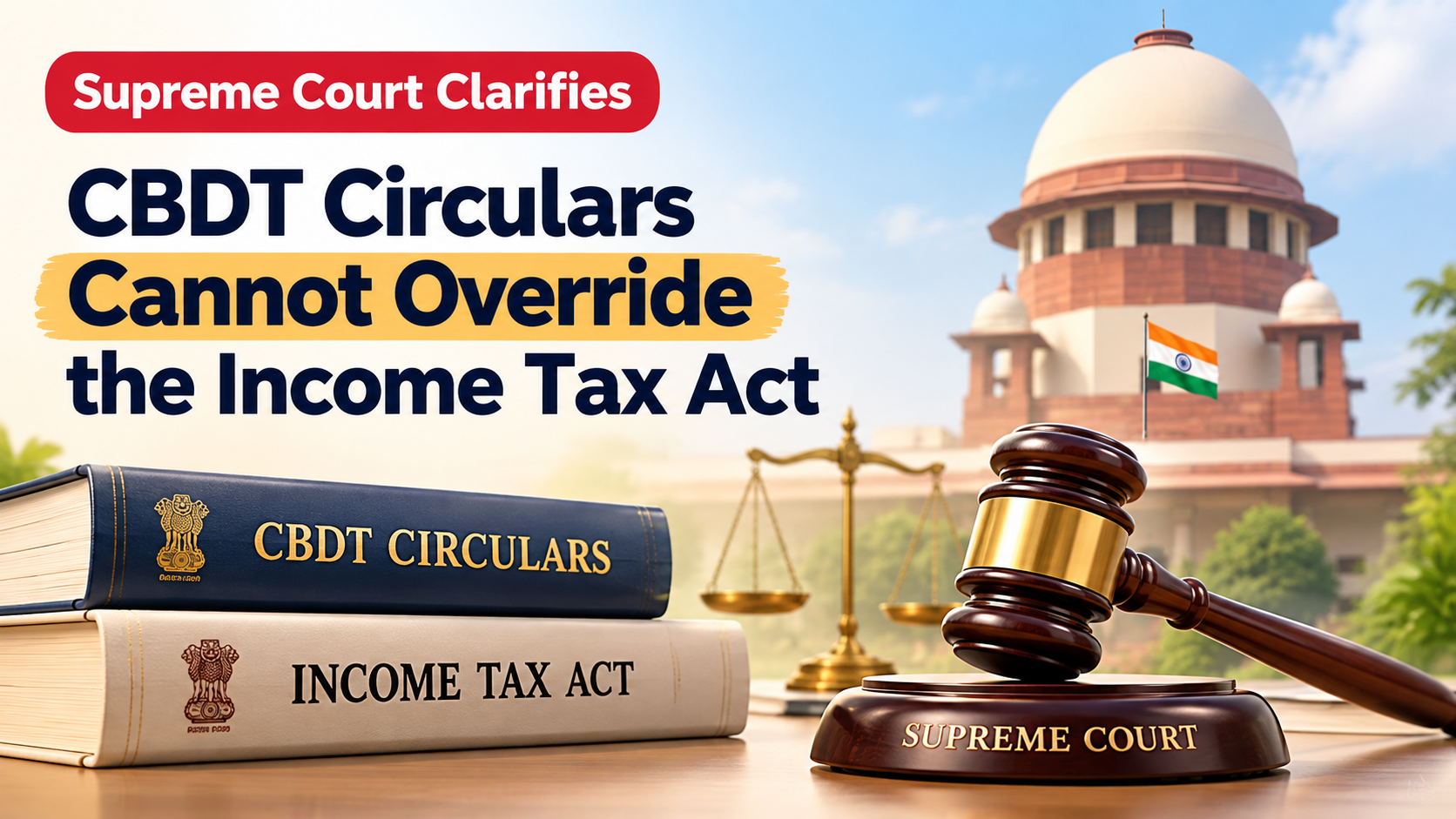

The Supreme Court has once again reaffirmed a fundamental principle of tax law: CBDT Circulars cannot override the Income Tax Act. While circulars issued by the Central Board of Direct Taxes (CBDT) play an important role in tax administration, they cannot replace, amend, or contradict the law enacted by Parliament.
This judgment is significant for taxpayers, Chartered Accountants, tax practitioners, and Income Tax officials because it clarifies the legal status of CBDT circulars and their relationship with the Income Tax Act.
What Did the Supreme Court Clarify?
The Supreme Court reaffirmed the well-settled legal principle that CBDT circulars and administrative instructions cannot override the provisions of the Income Tax Act enacted by Parliament. The Court emphasized that while CBDT circulars are valuable tools for ensuring uniform tax administration, they must operate within the framework of the law and cannot alter or expand statutory provisions.
Brief Background of the Case
The issue arose in the case of Orient Crafts Ltd., a company engaged in the export of readymade garments. The company had received a premium on the transfer of export quota and claimed deduction under the erstwhile Section 80HHC of the Income Tax Act by relying on a CBDT Office Memorandum dated 23 February 1998. The Office Memorandum suggested that such export quota premium could be treated on par with certain export incentives for the purpose of claiming the deduction.
The Assessing Officer accepted the claim and completed the assessment accordingly. Subsequently, the Commissioner of Income Tax invoked the revisionary powers under Section 263 of the Income Tax Act, holding that the assessment order was erroneous and prejudicial to the interests of the Revenue, as the deduction had been allowed based on an administrative instruction that was inconsistent with the statutory provisions of the Act.
The dispute eventually reached the Supreme Court, where the central question was whether a CBDT Office Memorandum or circular could confer a tax benefit that was not supported by the provisions of the Income Tax Act.
The Supreme Court answered this question in the negative. It held that although CBDT circulars and office memoranda are generally binding on the Income Tax Department for administrative purposes, they cannot override, amend, modify, or expand the provisions of the Income Tax Act. The Court observed that only Parliament has the legislative authority to enact or amend tax laws, and executive instructions cannot create deductions, exemptions, or tax liabilities beyond what the statute provides.
The Court also clarified that while departmental authorities may be guided by CBDT circulars in implementing the law, constitutional courts and judicial authorities are required to interpret the Income Tax Act independently. Whenever there is a conflict between a CBDT circular and the statutory provisions, the Income Tax Act will prevail.
Since the deduction claimed by the assessee was not supported by the provisions of the Income Tax Act, the Supreme Court upheld the Commissioner’s action under Section 263, reaffirming that an assessment based solely on an administrative instruction contrary to the statute is liable to be revised.
The judgment reinforces an important constitutional principle: executive instructions may aid the administration of tax laws, but they cannot replace or supersede legislation enacted by Parliament.
The Supreme Court Reaffirmed Three Important Principles
1. The Income Tax Act Has Supreme Authority
The Income Tax Act enacted by Parliament is the primary law governing direct taxation.
No executive instruction, office memorandum, circular, or administrative guideline can override the statute.
2. CBDT Circulars Are Administrative Instructions
CBDT circulars are issued to facilitate the implementation of tax laws and promote uniformity in tax administration. They explain the law but do not have the power to amend, enlarge, or curtail statutory provisions.
3. Courts Interpret the Law
While Income Tax authorities generally follow CBDT circulars in administering the law, constitutional courts are not bound by circulars that are inconsistent with the statute. The judiciary interprets the law independently, and where a conflict exists, the provisions of the Income Tax Act prevail.
What Are CBDT Circulars?
The Central Board of Direct Taxes (CBDT) issues circulars to:
- Clarify the interpretation of tax provisions.
- Ensure uniform implementation of the Income Tax Act across the country.
- Provide administrative guidance to Income Tax authorities.
- Explain new amendments or compliance procedures.
- Reduce ambiguity in the implementation of tax laws.
These circulars are issued under statutory powers granted to the CBDT and are intended to facilitate efficient tax administration.
Can CBDT Circulars Change the Law?
No.
The Supreme Court has reiterated that only Parliament can enact or amend the Income Tax Act.
CBDT circulars cannot:
- Introduce a new tax liability.
- Restrict or expand a statutory exemption.
- Override provisions of the Income Tax Act.
- Modify the meaning of the law enacted by Parliament.
If there is any inconsistency between a CBDT circular and the Income Tax Act, the provisions of the Act will prevail.
Why Are CBDT Circulars Still Important?
Although they cannot override the Act, CBDT circulars remain extremely important because they:
- Guide Income Tax officers in day-to-day administration.
- Promote uniform application of tax laws.
- Help reduce disputes arising from differing interpretations.
- Provide procedural clarity for taxpayers and tax professionals.
Income Tax authorities are generally expected to follow valid CBDT circulars unless they conflict with the statute or a binding judicial decision.
What Did the Supreme Court Clarify?
The Supreme Court reaffirmed three important principles:
1. The Income Tax Act Has Supreme Authority
The Income Tax Act enacted by Parliament is the primary law governing direct taxation.
No executive instruction, office memorandum, circular, or administrative guideline can override the statute.
2. CBDT Circulars Are Administrative Instructions
CBDT circulars are meant to facilitate implementation of the law.
They explain the law but do not replace it.
3. Courts Interpret the Law
While departmental authorities may follow CBDT circulars in administration, constitutional courts and judicial forums interpret the law independently.
If a circular is inconsistent with the statutory provisions, courts will apply the Act.
Practical Implications
For Taxpayers
- Do not rely solely on a CBDT circular.
- Always verify the relevant provisions of the Income Tax Act.
- If a circular appears inconsistent with the Act, seek professional advice.
For Tax Professionals
- Cite the statutory provisions first.
- Use CBDT circulars as interpretative aids.
- Keep track of judicial decisions that may affect the validity or application of circulars.
For Income Tax Officers
- Follow CBDT circulars in routine administration where they are consistent with the law.
- Ensure that assessments and orders conform to the provisions of the Income Tax Act and binding judicial precedents.
Illustrative Example
Suppose the Income Tax Act clearly grants a deduction subject to specified conditions.
If a CBDT circular attempts to impose an additional condition that is not found in the Act, the circular cannot curtail the statutory benefit. In such a situation, the provisions of the Income Tax Act would prevail.
Why This Judgment Matters
This reaffirmation by the Supreme Court:
- Strengthens the rule of law in tax administration.
- Protects taxpayers from executive instructions that are inconsistent with the statute.
- Reinforces the principle that taxation must be governed by legislation enacted by Parliament.
- Provides clarity to tax administrators and professionals regarding the legal hierarchy of statutes and administrative circulars.
Key Takeaways
- ✅ CBDT circulars are important administrative tools.
- ✅ They help ensure uniform implementation of tax laws.
- ✅ They are generally binding on Income Tax authorities in administration.
- ❌ They cannot override the Income Tax Act.
- ✅ In case of a conflict, the provisions of the Income Tax Act prevail.
- ✅ Courts interpret the law independently and are not bound by CBDT circulars that are inconsistent with the statute.
Conclusion
The Supreme Court’s reaffirmation that CBDT circulars cannot override the Income Tax Act reinforces a well-established legal principle. While CBDT circulars continue to play a vital role in tax administration, they must operate within the framework of the law enacted by Parliament.
For taxpayers and professionals, the decision serves as a reminder to always read CBDT circulars together with the relevant statutory provisions and applicable judicial precedents.
Disclaimer: This article is intended for educational purposes only and should not be construed as legal or professional advice. Readers should refer to the relevant provisions of the Income Tax Act, applicable CBDT circulars, and judicial decisions before taking any tax-related action.
Related case law discussion Article in Simple Income Tax
Source : Deccan Herald
About the Author