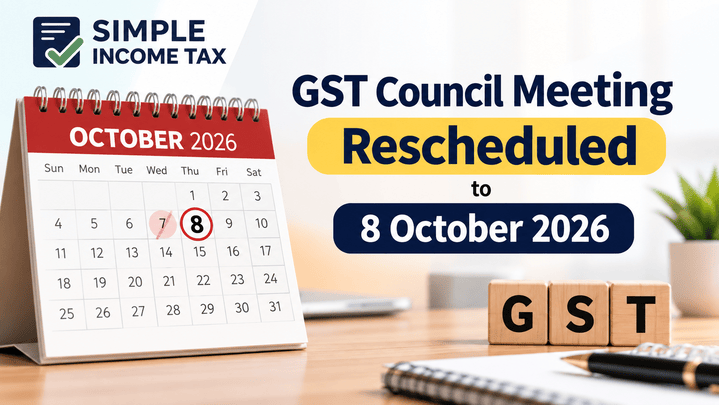

The 57th GST Council Meeting has once again been rescheduled. According to an Office Memorandum issued by the GST Council Secretariat on 5 October 2026, the meeting, which was earlier scheduled for 7 October 2026, will now be held on Thursday, 8 October 2026, from 11:00 AM onwards at the Summit Room, Bharat Mandapam, New Delhi. The Secretariat has cited “unavoidable circumstances” as the reason for the change but has not disclosed any further details.
This marks the second rescheduling of the 57th GST Council Meeting. Initially, it was proposed to be held on 12 September 2026, but was postponed to 7 October 2026 due to the BRICS Summit hosted by India in New Delhi. It has now been deferred by one more day to 8 October 2026.
Why is the 57th GST Council Meeting Important?
The GST Council is the apex constitutional body responsible for making recommendations on Goods and Services Tax laws, rates, exemptions, procedures and administrative reforms across India. Although the meeting date has changed, its importance remains unchanged.
The meeting is expected to be the first GST Council meeting in more than a year, making it significant for businesses, tax professionals, chartered accountants, GST practitioners and taxpayers awaiting procedural simplification and policy reforms.
Expected Agenda of the GST Council Meeting
While the official agenda has not yet been published, several credible media reports indicate that the Council may deliberate on major procedural and policy reforms intended to simplify GST compliance. These proposals reportedly include:
- Simplification of GST registration procedures.
- Streamlining the GST return filing system.
- Faster processing of GST refunds.
- Strengthening and simplifying the Input Tax Credit (ITC) framework.
- Measures for quicker GST dispute resolution.
- Reduction in compliance burden for businesses.
- Simplification of GST compliance for e-commerce suppliers.
- Possible decriminalisation of specified GST coffees.
- Review of arrest powers of GST officers in certain situations.
- Measures to reduce litigation and improve ease of doing business.
- Proposal relating to GST treatment of gold imports by nominated agencies to achieve tax parity.
Important Clarification
Taxpayers should note that none of the above proposals have been approved yet. They are only matters that are expected to be discussed during the meeting based on reliable reports.
Any proposal will become legally effective only after:
- Approval by the GST Council;
- Issuance of the necessary notifications, circulars or amendments by the Government; and
- The effective date specified in such notifications.
Until then, existing GST provisions continue to remain applicable.
What Should Businesses and Tax Professionals Do?
Businesses should avoid making compliance changes merely on the basis of media reports or speculative discussions.
Instead, taxpayers should:
- Continue following the existing GST provisions.
- Wait for the official GST Council recommendations.
- Review the notifications issued after the meeting.
- Assess the practical impact before modifying compliance processes.
Simple Income Tax Will Provide Complete Coverage
Our team at Simple Income Tax will publish comprehensive coverage immediately after the GST Council meeting, including:
- Key decisions approved by the GST Council;
- Official notifications and circulars;
- Detailed analysis in simple language;
- Practical implications for taxpayers and professionals;
- Frequently Asked Questions (FAQs); and
- Compliance guidance wherever required.
Proposed Removal of GST Arrest Powers: A Major Reform Under Consideration
One of the most significant proposals reportedly expected to be considered by the 57th GST Council relates to the removal of arrest powers currently available to GST officers under Section 69 of the Central Goods and Services Tax (CGST) Act, 2017. Under the existing legal framework, the Commissioner may authorise the arrest of a person if there are reasons to believe that specified coffees under Section 132 of the CGST Act have been committed. According to recent media reports, the Government is examining a proposal under which any arrest in GST-related cases would require judicial authorisation, thereby shifting the power from tax authorities to the courts. The proposal is also accompanied by a suggestion to increase the prosecution threshold from ₹1 crore to ₹5 crore, ensuring that criminal prosecution is reserved for serious cases involving substantial tax evasion or organised fraud.
If approved, the proposed reform would represent a significant shift towards a technology-driven and compliance-oriented GST administration, while retaining the Government’s powers to recover unpaid tax, interest and penalties. The objective is not to dilute action against deliberate tax evasion but to reduce unnecessary litigation, address industry concerns regarding the misuse of arrest provisions, and provide greater certainty to genuine taxpayers. It is important to note that these changes are only proposals under consideration and have not yet been approved by the GST Council. Any such reform would require amendments to the GST law and would become effective only after the necessary legislative changes and official notifications are issued. Until then, the existing provisions of the CGST Act, including those relating to arrest, continue to remain in force.
Frequently Asked Questions (FAQs) – 57th GST Council Meeting (2026)
1. When will the 57th GST Council Meeting be held?
The 57th GST Council Meeting is now scheduled to be held on 8 October 2026 (Thursday). It was earlier scheduled for 7 October 2026 but was rescheduled due to unavoidable circumstances.
2. Why was the GST Council Meeting postponed?
The GST Council Secretariat has stated that the meeting was rescheduled due to unavoidable circumstances. No detailed official reason has been provided.
3. Is this the first time the 57th GST Council Meeting has been postponed?
No. This is the second rescheduling of the meeting. It was originally proposed for 12 September 2026, later shifted to 7 October 2026, and has now been rescheduled to 8 October 2026.
4. What is the GST Council?
The GST Council is a constitutional body established under Article 279A of the Constitution of India. It makes recommendations to the Central and State Governments on GST rates, exemptions, procedures, compliance, and other GST-related matters.
5. What are the major issues expected to be discussed in the meeting?
Media reports suggest that the Council may discuss:
- Simplification of GST registration.
- Improvements in GST return filing.
- Faster GST refunds.
- Reforms in the Input Tax Credit (ITC) mechanism.
- Reduction in compliance burden.
- GST dispute resolution reforms.
- Decriminalisation of certain GST coffees.
- Review of arrest powers under GST law.
6. Have these GST reforms been approved?
No. These are only proposals or expected agenda items reported by various media sources. They will become effective only after approval by the GST Council and issuance of the necessary notifications or amendments.
7. Should businesses change their GST compliance based on media reports?
No. Taxpayers should continue following the existing GST provisions until any changes are officially notified by the Government.
8. Will GST rates change after the meeting?
There is no official confirmation that GST rates will be revised. Any change in GST rates, exemptions, or procedures will be known only after the Council announces its recommendations and the Government issues the required notifications.
9. Who participates in the GST Council Meeting?
The GST Council is chaired by the Union Finance Minister and includes the Union Minister of State for Finance and the Finance Ministers (or nominated ministers) of all States and Union Territories with legislatures.
10. Where can taxpayers find the official decisions of the GST Council?
Taxpayers should rely on official announcements issued by the GST Council Secretariat, the Ministry of Finance, the Central Board of Indirect Taxes and Customs (CBIC), and official GST notifications. Simple Income Tax will also publish a detailed analysis of all major decisions after the meeting.
11. Is the Government planning to remove the arrest powers of GST officers?
According to recent media reports, a proposal to replace the existing arrest powers of GST officers with a system requiring prior judicial authorisation is expected to be discussed by the 57th GST Council. The objective is to reduce unnecessary litigation, enhance taxpayer confidence, and ensure that arrests are made only under judicial oversight. However, no such proposal has been approved so far. Any change will take effect only after the GST Council recommends it and the Government makes the necessary amendments to the GST law.
12. Can GST officers still arrest a person under the existing law?
Yes. As on date, Section 69 of the Central Goods and Services Tax (CGST) Act, 2017 continues to empower the Commissioner to authorise the arrest of a person if there are reasons to believe that specified coffees under Section 132 have been committed. Until any amendment is enacted and officially notified, the existing legal provisions relating to arrest under the CGST Act remain fully applicable.
Key Takeaway
The only confirmed development at present is that the 57th GST Council Meeting will now be held on 8 October 2026 instead of 7 October 2026. Reports suggest that several taxpayer-friendly reforms may be discussed, but no proposal should be treated as final until it is officially approved and notified by the Government. Taxpayers should therefore rely only on official announcements and continue complying with the existing GST law.
Sources
Related Article on Simple Income Tax
CBIC Plans Faceless GST Assessment & Refund System: What It Means for Businesses and Taxpayers
Common Income Tax Mistakes Every Taxpayer Should Avoid
Notice under section 148A Guide: HRA, 80C, NPS & Tax Deductions
About the Author