
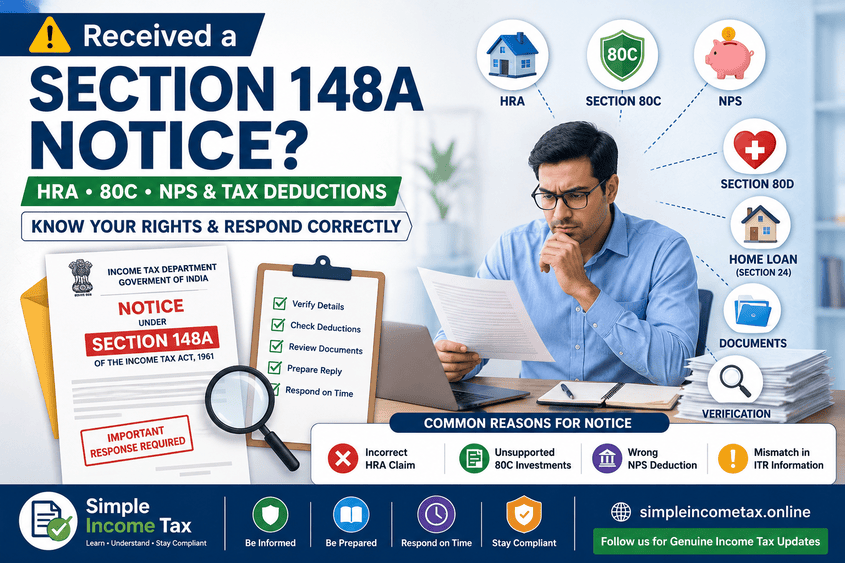

The Income Tax system in India is based on the principle of self-assessment and voluntary compliance. While filing an Income Tax Return (ITR), taxpayers are generally not required to upload documents relating to income, deductions, exemptions, investments, or expenses. The Income Tax Department accepts the information provided in the return in good faith, assuming that taxpayers have correctly reported their income and claimed only those deductions and exemptions for which they possess proper supporting documents. However, when the Department receives information from surveys, searches, AIS, GST records, banks, employers, investigation wings, or other third-party sources indicating possible discrepancies, it may undertake a detailed verification of the return. In such cases, taxpayers may be required to substantiate their claims with documentary evidence. Merely claiming a deduction in the return, reflecting it in Form 16, or filing an Updated Return (ITR-U) may not be sufficient. Therefore, every taxpayer should maintain proper records and supporting documents for all deductions, exemptions, and allowances claimed in the return, so that they can be produced whenever required by the Department. This article explains the documents required, precautions to be taken, and the consequences of unsupported claims. Several taxpayers have received notice under section 148A.
Notice u/s 148A for Wrong Deductions or Exemptions– A Practical Guide for Salaried Taxpayers
In recent years, the Income Tax Department has increasingly used data analytics, AIS, Form 26AS, TIS, Insight Portal information, survey findings and third-party data to identify cases where deductions, exemptions or allowances claimed in the Income Tax Return (ITR) appear inconsistent with available records. Consequently, many salaried taxpayers are receiving notices under Section 148A of the Income Tax Act, 1961.
A common misconception among taxpayers is that if a claim is reflected in Form 16 or if an Updated Return (ITR-U) has been filed, no further verification can be made by the Department. This is incorrect. During assessment or reassessment proceedings, the taxpayer is required to substantiate every deduction, exemption, allowance or relief claimed in the return with proper documentary evidence.
The purpose of this article is to help taxpayers understand what documents should be maintained, how claims should be justified, common mistakes noticed during proceedings, and the consequences of failing to support claims with evidence.
Important Principle
The responsibility of proving the correctness of a deduction or exemption lies upon the taxpayer. Merely because:
- A claim is reflected in Form 16,
- A tax consultant prepared the return,
- An Updated Return has been filed or
- Additional tax has been paid,
does not automatically establish that the claim is allowable under the Income Tax Act.
A Word About Form 16
Many taxpayers believe that every figure appearing in Form 16 has been verified by the employer.
This is not always correct.
In many cases, the Drawing and Disbursing Officer (DDO) or employer merely considers the declarations and documents submitted by the employee while computing TDS. Detailed verification of admissibility under the Income Tax Act may not be undertaken.
Therefore, the fact that a deduction or exemption appears in Form 16 does not by itself prove that the claim is legally admissible.
The taxpayer should independently maintain supporting records and be prepared to justify the claim during assessment proceedings.
House Rent Allowance (HRA) – Section 10(13A)
One of the most frequently disputed claims is HRA exemption. Many taxpayers submit only rent receipts and assume that the claim is fully justified. However, HRA exemption is governed by a specific formula under Rule 2A and requires proper computation.
Documents to Maintain
- Rent Agreement
- Rent Receipts
- Proof of Rent Payment
- Landlord PAN (where applicable)
- Salary Statement
- HRA received from employer
- HRA computation sheet
HRA Computation : Exemption is the least of the following:
- Actual HRA received
- Rent paid minus 10% of salary
- 50% of salary (metro cities) or 40% of salary (non-metro cities)
Salary for this purpose generally includes:
- Basic Pay
- Dearness Allowance (where it forms part of retirement benefits)
Common Mistakes
- Claiming HRA without rent receipts.
- Claiming HRA while residing in own house.
- Producing rent receipts without proof of payment.
- Producing rent receipts but not furnishing HRA working.
- Claiming HRA merely because it appears in Form 16.
Leave Travel Allowance (LTA) – Section 10(5)
Many taxpayers claim LTA without maintaining travel records.
Documents Required
- Travel Tickets
- Boarding Passes
- Travel Bills
- Employer Records
- Proof of Travel
Common Mistakes
- Claiming LTA without actual travel.
- Claiming hotel expenses as LTA.
- Claiming LTA without tickets.
- Claiming LTA merely because it appears in salary records.
Other Allowances – Section 10(14)
These allowances are exempt only when:
- Specifically granted for official duties.
- Actual expenditure is incurred.
Documents Required
- Employer Certificate
- Duty Details
- Expense Records
- Supporting Bills
Common Mistakes
- Claiming allowances without proof of expenditure.
- Assuming every allowance is exempt.
Housing Loan Interest – Section 24(b)
Many taxpayers claim deduction for interest on housing loans but fail to maintain supporting records. Documents Required
- Interest Certificate from Bank
- Loan Account Statement
- Possession Letter
- Ownership Documents
- Completion Certificate (where applicable)
Common Mistakes
- Producing loan sanction letter only.
- Producing EMI statements without interest certificate.
- Claiming deduction for under-construction property without eligibility.
- Claiming deduction in respect of loan taken for purchase of only plot.
Principal Repayment – Section 80C
Where principal repayment is claimed under Section 80C:
Documents Required
- Housing Loan Statement
- Principal Repayment Certificate
- Bank Records
Section 80C Deductions
Common Eligible Investments
- GPF
- PPF
- LIC Premium
- PLI Premium
- ELSS
- NSC
- Sukanya Samriddhi
- Tuition Fees
- Housing Loan Principal
Documents Required
LIC / PLI
- Premium Receipts
- Policy Documents
GPF / CPF
- Salary Statement
- Provident fund statment
- Employer Certificate
Tuition Fees
- School Receipts
- Student Details
ELSS
- Mutual Fund Statement
NSC
- NSC Certificates
NPS Deductions – Sections 80CCD(1), 80CCD(1B) and 80CCD(2)
This is one of the most misunderstood areas.
Section 80CCD(1)
Employee’s own contribution.
Documents Required
- NPS Statement
- PRAN Details
- Contribution Records
Section 80CCD(1B)
Additional deduction for NPS contribution.
Documents Required
- NPS Transaction Statement
- Contribution Records
Section 80CCD(2)
Employer’s contribution to NPS.
Documents Required
- Form 16
- Salary Statement
- Employer Certificate
- NPS Contribution Records
Important Caution
A common mistake noticed during assessment proceedings is that some employers allow deduction under Section 80CCD(2) in Form 16 without properly adding the employer’s contribution to the gross salary income.
In such cases:
- Employer contribution should first form part of salary income.
- Thereafter deduction u/s 80CCD(2) may be allowed subject to statutory limits.
Where employer contribution is not included in salary income but deduction u/s 80CCD(2) is claimed separately, it may result in double deduction or unintended tax benefit.
Therefore, taxpayers should carefully verify:
- Gross salary in Form 16.
- Employer contribution shown in salary records.
- Deduction claimed u/s 80CCD(2).
A mere entry in Form 16 may not be sufficient justification during assessment proceedings.
Medical Insurance – Section 80D
Documents Required
- Insurance Policy
- Premium Receipts
- Bank Payment Proof
Common Mistakes
- Claiming deduction without premium receipt.
- Claiming cash payments.
- Claiming expenses instead of insurance premium.
Disability Deduction – Section 80DD
Documents Required
- Valid Disability Certificate
- Prescribed Form 10-IA (where applicable)
- Dependent Details
Common Mistakes
- Producing only disability certificate.
- Not producing prescribed medical certification.
- Claiming deduction without proving dependency.
Specified Disease – Section 80DDB
Documents Required
- Prescribed Medical Certificate
- Treatment Records
- Medical Bills
Common Mistakes
- Claiming deduction on the basis of medical bills alone.
- Not furnishing prescribed certificate.
Filing Updated Return (ITR-U) Is Not a Complete Defence
Many taxpayers respond to notices by stating:
“I have filed Updated Return and paid tax, interest and additional tax.”
This alone may not be sufficient.
The Department can still verify:
- Exemptions retained in ITR-U.
- Deductions retained in ITR-U.
- Correctness of income declared.
- Supporting evidence for claims.
Every claim surviving in ITR-U must still be substantiated.
Uploading Documents – Important Precautions
Many cases fail because taxpayers upload:
- Corrupted files.
- 0 KB files.
- Password-protected PDFs.
- Incomplete documents.
- Unreadable scans.
Before uploading:
✓ Open the file.
✓ Verify readability.
✓ Ensure all pages are uploaded.
✓ Ensure file size is proper.
✓ Upload supporting documents separately wherever possible.
Consequences of Non-Submission of Documents
If proper documentary evidence is not furnished:
- Claims may be disallowed.
- Exemptions may be withdrawn.
- Income may be recomputed.
- Additional tax may become payable.
- Interest may be charged.
- Penalty proceedings may be initiated wherever applicable.
- Notice u/s 148 may be issued.
- Reassessment proceedings may follow.
Practical Advice to Taxpayers
Before filing your return:
✓ Verify Form 16.
✓ Verify AIS and Form 26AS.
✓ Verify NPS records.
✓ Verify housing loan certificates.
✓ Maintain rent records.
✓ Preserve all investment proofs.
✓ Maintain documents for at least eight years.
Most importantly, remember:
A deduction is not allowable merely because it is claimed in the return. A deduction becomes allowable only when it is supported by proper documentary evidence and satisfies the conditions prescribed under the Income Tax Act.
A Taxpayer can view notices by login to Income Tax e filing Portal.
Here is a Section 148A Notice Guide.
Earlier, we have posted Bogus Deduction Claims – CBDT Warns Taxpayers
About the Author



2 thoughts on “Notice under section 148A Guide: HRA, 80C, NPS & Tax Deductions”