
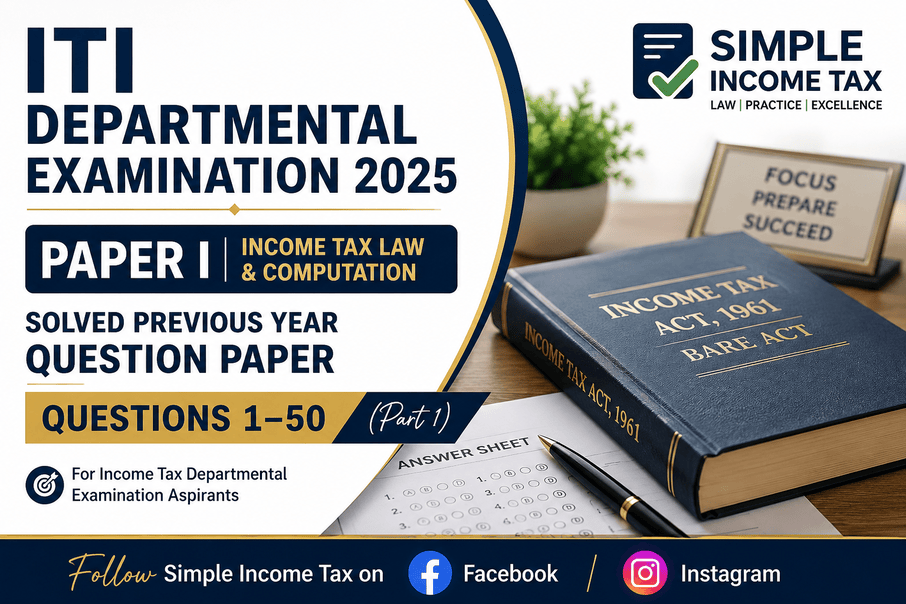

The ITI Departmental Examination is one of the most important departmental examinations conducted by the Income Tax Department for ministerial and executive staff. Success in this examination not only enhances an employee’s professional knowledge of the Income Tax Act but also plays a significant role in career progression within the Department.
Preparing for the departmental examination requires a thorough understanding of the Income Tax Act, 1961, Income Tax Rules, judicial principles, and departmental procedures. Among the various study resources available, previous years’ question papers remain one of the most valuable tools for understanding the examination pattern, the nature of questions, and the important topics frequently tested by the Department.
In this series, Simple Income Tax is publishing solved previous year question papers with concise explanations to help departmental examination aspirants revise the law quickly and effectively. Each question is reproduced from the original examination paper and is accompanied by:
- The correct answer.
- A brief explanation highlighting the relevant legal provision or principle.
- References to the applicable provisions of the Income Tax Act, wherever necessary.
This article covers Questions 1 to 25 from Paper I – Income Tax Law and Computation (Objective Type) of the Income Tax Inspector (ITI) Departmental Examination held on 8 September 2025 (Shift-2). The paper consisted of 150 objective-type questions, carrying one mark each, with a negative marking of 1/8th mark for every incorrect answer.
The explanations provided are intended to facilitate conceptual understanding and quick revision. Readers are encouraged to refer to the relevant statutory provisions, rules, and official notifications for a more comprehensive understanding of the subject.
Examination Details
| Particulars | Details |
| Examination | Income Tax Inspector (ITI) Departmental Examination |
| Paper | Paper I – Income Tax Law and Computation |
| YEAR | 2025 |
| Duration | 3 Hours |
| Maximum Marks | 150 |
| Question Type | Objective (Multiple Choice Questions) |
| Negative Marking | 1/8 mark for each incorrect answer |
About This Series
This is the first article in our Income Tax Inspector (ITI) Departmental Examination Series. The series aims to provide systematic guidance to departmental examination candidates by covering:
- Solved previous year question papers with explanations.
- Topic-wise practice questions.
- Model question papers based on the revised examination pattern.
- Important provisions of the Income Tax Act and Income Tax Rules.
- Quick revision notes and examination tips.
Whether you are appearing for the departmental examination for the first time or revising before the next examination, this series is designed to serve as a practical reference and revision guide.
ITI Departmental Examination 2025 (Paper I)
Question 1. Income accrued outside India and received outside India is taxable in case of:
a) Resident and Ordinary Resident (ROR) only | b) Resident but Not Ordinarily Resident (RNOR) only | c) Non-Resident only | d) ROR, RNOR and Non-Resident
Correct Answer: (a) Resident and Ordinary Resident (ROR) only
Explanation: Under Section 5, only a Resident and Ordinarily Resident is taxable on global income.
Question 2. Which statement is correct in respect of residential status of a company?
a) A company can only be resident | b) A company can only be non-resident | c) A company can be either resident or non-resident | d) All above are not correct
Correct Answer: (c) A company can be either resident or non-resident
Explanation: Under Section 6(3), a company may be resident or non-resident depending on its place of incorporation.
Question 3. Under Section 12, voluntary contributions received by a charitable trust are treated as:
a) Business income | b) Capital receipts | c) Income from other sources | d) Income from property held under trust
Correct Answer: (d) Income from property held under trust
Explanation: Section 12 deems voluntary contributions (other than corpus donations) as income derived from property held under trust.
Question 4. Which among the following does not constitute a transfer of a capital asset?
a) Sale, exchange or relinquishment of an asset | b) Maturity or redemption of zero coupon bond | c) Compulsory acquisition under any law | d) Conversion of preference shares into equity shares of the same company
Correct Answer: (d) Conversion of preference shares into equity shares of the same company
Explanation: Conversion of preference shares into equity shares is specifically excluded from the definition of “transfer”.
Question 5. As per Explanation 3 to Section 2(22), substantial interest in a concern exists where a person is beneficially entitled to not less than:
a) 20% | b) 25% | c) 10% | d) 15%
Correct Answer: (a) 20%
Explanation: Explanation 3 to Section 2(22) prescribes a 20% beneficial entitlement for substantial interest.
Question 6. “Inspector of Income Tax” has been defined under which provision of the Income Tax Act, 1961?
a) Section 2(28A) | b) Section 2(29) | c) Section 2(28) | d) Section 2(19)
Correct Answer: (c) Section 2(28)
Explanation: “Inspector of Income Tax” is defined under Section 2(28) of the Income Tax Act, 1961.
Question 7. Where specified violations are noticed under Section 10(23C), within what period should the Principal Commissioner or Commissioner pass the order?
a) Six months from the end of the quarter in which the first notice is issued | b) Six months from the end of the month in which the first notice is issued | c) Six months from the end of the quarter in which the violation was noticed | d) Six months from the end of the month in which the violation was noticed
Correct Answer: (a)
Explanation: The order must be passed within six months from the end of the quarter in which the first notice is issued.
Question 8. Which of the following is not a determinant of the residential status of a company?
a) Place of Effective Management (POEM) | b) Place of Incorporation | c) Place where the Board of Directors meets | d) Citizenship of the shareholders
Correct Answer: (d) Citizenship of the shareholders
Explanation: Shareholders’ citizenship has no relevance in determining a company’s residential status.
uestion 9. Which of the following is not deemed to accrue or arise in India?
a) Income from a business connection in India | b) Interest paid by an Indian company to a non-resident | c) Foreign salary paid to an Indian resident for services performed outside India | d) Capital gains from transfer of assets located in India
Correct Answer: (c) Foreign salary paid to an Indian resident for services performed outside India
Explanation: Salary for services rendered outside India is not deemed to accrue or arise in India merely because the recipient is an Indian resident.
Question 10. Which of the following is not taxable in India in the hands of a Non-Resident?
a) Salary received in India | b) Business profits from an Indian branch | c) Interest on NRE Account | d) Income from property situated in India
Correct Answer: (c) Interest on NRE Account
Explanation: Interest on an NRE account is exempt under Section 10(4)(ii), subject to the prescribed conditions.
Below are the solved answers for Questions 11–30 in the same concise format.
Question 11. Which of the following transactions of loans and advances would not constitute deemed dividend under Section 2(22)(e) of the Income Tax Act, 1961?
a) All of the above | b) Only 2 | c) Only 1 | d) Both 1 and 2
Correct Answer: (c) Only 1
Explanation: A loan to a concern in which the shareholder does not have substantial interest does not attract deemed dividend under Section 2(22)(e).
Question 12. Which of the following constitutes a “specified entity” under Section 9B?
a) Only 1 and 4 | b) Only 2 and 4 | c) Only 1, 2 and 3 | d) Neither of the above
Correct Answer: (c) Only 1, 2 and 3
Explanation: Section 9B applies to firms, associations of persons and bodies of individuals, but not to co-operative societies.
Question 13. Which of the following is deemed to be received income?
a) Salary credited to employee’s account | b) Dividend declared but not received | c) Interest credited to a recognised provident fund | d) Income earned abroad
Correct Answer: (c) Interest credited to a recognised provident fund
Explanation: Interest credited to a recognised provident fund is deemed to be received under the Income Tax Act.
Question 14. Which of the following is fully exempt under Section 10?
a) Gratuity received by a Government employee | b) Pension received after retirement | c) Bonus received during employment | d) Capital gains from house property
Correct Answer: (a) Gratuity received by a Government employee
Explanation: Death-cum-retirement gratuity received by a Government employee is fully exempt under Section 10(10).
Question 15. Income from property held for charitable purposes is exempt if:
a) 85% of the income is applied | b) 50% of the income is applied | c) 100% of the income is applied | d) No exemption is available
Correct Answer: (a) 85% of the income is applied
Explanation: Sections 11 and 12 require application of at least 85% of income for charitable or religious purposes.
Question 16. Exemption under Sections 11 and 12 is not available if:
a) Trust is formed for charitable purposes | b) Income is used for personal benefit of trustees | c) Income is accumulated for future use | d) Income is applied for educational purposes
Correct Answer: (b) Income is used for personal benefit of trustees
Explanation: Diversion of trust income for the private benefit of trustees results in denial of exemption.
Question 17. Determine the taxable income of the trust.
a) Rs. 2,00,000 | b) Nil | c) Rs. 4,40,000 | d) Rs. 6,00,000
Correct Answer: (b) Nil
Explanation: Since more than 85% of the total income has been applied for charitable purposes, the trust is entitled to full exemption.
Question 18
What is the basic exemption limit under the New Tax Regime for A.Y. 2025-26?
a) Rs. 2.5 lakh | b) Rs. 3 lakh | c) Rs. 5 lakh | d) Rs. 7 lakh
Correct Answer: (b) Rs. 3 lakh
Explanation: The Finance (No. 2) Act, 2024 increased the basic exemption limit under the default new tax regime to Rs. 3 lakh from A.Y. 2025-26.
Question 19. Will royalty paid by an Indian company to a non-resident for use of software be taxable in India?
a) Yes, since it is deemed to accrue or arise in India | b) No, as it is credited abroad | c) Yes, if the recipient visits India | d) No, since it is earned outside India
Correct Answer: (a) Yes, since it is deemed to accrue or arise in India
Explanation: Royalty payable by an Indian resident is generally deemed to accrue or arise in India under Section 9(1)(vi), subject to applicable exceptions and tax treaty provisions.
Question 20. What is the tax treatment of voluntary contributions received by a registered political party filing return under Section 139(4B)?
a) Fully taxable | b) Exempt if the party files its return | c) Exempt up to Rs. 50 lakh | d) Taxable if contribution exceeds Rs. 1 crore
Correct Answer: (b) Exempt if the party files its return
Explanation: Voluntary contributions are exempt under Section 13A, subject to fulfilment of the prescribed conditions, including filing the return of income.
Question 21. Which statement is incorrect under Section 36(1)?
a) Insurance premium against stock damage is allowable | b) Cash payment of health insurance premium for employees is allowable | c) Interest before first use of an asset is allowable | d) Both (b) and (c)
Correct Answer: (d) Both (b) and (c)
Explanation: Health insurance premium paid in cash and pre-use interest on borrowed capital for acquisition of an asset are not allowable deductions under Section 36(1).
Question 22. A co-operative society will be treated as:
a) Individual | b) Firm | c) Company | d) Person
Correct Answer: (d) Person
Explanation: Section 2(31) includes a co-operative society within the definition of “person”.
Question 23. Which receipts are included in “Income” under Section 2(24)?
a) Salary and commission only | b) Interest and lottery only | c) All of the above | d) None
Correct Answer: (c) All of the above
Explanation: Salary, commission, interest and lottery winnings are all included in the inclusive definition of income under Section 2(24).
Question 24. XYZ Ltd., an Indian company wholly owned by the Government, will be classified as:
a) Domestic Company | b) Foreign Company | c) Public Sector Undertaking | d) Partnership Firm
Correct Answer: (a) Domestic Company
Explanation: A company incorporated in India is a domestic company for the purposes of the Income Tax Act.
Question 25. Which deduction is not available under Section 16 while computing salary income?
a) Standard deduction | b) Property tax | c) Entertainment allowance | d) Professional tax
Correct Answer: (b) Property tax
Explanation: Property tax is relevant for computation under the head “Income from House Property” and is not deductible from salary under Section 16.
Question 26. Which of the following is/are true about the amount not deductible under Section 25 while computing “Income from House Property”? Any interest chargeable under the Income Tax Act which is payable outside India shall not be deducted in computing the income chargeable under the head “Income from House Property”—
(i) On which tax has not been paid or deducted under Chapter XVII-B.
(ii) In respect of which there is no person in India who may be treated as an agent under Section 163.
(iii) Which is paid on a loan taken from a non-scheduled bank as per Schedule II of the RBI Act, 1934.
a) (i) only
b) (ii) only
c) (i) and (ii) only
d) All of (i), (ii) and (iii)
Correct Answer: (c) (i) and (ii) only
Explanation: Under Section 25, interest payable outside India is not deductible if tax has not been deducted/paid under Chapter XVII-B or where there is no agent in India under Section 163; borrowing from a non-scheduled bank is not, by itself, a ground for disallowance.
Question 27. If an assessee is engaged in the manufacture or production of any article or thing, the rate of normal depreciation under Section 32(1)(ii) and additional depreciation under Section 32(1)(iia) on Plant and Machinery are:
a) 10% and 20% | b) 15% and 20% | c) 25% and 40% | d) 15% and 30%
Correct Answer: (b) 15% and 20%
Explanation: New plant and machinery used in manufacturing is eligible for normal depreciation at 15% and additional depreciation at 20%, subject to the conditions of Section 32.
Question 28. X received arrears of rent from a tenant which were taxed under the head “Income from House Property”. What deduction is allowable under Section 25A?
a) 30% of the arrears of rent received | b) 25% of the arrears/unrealised rent | c) Maximum Rs. 1 lakh | d) Maximum Rs. 1.5 lakh
Correct Answer: (a) 30% of the arrears of rent received
Explanation: Section 25A allows a standard deduction of 30% of arrears or unrealised rent taxable in the year of receipt.
Question 29. Who among the following is deemed to be the owner of house property under Section 27 of the Income Tax Act, 1961?
a) An individual transferring house property to spouse without consideration | b) Holder of an impartible estate | c) Person in possession under Section 53A of the Transfer of Property Act, 1882 | d) All of the above
Correct Answer: (d) All of the above
Explanation: Section 27 deems all these categories as owners for the purpose of taxation under the head “Income from House Property.”
Question 30. Annual accretion to the balance at the credit of an employee participating in a recognised provident fund, to the extent taxable, is chargeable under:
a) Salary under Section 17(1) | b) Perquisites | c) Allowances | d) Profits in lieu of salary
Correct Answer: (a) Salary under Section 17(1)
Explanation: Taxable annual accretion to a recognised provident fund is specifically included in the definition of salary under Section 17(1) of the Income Tax Act, 1961.
Question 31. Which of the following expenditures incurred by an assessee on the premises used for the purpose of business or profession does not qualify for deduction under Section 30 of the Income Tax Act, 1961 while computing income under the head “Profits and Gains of Business or Profession”?
a) Sums paid on account of municipal taxes. | b) Insurance premium paid against risk of damage to the premises. | c) Replacement of electrical panels and electrical work in the premises. | d) Restoration and extension of reception area.
Correct Answer: (d) Restoration and extension of reception area
Explanation: Expenditure on extension or improvement of premises is capital in nature and is not deductible under Section 30.
Question 32. The definition of the term “Actual Cost” can be found under which provision of the Income Tax Act, 1961?
a) Section 43(1) | b) Section 2(43) | c) Section 2(42) | d) None of the above
Correct Answer: (a) Section 43(1)
Explanation: Section 43(1) defines the expression “Actual Cost” for depreciation purposes.
Question 33. According to Section 50C, if the value determined by the Stamp Valuation Authority is lower than the value assessed by the Valuation Officer, the full value of consideration shall be:
a) Value determined by the Valuation Officer. | b) Value declared by the assessee. | c) Higher of the Valuation Officer’s value or Stamp Valuation Authority’s value. | d) Value adopted or assessed by the Stamp Valuation Authority.
Correct Answer: (d) Value adopted or assessed by the Stamp Valuation Authority
Explanation: Where the stamp duty value is lower than the value determined by the Valuation Officer, the lower stamp duty value is adopted under Section 50C.
Question 34. According to Section 50B, which of the following statements is incorrect regarding computation of capital gains in case of slump sale?
a) Profit from slump sale is taxable in the year of transfer. | b) Net worth is deemed to be cost of acquisition and improvement. | c) Net worth should be certified in the Accountant’s Report. | d) Revaluation of assets is included while computing net worth.
Correct Answer: (d) Revaluation of assets is included while computing net worth
Explanation: Revaluation of assets is ignored while computing net worth under Section 50B.
Question 35. Where the income of an individual includes the income of three minor children under Section 64(1A) read with Section 10(32), the exemption available is:
a) Rs. 2,500 | b) Rs. 1,500 | c) Rs. 3,000 | d) Rs. 5,000
Correct Answer: (b) Rs. 1,500
Explanation: Exemption under Section 10(32) is Rs. 1,500 per minor child whose income is clubbed.
Question 36. When a capital asset is acquired by an assessee through gift or will, the cost of acquisition shall be:
a) Cost to the previous owner. | b) Cost of improvement incurred by the previous owner. | c) Cost of improvement incurred by the assessee. | d) All of the above together.
Correct Answer: (d) All of the above together
Explanation: Under Sections 49 and 55, cost to the previous owner along with eligible cost of improvements is considered.
Question 37. Which of the following transactions shall not be regarded as transfer under Section 47 of the Income Tax Act?
a) Transfer during amalgamation where amalgamated company is a foreign company. | b) Transfer under a gift, will or irrevocable trust. | c) Extinguishment of rights in a capital asset. | d) Compulsory acquisition under any law.
Correct Answer: (b) Transfer under a gift, will or irrevocable trust
Explanation: Section 47 specifically excludes transfers under gift, will or irrevocable trust from the definition of transfer.
Question 38. Who is required to get accounts audited under Section 44AB (ignoring the proviso to the section)?
a) A person carrying on business with turnover exceeding Rs. 1 crore. | b) A person declaring profit under Section 44AD(1). | c) A professional having gross receipts exceeding Rs. 40 lakh. | d) None of the above.
Correct Answer: (a) A person carrying on business with turnover exceeding Rs. 1 crore
Explanation: Section 44AB mandates tax audit where business turnover exceeds the prescribed threshold, subject to applicable provisions.
Question 39. As per the Capital Gains Accounts Scheme, the unutilised capital gain should be deposited by the assessee before:
a) Due date of furnishing the return under Section 139(1). | b) End of the assessment year. | c) Within two years from transfer. | d) End of the financial year.
Correct Answer: (a) Due date of furnishing the return under Section 139(1)
Explanation: Deposit under the Capital Gains Accounts Scheme must be made before the due date under Section 139(1).
Question 40. Which section provides exemption from long-term capital gains arising from transfer of agricultural land if another agricultural land is purchased?
a) Section 54A | b) Section 54B | c) Section 54F | d) Section 54C
Correct Answer: (b) Section 54B
Explanation: Section 54B grants exemption on capital gains arising from transfer of agricultural land when another agricultural land is purchased within the prescribed period.
Question 41. X converts his land (acquired on 25.04.2015 for Rs. 1,00,000) into stock-in-trade on 31.03.2017 (Fair Market Value: Rs. 2,15,000) and subsequently sells the stock-in-trade for Rs. 6,00,000 on 20.06.2023. Determine the assessable profits for A.Y. 2024-25. (CII: FY 2015-16: 254; FY 2023-24: 348).
a) Short-term Capital Gain of Rs. 1,15,000 and Business Income of Rs. 3,85,000 | b) Long-term Capital Gain of Rs. 1,11,063 and Business Income of Rs. 3,85,000 | c) Long-term Capital Gain of Rs. 4,62,992 and No Business Income | d) Short-term Capital Gain of Rs. 5,00,000 and No Business Income
Correct Answer: (b) Long-term Capital Gain of Rs. 1,11,063 and Business Income of Rs. 3,85,000
Explanation: Under Sections 45(2) and 48, indexed capital gain is computed up to the date of conversion and business income is computed as the excess of sale price over fair market value.
Question 42. The benefit of indexation is NOT available in which of the following cases of long-term capital assets?
(i) Transfer before 23 July 2024.
(ii) Slump sale covered under Section 50B.
(iii) Depreciable assets.
(iv) Equity shares/equity-oriented mutual funds/business trust units covered under Section 112A.
a) (i), (ii) & (iii) | b) (ii), (iii) & (iv) | c) (i), (ii) & (iv) | d) All of the above
Correct Answer: (b) (ii), (iii) & (iv)
Explanation: Indexation is not available for slump sale, depreciable assets and assets covered under Section 112A.
Question 43. As per the Explanation to Section 50AA, ‘Specified Mutual Fund’ means a mutual fund where not more than ______ of its total proceeds is invested in equity shares of domestic companies.
a) 30% | b) 35% | c) 40% | d) 50%
Correct Answer: (b) 35%
Explanation: Section 50AA defines a Specified Mutual Fund as one investing not more than 35% of its total proceeds in equity shares of domestic companies.
Question 44. Which of the following conditions is NOT correct for claiming exemption under Section 54D of the Income Tax Act?
a) The taxpayer may be an individual, HUF, firm, company or any other person. | b) The asset shall be a long-term capital asset only. | c) Capital gain should arise on compulsory acquisition of land or building forming part of an industrial undertaking. | d) The new land or building should be used for shifting, re-establishing or setting up another industrial undertaking.
Correct Answer: (b) The asset shall be a long-term capital asset only.
Explanation: Section 54D applies to compulsory acquisition of land or building used for an industrial undertaking and is not restricted only to long-term capital assets.
Question 45. The provisions of Section 54B apply where the transferred agricultural land was used for agricultural purposes during the ______ years immediately preceding the date of transfer.
a) One | b) Two | c) Three | d) Four
Correct Answer: (b) Two
Explanation: The agricultural land must have been used for agricultural purposes during the two years immediately preceding its transfer.
Question 46. Which of the following statements is NOT correct with respect to Section 56(2)(viib) of the Income Tax Act?
a) It was inserted from A.Y. 2013-14. | b) It applies to a company in which the public are substantially interested. | c) Finance Act, 2023 omitted the words “being a resident” with effect from 01.04.2024. | d) Finance (No. 2) Act, 2024 provides that Section 56(2)(viib) shall not apply from 01.04.2025.
Correct Answer: (b) It applies to a company in which the public are substantially interested.
Explanation: Section 56(2)(viib) applies to closely held companies and not to companies in which the public are substantially interested.
Question 47. X transfers a house property to A but retains the right to revoke the transfer during A’s lifetime. Which of the following statements is/are correct under Section 61?
(i) It is a revocable transfer.
(ii) Income from the house property is taxable in the hands of A.
a) Only (i) | b) Only (ii) | c) Both (i) and (ii) | d) Both (i) and (ii) are incorrect
Correct Answer: (a) Only (i)
Explanation: Income from a revocable transfer is taxable in the hands of the transferor under Section 61.
Question 48. Which of the following statements are correct regarding Section 68 (Cash Credits)?
a) It applies only to cash transactions. | b) It applies to any unexplained credit irrespective of the mode of receipt. | c) Unexplained cash credits are taxable at 60% subject to basic exemption. | d) Both (b) and (c)
Correct Answer: (b) It applies to any unexplained credit irrespective of the mode of receipt.
Explanation: Section 68 covers all unexplained credits in the books, whether received by cash, cheque, draft or any other mode.
Question 49. Match the following Sections with the relevant provisions:
(i) Section 69
(ii) Section 69A
(iii) Section 69B
(iv) Section 69C
a) (i)-a, (ii)-b, (iii)-d, (iv)-c | b) (i)-c, (ii)-d, (iii)-a, (iv)-b | c) (i)-c, (ii)-a, (iii)-d, (iv)-b | d) (i)-b, (ii)-d, (iii)-a, (iv)-c
Correct Answer: (b) (i)-c, (ii)-d, (iii)-a, (iv)-b
Explanation: Section 69 relates to unexplained investments, Section 69A to unexplained money, Section 69B to investments not fully disclosed, and Section 69C to unexplained expenditure.
Question 50. During assessment proceedings, the Assessing Officer establishes unexplained expenditure as the assessee fails to satisfactorily explain its source. The Assessing Officer shall:
a) Treat such expenditure as income of the relevant previous year. | b) Allow deduction under any head of income. | c) Disallow any deduction notwithstanding any other provision of the Income Tax Act. | d) Both (a) and (c)
Correct Answer: (d) Both (a) and (c)
Explanation: Under Section 69C, unexplained expenditure is deemed to be income and no deduction is allowable in respect of such expenditure.
Conclusion
With this, we have completed the first 50 questions of Paper I – Income Tax Law and Computation from the Income Tax Inspector (ITI) Departmental Examination held on 8 September 2025. These questions cover a wide range of fundamental topics under the Income Tax Act, 1961, including residential status, charitable trusts, capital gains, house property, business deductions, depreciation, clubbing provisions, audit requirements, and unexplained income.
A careful analysis of these questions indicates that the Department places significant emphasis not only on the statutory provisions of the Income Tax Act but also on their practical application. Candidates should therefore focus on understanding the concepts behind each provision rather than relying solely on memorisation. Familiarity with frequently tested sections, recent amendments, and computational provisions is essential for performing well in the departmental examination.
Readers are encouraged to revisit the relevant provisions of the Income Tax Act, 1961 and the Income Tax Rules after attempting these questions independently. A thorough review of the explanations provided in this article will help reinforce the legal concepts and improve accuracy in answering objective-type questions.
In Part 2 of this series, we will continue with Questions 51 to 100, accompanied by the correct answers and concise explanations in the same easy-to-understand format. The remaining questions cover several important topics, including deductions under Chapter VI-A, international taxation, assessment procedures, reassessment, TDS/TCS, penalties, prosecution, and other significant provisions frequently tested in departmental examinations.
If you found this article useful, consider bookmarking it for future revision and sharing it with colleagues preparing for the Income Tax Inspector Departmental Examination. Stay connected with Simple Income Tax for more solved previous year papers, practice question banks, model test papers, and comprehensive study material designed specifically for departmental examination aspirants.
You can access STUDY MATERIAL on Simple Income Tax
Always refer Income Tax Act from official website of Income Tax Department.
About the Author


13 thoughts on “ITI Departmental Examination 2025 (Paper I): Solved Previous Year Question Paper with Answers & Explanations (PART-1)”