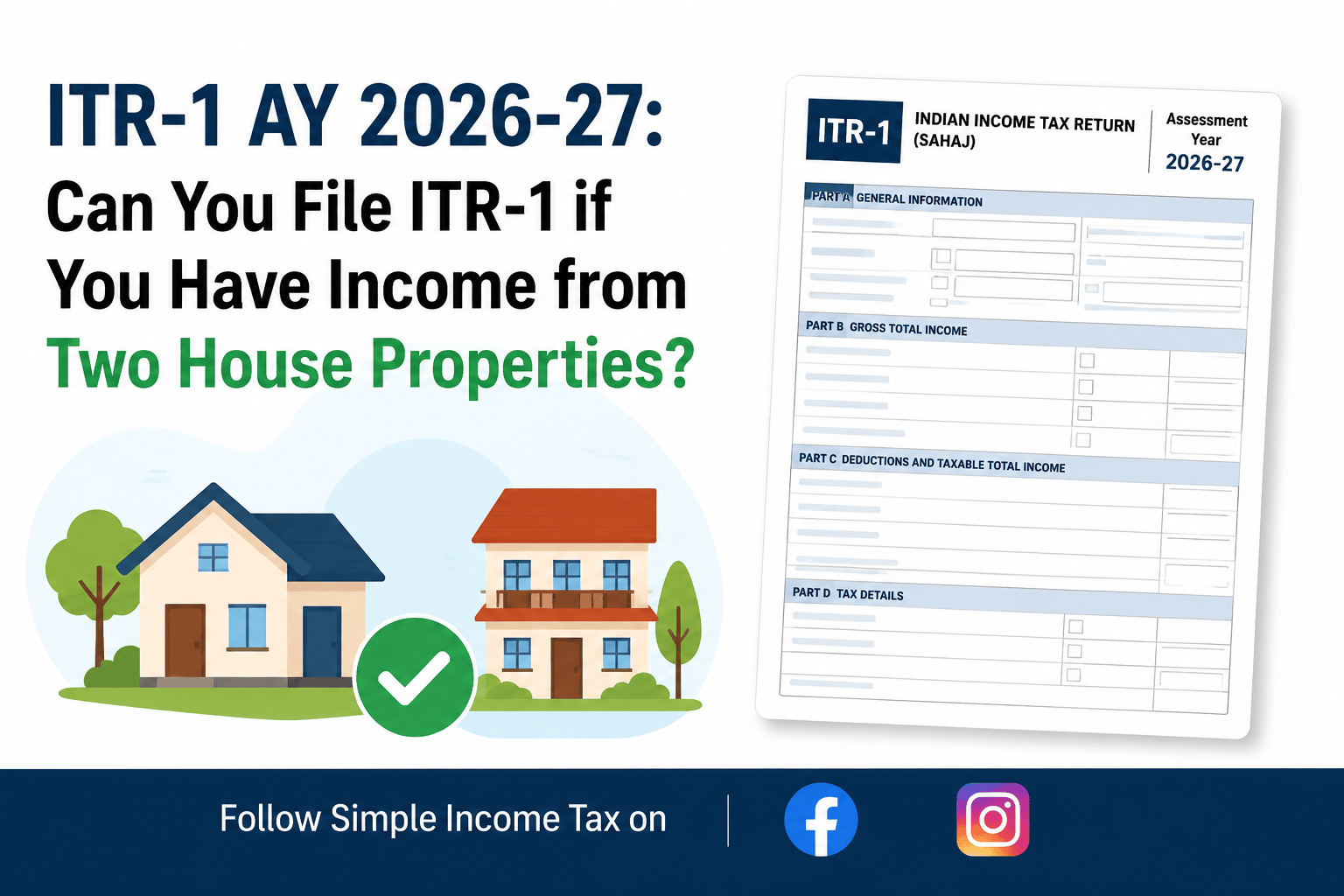

Income from two house properties can now be reported in ITR-1 AY 2026-27, subject to the eligibility conditions prescribed by the Income Tax Department. The Income Tax Department has introduced a significant taxpayer-friendly change in ITR-1 (Sahaj) for Assessment Year (AY) 2026-27. One of the most important changes is that eligible resident individuals can now report income from up to two house properties while filing ITR-1, subject to the prescribed conditions.
This amendment is expected to benefit a large number of salaried employees and pensioners who own more than one residential property but have otherwise simple sources of income. Earlier, taxpayers owning more than one house property often had to file ITR-2, resulting in additional compliance.
What is ITR-1 (Sahaj)?
ITR-1, popularly known as Sahaj, is the simplest Income Tax Return form prescribed for resident individuals having comparatively straightforward sources of income.
It is generally meant for taxpayers whose income consists of:
- Salary or Pension
- Income from House Property
- Income from Other Sources (such as bank interest)
- Agricultural income up to the prescribed limit
However, the return can be used only when the taxpayer satisfies all the eligibility conditions prescribed by the Central Board of Direct Taxes (CBDT).
For official eligibility details, refer to the Income Tax Department’s ITR-1 FAQs:
ITR-1 (Sahaj) FAQs – Income Tax Department
Major Change in AY 2026-27
One of the biggest changes notified for AY 2026-27 is the expansion of ITR-1 eligibility.
Earlier Position
Until AY 2025-26, ITR-1 generally permitted reporting income from only one house property.
Position for AY 2026-27
For AY 2026-27, eligible taxpayers may report income from up to two house properties while continuing to file ITR-1, provided all other eligibility conditions are fulfilled. This change has been incorporated in the notified ITR-1 form and the official FAQs issued by the Income Tax Department. (Income Tax Department)
Who Can File ITR-1 with Two House Properties?
A taxpayer can file ITR-1 only if all the prescribed conditions are satisfied.
| Particulars | Eligibility |
| Residential Status | Resident Individual |
| Total Income | Does not exceed Rs. 50 lakh |
| Salary/Pension | Permitted |
| House Property | Income from up to two house properties |
| Other Sources | Interest and specified other income |
| Agricultural Income | Up to Rs. 5,000 |
| Business/Profession | Not permitted |
| Foreign Assets | Not permitted |
| Certain Complex Incomes | Not permitted under ITR-1 |
Does Ownership of Two Houses Automatically Make You Eligible?
No.
The amendment merely permits reporting income from up to two house properties in ITR-1.
A taxpayer must still satisfy every other condition prescribed for filing ITR-1.
For example, if a person has:
- Business income,
- Foreign assets,
- Income exceeding Rs. 50 lakh, or
- Any other disqualification under the notified form,
ITR-1 cannot be used even though only two house properties are owned.
Types of House Properties That May Be Reported
Depending upon the facts of the case, the two properties may include:
- Self-occupied property
- Let-out property
- Properties whose income is computed under the head “Income from House Property”
The income from each property should be computed strictly in accordance with the provisions of the Income Tax Act, 1961 before entering the details in the return.
Home Loan Interest Deduction under Section 24(b)
If the taxpayer has borrowed funds for purchase, construction, repair or reconstruction of a house property, deduction under Section 24(b) of the Income Tax Act, 1961 may be available, subject to statutory conditions and limits.
For AY 2026-27, the ITR-1 form also requires additional disclosure relating to the housing loan, including:
- Name of the lender
- Loan account number
- Date of sanction
- Total amount of loan
- Outstanding balance
- Interest payable
These additional disclosures improve transparency and facilitate verification by the Department.
Important Restriction Regarding House Property Loss
Taxpayers should note an important restriction.
The notified ITR-1 Instructions specifically state that while house property loss can be adjusted up to the permissible limit during the year, taxpayers wishing to carry forward house property loss should use the applicable return form such as ITR-2 or ITR-3, as the case may be. Therefore, taxpayers should carefully examine their facts before selecting ITR-1.
When Should You File ITR-2 Instead?
Generally, ITR-2 becomes applicable if you are not eligible to file ITR-1 and you do not have business or professional income.
Examples include situations where the taxpayer has:
- More than two house properties;
- Capital gains requiring ITR-2;
- Foreign assets or foreign income;
- Total income exceeding Rs. 50 lakh;
- Agricultural income above the prescribed limit; or
- Other circumstances specified in the notified form.
Practical Examples
Example 1
Mr. A earns salary income of Rs. 18 lakh.
He owns:
- One self-occupied house.
- One let-out residential house.
He has savings bank interest of Rs. 25,000.
He has no capital gains or business income.
Result: Subject to satisfying all notified conditions, he can file ITR-1.
Example 2
Mrs. B earns salary income of Rs. 32 lakh.
She owns two residential properties and has long-term capital gains from sale of mutual funds requiring reporting beyond ITR-1 eligibility.
Result: She cannot file ITR-1 merely because she owns only two houses. The presence of capital gains requiring ITR-2 makes her ineligible for ITR-1.
Example 3
Mr. C owns three residential properties.
Even if his total income is below Rs. 50 lakh, he should examine his eligibility under the notified return forms. In such circumstances, ITR-2 would ordinarily be the appropriate return form if there is no business income.
Common Mistakes Made by Taxpayers
Many taxpayers commit avoidable mistakes while selecting the return form. Some common errors include:
- Assuming that ownership of two houses alone makes them eligible for ITR-1.
- Ignoring the restriction relating to carried forward house property losses.
- Incorrectly claiming deduction under Section 24(b) without proper loan details.
- Filing ITR-1 despite having income that requires ITR-2.
- Not verifying the pre-filled information available on the e-Filing portal.
Frequently Asked Questions (FAQs)
Q. Can I file ITR-1 if I own two residential houses?
Yes, provided you satisfy all other eligibility conditions prescribed in the notified ITR-1.
Q. Is the Rs. 50 lakh income limit still applicable?
Yes.
Q. Can I claim deduction under Section 24(b)?
Yes, subject to the provisions of the Income Tax Act, 1961.
Q. Do I have to provide loan details?
Yes. The revised ITR-1 requires disclosure of specified housing loan details.
Q. Can I carry forward house property loss through ITR-1?
The official ITR-1 Instructions specify that taxpayers who wish to carry forward and set off house property loss should use the applicable return form such as ITR-2 or ITR-3, as applicable.
Conclusion
The decision to permit reporting of income from up to two house properties in ITR-1 (Sahaj) is a welcome simplification for salaried taxpayers and pensioners. It reduces unnecessary compliance for individuals whose income profile remains otherwise straightforward.
However, taxpayers should remember that this amendment does not relax the other eligibility conditions. Before selecting ITR-1, every taxpayer should carefully examine the notified form, instructions, and FAQs to ensure that the correct return form is used. Filing the correct return not only avoids defective return notices but also facilitates faster processing by the Income Tax Department.
Use only official Income Tax Department links as external references:
- ITR-1 (Sahaj) FAQs – Income Tax Department
- ITR-1 (Sahaj) Form for AY 2026-27 (PDF)
- Income Tax Department e-Filing Portal
Related Article on Simple Income Tax
Common Income Tax Mistakes Every Taxpayer Should Avoid
Income Tax Latest News & FAQs (2025): Refund Delays, ITR Mismatch, Revised Returns & Foreign Assets
About the Author