
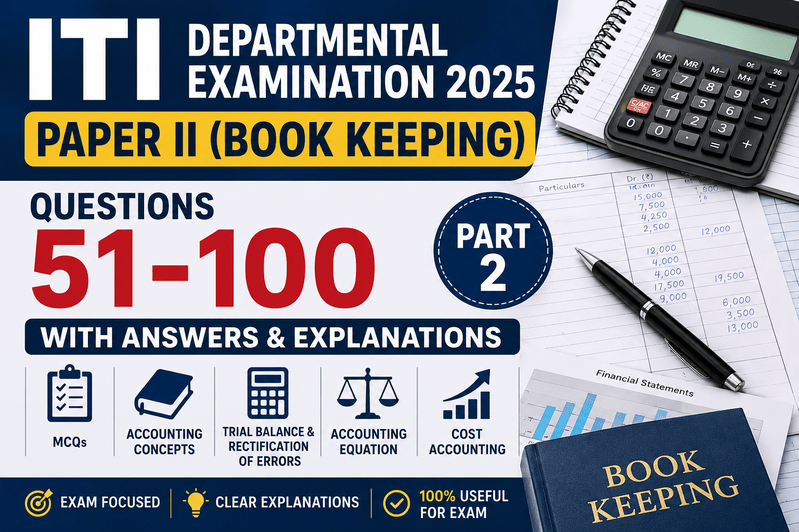

The second half of the ITI Departmental Examination 2025 – Paper II (Book Keeping) focuses on several core areas of accounting, including final accounts, accounting concepts and conventions, accounting standards, rectification of errors, trial balance, accounting equation, bills of exchange, cost accounting, and the double-entry system. These topics form the foundation of practical bookkeeping and are frequently tested in departmental examinations.
In this part, we have provided Questions 51–100 along with their answer options, the correct answer, and a concise explanation for each question. The explanations are designed to help candidates understand the underlying accounting principles rather than merely memorize the answers. This approach is particularly useful for the Income Tax Inspector (ITI) Departmental Examination, where conceptual clarity is essential for solving objective questions accurately.
Whether you are preparing for the upcoming departmental examination or revising important bookkeeping concepts, these solved MCQs will strengthen your understanding of accounting fundamentals and improve your confidence in tackling similar questions in future examinations.
Let’s begin with the detailed solutions to Questions 51–100, including the correct answer and a brief explanation for each question to help you understand the underlying accounting concepts.
51. While preparing a Trial Balance, Ravi posted Bank Overdraft of Rs.2,00,000 on the debit side, Opening Stock of Rs.1,50,000 on the debit side, Purchase Returns of Rs.2,00,000 and Sundry Creditors of Rs.1,50,000 on the credit side. What correction is required?
Options: (a) Opening Stock to credit side (b) Bank Overdraft to credit side (c) Purchase Returns and Sundry Creditors to debit side (d) Only Purchase Returns to debit side
Answer: (b)
Explanation: Bank Overdraft is a liability and should appear on the credit side.
52. Which statement is not correct about Operating Profit?
Options: (a) Revenue exceeds operating costs (b) Includes core business income and expenses (c) Includes investment and loan income (d) Shows operational efficiency
Answer: (c)
Explanation: Operating profit excludes non-operating income such as investments and loans.
53. Consider the statements regarding Manufacturing Account. Choose the correct option.
Options: (a) Only 1 & 2 (b) Only 1 & 3 (c) Only 2 & 4 (d) All of the above
Answer: (d)
Explanation: All the statements correctly describe a Manufacturing Account.
54. Which of the following will lead to understatement of net profit?
Options: (a) Transfer of General Reserve (b) Treating capital expenditure as revenue expenditure (c) Amortization of fictitious assets (d) Treating revenue expenditure as capital expenditure
Answer: (b)
Explanation: Charging capital expenditure as revenue increases expenses and reduces profit.
55. Assets held for immediate conversion into money are known as:
Options: (a) Current Assets (b) Quick Assets (c) Intangible Assets (d) Tangible Assets
Answer: (b)
Explanation: Quick assets are readily convertible into cash.
56. Wages paid for installation of new machinery were debited to Wages Account. This is:
Options: (a) Error of Commission (b) Error of Principle (c) Compensating Error (d) Error of Omission
Answer: (b)
Explanation: Capital expenditure has been wrongly treated as revenue expenditure.
57. Goods worth Rs.5,000 distributed as free samples will appear in:
Options: (a) Profit & Loss Account (b) Trading Account and Profit & Loss Account (c) Trading Account (d) None of these
Answer: (b)
Explanation: It affects both cost of goods sold and advertisement/sales promotion expense.
58. Closing Stock = Rs.53,000, Cost of Goods Sold = Rs.85,000, Purchases = Rs.70,000. Opening Stock equals:
Options: (a) Rs.68,000 (b) Rs.1,02,000 (c) Rs.38,000 (d) Rs.73,000
Answer: (a)
Explanation: Opening Stock = COGS + Closing Stock − Purchases = Rs.68,000.
59. A company capitalized development cost of technology at Rs.5,00,000. Sales pattern is 50%, 35%, and 15% over three years. Amortization in Year 3 is:
Options: (a) Rs.2,50,000 (b) Rs.1,66,667 (c) Rs.75,000 (d) Rs.1,75,000
Answer: (c)
Explanation: 15% of Rs.5,00,000 = Rs.75,000.
60. If the Purchase Day Book is overcast, it will:
Options: (a) Increase GP, reduce NP (b) Reduce GP, increase NP (c) Reduce GP and NP (d) Increase GP and NP
Answer: (c)
Explanation: Excess purchases increase cost, reducing both gross and net profit.
61. Consider the statements regarding Suspense Account.
Options: (a) Only 1 (b) Only 2 (c) Both 1 & 2 (d) Neither
Answer: (b)
Explanation: Suspense Account temporarily records unidentified differences, not permanent transactions.
62. Goods worth Rs.3,000 returned by a customer were not recorded. This is an example of:
Options: (a) Error of Principle (b) Error of Omission (c) Error of Commission (d) Compensating Error
Answer: (b)
Explanation: The transaction has been completely omitted.
63. Match the following errors with their descriptions.
Options: (a) 1-a, 2-b, 3-c, 4-d (b) 1-b, 2-a, 3-d, 4-c (c) 1-a, 2-d, 3-b, 4-c (d) 1-c, 2-b, 3-a, 4-d
Answer: (a)
Explanation: Each error correctly matches its standard accounting example.
64. Trial Balance is extracted after posting to ledger accounts in order to:
Options: (a) Prepare Balance Sheet (b) Determine Profit/Loss (c) Check arithmetical accuracy (d) Rectify all errors
Answer: (c)
Explanation: Trial Balance verifies the arithmetic accuracy of ledger postings.
65. Trial Balance differs by Rs.5,000 because wages paid were posted only on the debit side. Which type of error is this?
Options: (a) Error of Omission (b) One-sided Error (c) Compensating Error (d) Error of Principle
Answer: (b)
Explanation: Posting to only one side causes disagreement in the Trial Balance.
66. Depreciation on furniture of Rs.50,000 at 10% requires which journal entry?
Options: (a) Dr Furniture, Cr P&L (b) Dr Depreciation, Cr Furniture (c) Dr P&L, Cr Depreciation (d) Dr Depreciation Rs.50,000, Cr Furniture Rs.50,000
Answer: (b)
Explanation: Depreciation is debited and Furniture Account is credited by Rs.5,000.
67. Rs.10,000 received from a debtor was posted only to the debtor’s account. Effect on Trial Balance?
Options: (a) Credit understated by Rs.10,000 (b) Debit overstated by Rs.10,000 (c) Credit overstated by Rs.10,000 (d) No effect
Answer: (a)
Explanation: Cash Book credit is missing, causing the credit side to be short.
68. Cash payment of Rs.2,500 for stationery was entered in Cash Book but not posted to Stationery Account. Effect?
Options: (a) Two-sided error (b) Error of Commission (c) One-sided error; excess credit (d) One-sided error; excess debit
Answer: (c)
Explanation: Only the debit posting is missing, making the credit side appear excessive.
69. Which statements are TRUE?
Options: (a) Only 1 & 4 (b) Only 1 & 2 (c) Only 1 & 3 (d) All
Answer: (c)
Explanation: Statement 1 and 3 are correct; statements 2 and 4 are incorrect.
70. Which account appears on the debit side of a Trial Balance?
Options: (a) Prepaid Expenses (b) Bills Payable (c) Outstanding Expenses (d) Purchase Returns
Answer: (a)
Explanation: Prepaid expenses are current assets and have a debit balance.
71. ABC Ltd. identified several accounting errors after opening a Suspense Account. During rectification, Suspense Account will be:
Options: (a) Credited by Rs.9,000 (b) Debited by Rs.9,000 (c) Credited by Rs.10,000 (d) None of the above
Answer: (b)
Explanation: The net effect of one-sided errors requires a debit of Rs.9,000 to Suspense Account.
72. If the Trial Balance does not tally even after efforts to rectify errors, then:
Options: (a) Delay final accounts (b) Ignore errors (c) Transfer difference to Suspense Account (d) Remove erroneous accounts
Answer: (c)
Explanation: A Suspense Account is opened temporarily to facilitate preparation of final accounts.
73. Which error does not affect the agreement of Trial Balance?
Options: (a) Wrong amount in Journal (b) Wrong totaling of Trial Balance (c) Posting on wrong side of Ledger (d) Omitting account balance in Trial Balance
Answer: (a)
Explanation: Equal wrong amounts on both sides still keep the Trial Balance in agreement.
74. According to which concept is the owner treated as a creditor of the business?
Options: (a) Money Measurement (b) Dual Aspect (c) Separate Entity (d) Going Concern
Answer: (c)
Explanation: The Separate Entity Concept treats the business and owner as distinct entities.
75. Under the Business Entity Concept, the owner’s personal transactions are:
Options: (a) Included with business transactions (b) Not recorded in books (c) Recorded under liabilities (d) Treated as revenue
Answer: (b)
Explanation: Personal transactions are excluded from the business books unless they affect the business (e.g., drawings or capital introduced).
76. Which of the following conventions requires that a business should anticipate all possible losses but not show profits unless they are realized?
Options:
- a) Consistency
- b) Prudence
- c) Matching
- d) Full Disclosure
Correct Answer: (b) Prudence
Explanation: The Prudence (Conservatism) convention requires recognition of anticipated losses but not unrealized profits.
77. Match the accounting concept with its correct description:
| Column A | Column B |
| 1. Going Concern | A) Transactions are recorded in monetary terms only |
| 2. Accrual Concept | B) Revenue is recognized when earned, expenses when incurred |
| 3. Money Measurement | C) Business will continue operating indefinitely |
| 4. Consistency Principle | D) Same accounting methods applied over time |
Options:
- a) 1-C, 2-B, 3-A, 4-D
- b) 1-B, 2-A, 3-C, 4-D
- c) 1-D, 2-C, 3-B, 4-A
- d) 1-A, 2-D, 3-C, 4-B
Correct Answer: (a) 1-C, 2-B, 3-A, 4-D
Explanation: Each accounting concept is matched with its universally accepted definition.
78. Which theory states that “for every debit, there is an equal and opposite credit”?
Options:
- a) The Concept of Money Measurement
- b) Accounting Period Concept
- c) The Concept of a Separate Entity
- d) The Concept of Dual Aspects
Correct Answer: (d) The Concept of Dual Aspects
Explanation: The Dual Aspect concept is the foundation of double-entry bookkeeping, where every debit has an equal corresponding credit.
79. Which convention is also known as doctrine of prudence?
Options:
- a) Convention of consistency
- b) Convention of full disclosure
- c) Convention of conservatism
- d) Convention of materiality
Correct Answer: (c) Convention of Conservatism
Explanation: The Convention of Conservatism is another name for the Prudence principle, emphasizing caution in financial reporting.
80. Prepaid Expenses are shown as an asset due to
Options:
- a) Money Measurement Concept
- b) Business Entity Concept
- c) Going Concern Concept
- d) Matching Concept
Correct Answer: (c) Going Concern Concept
Explanation: Prepaid expenses are treated as assets because the business is assumed to continue in the future, allowing these expenses to provide benefits in subsequent accounting periods.
81. Goods of the value of Rs. 15,000 taken by the proprietor for personal use should be debited to:
Options:
- a) Purchases Account
- b) Sales Account
- c) Stock Account
- d) Drawing Account
Correct Answer: (d) Drawing Account
Explanation: Goods withdrawn by the proprietor for personal use are treated as drawings and debited to the Drawing Account.
82. Which of the following transactions is of a financial character and will be recorded in the business?
Options:
- a) Goods taken from the business by proprietor for his/her personal use
- b) Interviewing the candidates for employment
- c) Sale of household furniture of Rs. 5,000
- d) Received an order for sale of goods
Correct Answer: (a) Goods taken from the business by proprietor for his/her personal use
Explanation: Drawings affect the financial position of the business and are therefore recorded in the books.
83. Which of the following statements are true with regard to promissory notes?
Options:
- a) (i), (iii), (iv), and (v)
- b) (i), (iv), and (v)
- c) (ii), (iii), and (iv)
- d) (ii), (iv), and (v)
Correct Answer: (b) (i), (iv), and (v)
Explanation: A promissory note must be properly stamped, payable to a specified person (not bearer), and for a certain sum. The promise must be unconditional and signed by the maker, not the payee.
84. Future Ltd. purchased shares for Rs.10,000. Market value increased to Rs.10,500. Which accounting convention prevents showing the investment at Rs.10,500?
Options:
- a) Full Disclosure
- b) Consistency
- c) Conservatism
- d) Materiality
Correct Answer: (c) Conservatism
Explanation: The Conservatism (Prudence) convention does not permit recognition of unrealized gains.
85. Mr. Avinash received salary through bank of Rs.12,00,000 though Form 16 shows Rs.14,00,000. He offers Rs.12,00,000 as income. Which accounting system has he followed?
Options:
- a) Mercantile system
- b) Hybrid system
- c) Cash system
- d) Mercantile up to September and Cash thereafter
Correct Answer: (c) Cash system of accounting
Explanation: Under the cash system, income is recognized only when actually received.
86. Cost of Goods Manufactured is determined by
Options:
- a) Financial Accounting
- b) Cost Accounting
- c) Management Accounting
- d) Human Resource Accounting
Correct Answer: (b) Cost Accounting
Explanation: Cost Accounting is used to ascertain the cost of manufacturing products.
87. Choose the correct journal entry for transferring net sales and closing stock to the Trading Account.
Options:
- a) Trading A/c Dr. Rs.28,00,000
To Sales A/c Rs.24,90,000
To Stock-in-hand Rs.3,10,000 - b) Sales A/c Dr. Rs.24,90,000
Stock-in-hand Dr. Rs.3,10,000
To Trading A/c Rs.28,00,000 - c) Sales A/c Dr. Rs.3,10,000
To Stock-in-hand Rs.3,10,000 - d) Stock-in-hand Dr. Rs.24,90,000
To Sales A/c Rs.24,90,000
Correct Answer: (b)
Explanation: Net Sales and Closing Stock are transferred to the Trading Account by debiting Sales and Stock and crediting the Trading Account.
88. Consider the following statements about Single Entry and Double Entry systems.
Options:
- a) All statements are false.
- b) Only (ii), (iii) and (iv) are true.
- c) Only (iii) and (iv) are false.
- d) All statements are true.
Correct Answer: (d) All statements are true
Explanation: Double-entry accounting is scientific, enables preparation of a Trial Balance, and determines profit accurately, whereas single-entry is generally suitable only for small businesses.
89. A company receives Rs.10,000 from a debtor. How does it affect the accounting equation?
Options:
- a) Assets increase; liabilities decrease.
- b) Assets unchanged; liabilities decrease.
- c) Cash increases by Rs.10,000 and Debtors decrease by Rs.10,000.
- d) Assets increase by Rs.10,000.
Correct Answer: (c)
Explanation: One asset (Cash) increases while another asset (Debtors/Accounts Receivable) decreases. Total assets remain unchanged.
90. Which of the following is true about liabilities in the double-entry system?
Options:
- a) Liabilities represent claims against the company’s assets.
- b) Liabilities are not recorded in the Balance Sheet.
- c) Liabilities always increase with a debit entry.
- d) Liabilities reduce the company’s equity.
Correct Answer: (a) Liabilities represent claims against the company’s assets.
Explanation: Liabilities are obligations of the business and represent claims of creditors against the company’s assets.
91. Which of the following statements is incorrect regarding the accounting equation?
Options:
- a) (i), (ii), (iii) & (iv)
- b) (iii) & (iv)
- c) Only (ii)
- d) Only (iii)
Correct Answer: (d) Only (iii)
Explanation: An increase in expenses reduces capital and does not necessarily increase liabilities.
92. Which of the following transactions affects only real accounts?
Options:
- a) Cash withdrawn from bank for office use.
- b) Goods sold on credit.
- c) Payment of commission to an agent.
- d) Rent paid to the landlord.
Correct Answer: (a) Cash withdrawn from bank for office use
Explanation: Both Cash and Bank are real accounts, so only real accounts are affected.
93. Even if the Trial Balance does not tally due to the existence of ________, an accountant can proceed by placing the difference on the ________ side as a ________ account.
Options:
- a) Both-side errors, larger, Temporary account
- b) Quick errors, both, Permanent account
- c) One-sided errors, shorter, Suspense account
- d) Both-side errors, larger, Suspense account
Correct Answer: (c) One-sided errors, shorter, Suspense account
Explanation: One-sided errors cause disagreement in the Trial Balance, and the difference is temporarily placed in the Suspense Account on the shorter side.
94. A customer returns goods to a supplier. How does the supplier record this in his ledger?
Options:
- a) Customer A/c Dr.
To Purchase Returns A/c - b) Customer A/c Dr.
To Sales Return A/c - c) Purchase Return A/c Dr.
To Customer A/c - d) Sales Return A/c Dr.
To Customer A/c
Correct Answer: (d) Sales Return A/c Dr. To Customer A/c
Explanation: For the supplier, goods returned by a customer are recorded as Sales Returns, reducing the customer’s outstanding balance.
95. Cash of Rs.12,000 received from a customer was recorded in the Cash Book but not posted to the customer’s ledger account. What is the rectifying journal entry?
Options:
- a) Dr. Customer A/c Rs.12,000
- b) Dr. Suspense A/c Rs.12,000
Cr. Customer A/c Rs.12,000 - c) Dr. Customer A/c Rs.12,000
Cr. Suspense A/c Rs.12,000 - d) Dr. Suspense A/c Rs.12,000
Cr. Cash A/c Rs.12,000
Correct Answer: (b) Dr. Suspense A/c Rs.12,000, Cr. Customer A/c Rs.12,000
Explanation: The customer’s account should have been credited. The omitted credit is rectified by crediting the Customer Account and debiting the Suspense Account.
96. When a mistake is committed while totalling the subsidiary book, it is called an
Options:
- a) Error of Casting
- b) Error of Carrying Forward
- c) Error of Posting
- d) Error of Principle
Correct Answer: (a) Error of Casting
Explanation: Errors in totaling books or accounts are known as Errors of Casting.
97. The Bank Statement shows Rs.2,500 while the Cash Book shows Rs.1,750. Cheques of Rs.750 have not yet been presented. Which balance will appear in the Balance Sheet?
Options:
- a) Rs.1,000
- b) Rs.1,750
- c) Rs.2,500
- d) Rs.3,250
Correct Answer: (c) Rs.2,500
Explanation: The correct bank balance after considering unpresented cheques is Rs.2,500, which appears in the Balance Sheet.
98. After considering the given adjustments, what is the correct amount of profit?
Options:
- a) Rs.1,47,000
- b) Rs.1,51,000
- c) Rs.1,63,000
- d) Rs.1,41,000
Correct Answer: (d) Rs.1,41,000
Explanation: After correcting the wrong treatment of the asset, removing anticipated profit, accounting for outstanding salary, and correcting the overvaluation of the asset, the revised profit is Rs.1,41,000.
99. A company receives a five-star rating from a customer. Should it be recorded in the financial statements?
Options:
- a) Yes, as goodwill.
- b) No, because it is an intangible asset.
- c) No, because it does not involve a monetary transaction.
- d) Yes, as an asset measuring company performance.
Correct Answer: (c) No, because it does not involve a monetary transaction
Explanation: Accounting records only measurable monetary transactions. A customer rating is non-monetary and is therefore not recorded.
100. Alpha Ltd. purchased machinery for Rs.10,00,000 and incurred installation charges of Rs.1,00,000. The market value at year-end is Rs.12,00,000. If the company records the machinery at Rs.12,00,000, which accounting concept is violated?
Options:
- a) Matching
- b) Accrual
- c) Cash
- d) Cost
Correct Answer: (d) Cost
Explanation: Under the Historical Cost Concept, fixed assets should be recorded at acquisition cost (including installation charges), not at current market value. Recording the machinery at Rs.12,00,000 violates the Cost Concept.
Conclusion
With this, we have completed the detailed solutions for Questions 51–100 of the ITI Departmental Examination 2025 – Paper II (Book Keeping). These questions cover essential topics such as accounting concepts and conventions, the accounting equation, trial balance, rectification of errors, bills of exchange, cost accounting, and preparation of final accounts. A thorough understanding of these concepts is crucial for scoring well in the departmental examination as well as for developing a strong foundation in accounting.
We hope these solved MCQs, along with their concise explanations, help you revise important bookkeeping principles effectively. If you found this compilation useful, explore our other ITI Departmental Examination study materials, previous year question papers with solutions, practice MCQs, and preparation guides available on Simple Income Tax. Regular practice and conceptual clarity are the keys to success in the examination. Best wishes for your preparation!
✅ Part 1: Questions 1–50 – Solved with Answers & Explanations
✅ Part 2: Questions 51–100 – Solved with Answers & Explanations
✅ Part 3: Questions 101–150 – Solved with Answers & Explanations
Thank you for reading. Best wishes for your preparation and success in the Income Tax Inspector Departmental Examination!
Always refer to Official Income Income Tax Act
About the Author



1 thought on “ITI Departmental Examination 2025 Paper II (Book Keeping): Questions 51–100 with Answers & Explanations (Part 2)”