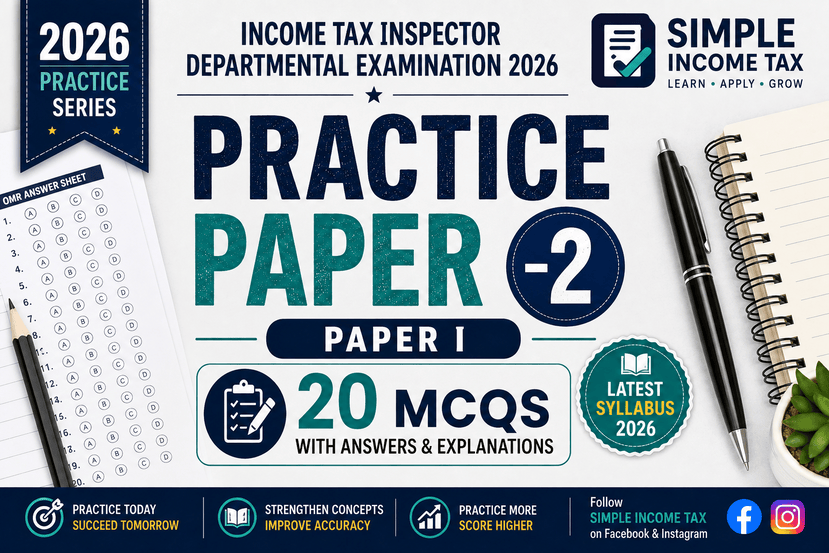

After completing Practice Paper-1, it’s time to take your preparation to the next level. Consistent practice is one of the most effective ways to improve accuracy, strengthen conceptual understanding, and build confidence for the Income Tax Inspector Departmental Examination. With this objective in mind, Simple Income Tax brings you Practice Paper-2, the next set of original practice questions prepared in accordance with the latest Departmental Examination Rules, 2026 and the current syllabus.
This Practice Paper contains 20 carefully designed multiple-choice questions (MCQs) covering important topics from Paper I. All questions are original and have been created exclusively for practice. They are different from the questions asked in the 2025 Departmental Examination and are intended to test your understanding of the subject, analytical ability, and examination readiness. Each question is followed by the correct answer and a detailed explanation to help you understand the concept and avoid common mistakes.
Attempt all the questions without referring to the answers first and evaluate your performance honestly. Regular practice through this series will not only strengthen your fundamentals but also improve your confidence and speed for the actual departmental examination.
1. Mr. X, a resident individual, owns two self-occupied residential houses during the Previous Year. Which of the following statements is correct?
a) Only one house can be treated as self-occupied.
b) Both houses may be treated as self-occupied, subject to the provisions of the Income Tax Act.
c) Both houses shall always be deemed to be let out.
d) Self-occupation is determined by the Assessing Officer irrespective of the Act.
Answer: (b)
Explanation:
The Income Tax Act permits an individual to claim the benefit of two self-occupied house properties, subject to the prescribed conditions.
2. Consider the following statements regarding deduction of tax at source (TDS):
Statement I: The liability to deduct tax arises only after actual payment in every case.
Statement II: In many provisions, tax is required to be deducted at the time of credit or payment, whichever is earlier.
Choose the correct option.
a) Both statements are true.
b) Both statements are false.
c) Statement I is false but Statement II is true.
d) Statement I is true but Statement II is false.
Answer: (c)
Explanation:
Several TDS provisions require deduction at the earlier of credit or payment. Therefore, actual payment is not always necessary before the obligation arises.
3. Which of the following best describes the purpose of the Annual Information Statement (AIS)?
a) To determine residential status.
b) To provide a comprehensive view of financial and tax-related information available with the Department.
c) To issue refunds automatically.
d) To calculate advance tax without taxpayer intervention.
Answer: (b)
Explanation:
AIS provides taxpayers with a consolidated view of financial transactions and tax-related information available with the Income Tax Department, enabling reconciliation while filing the return.
4. Mr. A receives dividend income from an Indian company during the Previous Year. Which statement is correct?
a) Dividend income is never taxable.
b) Dividend income is taxable according to the provisions of the Income Tax Act applicable for the relevant assessment year.
c) Dividend income is taxable only if it exceeds Rs. 10 lakh.
d) Dividend income is taxable only in the hands of companies.
Answer: (b)
Explanation:
The taxability of dividend income depends upon the provisions applicable for the relevant assessment year and the prevailing law.
5. Consider the following statements:
Statement I: Filing of an Income Tax Return promotes voluntary tax compliance.
Statement II: Filing of a return merely creates a tax liability.
Choose the correct option.
a) Both statements are true.
b) Both statements are false.
c) Statement I is true but Statement II is false.
d) Statement I is false but Statement II is true.
Answer: (c)
Explanation:
Return filing is a statutory compliance mechanism and supports voluntary compliance. Filing a return does not itself create a tax liability; taxability depends on the provisions of the Act.
6. Which of the following authorities administers the Income Tax Act, 1961?
a) Reserve Bank of India
b) Central Board of Direct Taxes
c) Comptroller and Auditor General of India
d) Ministry of Corporate Affairs
Answer: (b)
Explanation:
The Central Board of Direct Taxes (CBDT) is the apex body responsible for administration of the Income Tax Act and formulation of direct tax policies.
7. Mr. B discovers an error in the bank interest reported in his return after the expiry of the time permitted for filing a revised return. Which option may be available, subject to the provisions of the Act?
a) Ignore the omission permanently.
b) File an Updated Return, if eligible under the Income Tax Act.
c) File another Original Return.
d) Wait until scrutiny proceedings begin.
Answer: (b)
Explanation:
Where the statutory conditions are satisfied, an assessee may furnish an Updated Return within the time prescribed under the Act.
8. Which of the following best represents the objective of faceless tax administration?
a) To eliminate all assessments.
b) To increase physical interaction between taxpayers and tax authorities.
c) To promote transparency, efficiency and accountability through technology-driven processes.
d) To abolish electronic communication.
Answer: (c)
Explanation:
Faceless tax administration aims to minimize personal interface and improve transparency, efficiency and accountability through digital processes.
9. Consider the following statements:
Statement I: Every person whose total income exceeds the maximum amount not chargeable to tax is required to furnish a return unless otherwise exempt.
Statement II: Filing of return is governed only by administrative instructions and not by statutory provisions.
Choose the correct option.
a) Both statements are true.
b) Both statements are false.
c) Statement I is true but Statement II is false.
d) Statement I is false but Statement II is true.
Answer: (c)
Explanation:
The obligation to furnish a return is prescribed under the Income Tax Act. Administrative instructions cannot override statutory provisions.
10. Which of the following is the most appropriate objective of taxpayer services provided by the Income Tax Department?
a) To maximize litigation.
b) To ensure voluntary compliance through efficient, transparent and taxpayer-friendly services.
c) To reduce the number of taxpayers.
d) To eliminate electronic services.
Answer: (b)
Explanation:
Taxpayer services are intended to facilitate voluntary compliance by providing accessible, transparent and technology-enabled services while safeguarding taxpayers’ rights.
11. Consider the following statements regarding reassessment proceedings:
Statement I: A notice under the reassessment provisions can be issued only in accordance with the conditions prescribed under the Income Tax Act.
Statement II: Every case of mismatch in the Annual Information Statement (AIS) automatically results in reassessment.
Choose the correct option:
a) Both statements are true.
b) Both statements are false.
c) Statement I is true but Statement II is false.
d) Statement I is false but Statement II is true.
Answer: (c)
Explanation:
Reassessment can be initiated only after fulfilling the statutory conditions. An AIS mismatch alone does not automatically lead to reassessment; the prescribed legal requirements must also be satisfied.
12. A taxpayer has paid excess self-assessment tax due to a computation error while filing the return. What is the most appropriate remedy?
a) No remedy is available.
b) The excess amount may be claimed as a refund in accordance with the provisions of the Income Tax Act.
c) The amount automatically lapses to the Government.
d) The taxpayer should pay the same amount again in the next assessment year.
Answer: (b)
Explanation:
Where excess tax has been paid, the taxpayer may become entitled to a refund, subject to processing of the return and fulfillment of statutory conditions.
13. Which of the following statements correctly describes the role of the Annual Information Statement (AIS)?
a) It is the sole basis for completing an assessment.
b) It is an information tool that assists taxpayers in voluntary compliance.
c) It replaces the Income Tax Return.
d) It is prepared only after assessment is completed.
Answer: (b)
Explanation:
AIS is an informational statement that helps taxpayers verify financial transactions and correctly report income. It does not replace the return of income.
14. Consider the following statements:
Statement I: The Income Tax Department encourages electronic communication with taxpayers.
Statement II: A taxpayer should regularly verify communications received through the registered e-filing account, email and mobile number.
Choose the correct option:
a) Both statements are true.
b) Both statements are false.
c) Statement I is true but Statement II is false.
d) Statement I is false but Statement II is true.
Answer: (a)
Explanation:
The Department has adopted digital governance. Taxpayers should regularly monitor their registered communication channels to avoid missing statutory notices or important updates.
15. Which of the following best describes the objective of the Taxpayers’ Charter?
a) To increase tax rates.
b) To define reciprocal commitments between the Department and taxpayers.
c) To prescribe penalty provisions.
d) To determine residential status.
Answer: (b)
Explanation:
The Taxpayers’ Charter lays down the commitments of the Department towards taxpayers and also outlines the responsibilities expected from taxpayers.
16. Mr. A receives interest from a savings bank account and from fixed deposits during the Previous Year. Which statement is correct?
a) Both incomes are exempt.
b) Both incomes are generally chargeable under the head “Income from Other Sources,” subject to the provisions of the Act.
c) Savings bank interest is always taxable under the head “Salary.”
d) Fixed deposit interest is exempt if tax has been deducted at source.
Answer: (b)
Explanation:
Interest from savings accounts and fixed deposits is generally taxable under the head “Income from Other Sources.” Deduction of tax at source does not determine taxability.
17. Consider the following statements regarding PAN:
Statement I: A person can legally hold more than one PAN for different sources of income.
Statement II: Where more than one PAN has been allotted to the same person, the duplicate PAN should be surrendered in accordance with the prescribed procedure.
Choose the correct option:
a) Both statements are true.
b) Both statements are false.
c) Statement I is false but Statement II is true.
d) Statement I is true but Statement II is false.
Answer: (c)
Explanation:
A person should possess only one PAN. If multiple PANs are allotted inadvertently, the duplicate PAN should be surrendered as per the prescribed procedure.
18. Which of the following is the primary objective of e-filing of Income Tax Returns?
a) To eliminate assessment proceedings.
b) To facilitate efficient, transparent and paperless tax administration.
c) To increase litigation.
d) To replace the Income Tax Act.
Answer: (b)
Explanation:
Electronic filing enhances efficiency, transparency, speed and convenience in tax administration while reducing paperwork.
19. Consider the following statements:
Statement I: Deduction of tax at source is one of the methods of collection of Income Tax.
Statement II: Tax deducted at source is independent of the final tax liability of the taxpayer.
Choose the correct option:
a) Both statements are true.
b) Both statements are false.
c) Statement I is true but Statement II is false.
d) Statement I is false but Statement II is true.
Answer: (c)
Explanation:
TDS is a mechanism for collection of tax. The tax deducted is generally available as credit against the taxpayer’s final tax liability and is not independent of it.
20. Which of the following statements is correct regarding voluntary tax compliance?
a) It means paying tax only after receipt of a notice.
b) It includes timely filing of returns, payment of taxes and furnishing accurate information.
c) It is applicable only to business taxpayers.
d) It is relevant only during scrutiny assessment.
Answer: (b)
Explanation:
Voluntary compliance encompasses timely filing of returns, payment of taxes, maintenance of records, and providing complete and accurate information in accordance with the Income Tax Act.
Well done on completing Practice Paper-2! Every practice paper you solve brings you one step closer to success in the Income Tax Inspector Departmental Examination. Take a few minutes to review the explanations carefully, especially for the questions you answered incorrectly, as understanding your mistakes is the key to continuous improvement. If you found this practice paper helpful, continue your preparation with the next Practice Paper in this series and maintain a regular study schedule. Don’t forget to bookmark this page and share it with fellow aspirants so that they too can benefit from these practice questions. Simple Income Tax remains committed to providing quality study material to help you achieve your goal. Best wishes for your preparation and upcoming departmental examination!
Disclaimer
This Practice Paper has been prepared by Simple Income Tax solely for educational and self-assessment purposes. The questions, answers and explanations are original and based on the latest syllabus and relevant provisions available at the time of publication. This is not an official question paper or answer key issued by the Income Tax Department or any Government authority. Readers should refer to the latest official notifications, rules and instructions for authoritative guidance.
Related Article on Simple Income Tax
- ITI Departmental Examination 2025 (Paper I): Solved Previous Year Question Paper with Answers & Explanations (PART-1)
- ITI Departmental Examination 2025 (Paper I): Solved Previous Year Question Paper with Answers & Explanations (Part-2)
- ITI Departmental Examination 2025 (Paper I): Solved Previous Year Question Paper with Answers & Explanations (Part – 3)
- Income Tax Inspector Departmental Examination 2026: Paper I Practice Paper-1 (MCQs with Answers & Explanations)
Always refer official website of Income Tax Department
About the Author