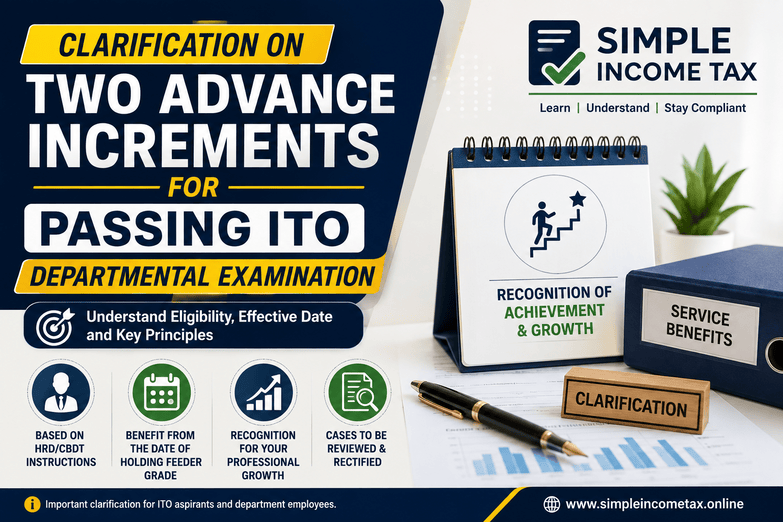

The Office of the Principal Chief Commissioner of Income Tax, Nagpur has issued an important clarification regarding the grant of two advance increments on passing the Departmental Examination for Income Tax Officer (ITO). The circular, dated 14 August 2026, addresses several practical issues that have arisen due to cadre restructuring and differing interpretations of earlier instructions.
The clarification, based on guidance received from the Directorate of Human Resource Development (HRD), CBDT, explains who is eligible for advance increments, from which date the benefit becomes admissible, and how cases involving promotion, reversion, or revised seniority should be dealt with.
This clarification is likely to have a significant impact on many officials who have qualified the ITO Departmental Examination in the past or are planning to appear for it in future.
Background of the Clarification
Over the years, the promotional hierarchy in the Income Tax Department has undergone restructuring. Consequently, doubts were being raised regarding the applicability of earlier HRD instructions issued in 1955, 1977 and 1996.
The Principal Chief Commissioner of Income Tax, Nagpur sought clarification from the Directorate of HRD on issues such as:
- Whether erstwhile Senior Tax Assistants (Sr. TA)/Office Superintendents (OS) who passed the ITO Departmental Examination are entitled to two advance increments.
- Whether officials who later reverted to a lower post can continue to claim the benefit.
- From which date the increments should actually be granted.
After examining the existing instructions, HRD clarified that the benefit has to be decided on the basis of the principle (ratio) contained in the earlier instructions rather than the old cadre nomenclature.
The Fundamental Principle Explained
The circular lays down a simple but important principle.
Two advance increments are admissible only when the departmental examination is prescribed for the employee’s immediate next higher promotional grade.
In other words:
- The examination should correspond to the next promotional post.
- The employee should already be holding the feeder grade for that promotional post.
- Merely passing the examination does not automatically create entitlement if the employee is still serving in a lower grade.
This clarification removes the confusion that existed because of earlier cadre restructuring.
Present Promotional Hierarchy
The circular specifically refers to the present hierarchy:
Senior Tax Assistant / Office Superintendent → Inspector of Income Tax (ITI) → Income Tax Officer (ITO)
Accordingly,
- Inspector of Income Tax (ITI) is the feeder grade for promotion as Income Tax Officer (ITO).
- Therefore, the ITO Departmental Examination is considered to be the examination prescribed for officials holding the grade of Inspector of Income Tax.
This clarification forms the basis for deciding eligibility.
Who is Eligible?
An official becomes eligible for two advance increments only if:
- he or she has passed the ITO Departmental Examination;
- he or she is holding the feeder grade of Inspector of Income Tax in accordance with law; and
- the examination is prescribed for the next higher promotional post from that feeder grade.
Thus, merely passing the examination while serving in another lower cadre does not create an immediate right to receive advance increments.
Who is Not Eligible Immediately?
The circular clearly states that an erstwhile Senior Tax Assistant or Office Superintendent who passes the ITO Departmental Examination while continuing in that grade is not immediately entitled to two advance increments because ITO is not the next higher promotional post from Sr. TA/OS.
However, the benefit is not lost permanently.
Instead, it remains deferred and becomes payable once the official legally enters the feeder grade of Inspector of Income Tax.
When Will the Benefit Actually Start?
One of the most important clarifications in the circular relates to the effective date.
The two advance increments will not commence from the date of passing the examination.
Instead, they become admissible from the date the official validly holds the grade of Inspector of Income Tax, which is the feeder grade for the ITO post.
This distinction is crucial because many officials were under the impression that increments become payable immediately after declaration of examination results. The circular expressly clarifies that this interpretation is not correct.
What Happens if Promotion is Revised Later?
Another practical issue addressed by HRD concerns cases where:
- seniority is revised later,
- promotion is modified retrospectively,
- an official is found not to have legally held the Inspector grade on the relevant date.
In such situations, eligibility has to be examined based on the grade actually held in law (de jure) on the date of passing the examination.
If the official legally held only the Sr. TA/OS grade on that date, advance increments cannot be granted until he or she subsequently acquires the Inspector grade in accordance with law.
Cases of Reversion
The clarification also deals with officials who passed the examination while serving as Inspectors but were subsequently reverted.
The entitlement has to be examined on the basis of the legal status of the officer and the applicable feeder grade principles.
The circular emphasizes that the ratio laid down by HRD should be uniformly applied while examining such cases.
Directions Issued to All Heads of Offices
The Principal Chief Commissioner has instructed all Heads of Offices to:
- review all cases relating to grant of two advance increments;
- specifically examine cases involving delayed or revised promotion to the feeder grade;
- verify correctness of earlier pay fixation;
- identify excess payments, wherever made contrary to the clarification;
- recover excess payment in accordance with applicable rules and instructions;
- take corrective action regarding pay fixation and consequential benefits.
A compliance report, wherever applicable, has also been called for within the prescribed timeline mentioned in the circular.
Practical Impact of the Circular
The clarification provides much-needed certainty regarding the interpretation of earlier HRD instructions.
Officials should carefully verify:
- the grade they legally held on the date of passing the examination;
- whether that grade was the feeder grade for ITO;
- the date from which they became Inspectors;
- whether earlier pay fixation requires correction.
Employees who have already received advance increments contrary to the clarified position may also find their cases reviewed by their respective offices.
Frequently Asked Questions (FAQs)
1. What is the recent clarification issued by the Principal Chief Commissioner of Income Tax, Nagpur?
The Office of the Principal Chief Commissioner of Income Tax, Nagpur has clarified the eligibility for grant of two advance increments to officials who pass the Income Tax Officer (ITO) Departmental Examination. The clarification explains the eligibility criteria, effective date of benefit, treatment of cases involving promotion, reversion and revised seniority, based on the guidance received from the Directorate of HRD, CBDT.
2. Why was this clarification required?
Several doubts had arisen after cadre restructuring regarding the applicability of earlier CBDT/HRD instructions issued in 1955, 1977 and 1996. The clarification removes ambiguity by reaffirming that eligibility is governed by the principle (ratio) of those instructions rather than the old cadre nomenclature.
3. What is the basic principle governing the grant of two advance increments?
The fundamental principle is that two advance increments are admissible only when the departmental examination is prescribed for the employee’s immediate next higher promotional post.
4. Does merely passing the ITO Departmental Examination make an employee eligible for advance increments?
No. Passing the examination alone does not confer an automatic right to receive two advance increments. The employee must also be holding the prescribed feeder grade for promotion to the post of Income Tax Officer.
5. Which is the feeder grade for promotion to Income Tax Officer (ITO)?
Under the present promotional hierarchy, the Inspector of Income Tax (ITI) is the feeder grade for promotion to the post of Income Tax Officer (ITO).
6. Are Senior Tax Assistants (STA) or Office Superintendents (OS) entitled to two advance increments immediately after passing the ITO Departmental Examination?
No. Since the next promotional post for Senior Tax Assistants/Office Superintendents is Inspector of Income Tax and not Income Tax Officer, they are not immediately eligible for two advance increments merely by passing the ITO Departmental Examination.
7. Will Senior Tax Assistants lose the benefit permanently if they pass the ITO Examination?
No. The benefit is only deferred, not denied. It becomes admissible once the official legally enters the feeder grade of Inspector of Income Tax, subject to the applicable rules.
8. From which date are the two advance increments admissible?
The benefit becomes admissible from the date the official legally holds the post of Inspector of Income Tax, and not from the date of passing the departmental examination.
9. Is the date of declaration of the examination result relevant for grant of increments?
The date of passing the examination is relevant only for determining qualification. The financial benefit is linked to the date on which the official legally occupies the feeder grade.
10. What happens if an employee is promoted to Inspector after passing the ITO Examination?
Once the employee legally becomes an Inspector of Income Tax, the eligibility for grant of two advance increments may arise in accordance with the applicable instructions and the clarification issued by HRD.
11. What if an employee’s promotion is revised retrospectively?
In such cases, eligibility has to be examined based on the grade legally held (de jure) on the relevant date. The competent authority will determine whether the employee satisfied the feeder-grade requirement.
12. What is meant by “de jure” in the clarification?
De jure means holding the post legally or by lawful authority, as distinguished from merely performing duties or holding charge.
13. What happens if an official is reverted after passing the examination?
The entitlement has to be examined based on the employee’s legal status and the applicable feeder-grade principles. Each case is to be considered in accordance with the HRD clarification.
14. Will the clarification affect officials who have already received advance increments?
Yes. Heads of Offices have been directed to review earlier cases. If advance increments were granted contrary to the clarified position, the cases may be re-examined and corrective action may be taken in accordance with the applicable rules.
15. Can excess payments be recovered?
The circular directs Heads of Offices to identify incorrect pay fixation and take appropriate action, including recovery of excess payments, wherever permissible under the applicable rules and government instructions.
16. What responsibilities have been assigned to Heads of Offices?
Heads of Offices have been instructed to:
- Review all cases relating to grant of advance increments.
- Verify correctness of pay fixation.
- Examine cases involving delayed or revised promotions.
- Rectify incorrect fixation, if any.
- Recover excess payments wherever required.
- Submit compliance reports as prescribed.
17. Does the clarification change the existing policy?
No. The clarification does not introduce a new policy. It explains how the existing HRD/CBDT instructions should be interpreted and applied under the present cadre structure.
18. Which earlier CBDT/HRD instructions have been relied upon?
The clarification refers to earlier instructions issued in:
- 24 July 1955
- 19 February 1977
- 23 February 1996
These instructions form the basis for applying the “immediate next promotional grade” principle.
19. Does this clarification apply only to Nagpur Region?
Although the clarification has been issued by the Office of the Principal Chief Commissioner of Income Tax, Nagpur, it is based on guidance received from the Directorate of Human Resource Development (HRD), CBDT. Officials in other regions may also find the clarification useful where similar issues arise, subject to instructions issued by their respective authorities.
20. What should employees do if they are unsure about their eligibility?
Employees should:
- Verify the post they legally held on the date of passing the examination.
- Check whether they were holding the feeder grade of Inspector of Income Tax.
- Review their promotion orders and pay fixation.
- Consult their Head of Office or administrative section for clarification wherever necessary.
Key Takeaways
- Passing the ITO Departmental Examination alone does not automatically entitle an employee to two advance increments.
- Eligibility depends upon the official holding the feeder grade of Inspector of Income Tax.
- The benefit is determined according to the functional principle (ratio) rather than old cadre nomenclature.
- Advance increments become payable from the date the official legally enters the feeder grade, not from the examination result date.
- Heads of Offices have been directed to review all existing cases and rectify incorrect pay fixation wherever necessary.
Conclusion
The clarification issued by the Principal Chief Commissioner of Income Tax, Nagpur brings welcome clarity to a long-standing issue concerning advance increments after passing the ITO Departmental Examination. By reaffirming the principle that the benefit is linked to the feeder grade rather than merely passing the examination, the circular promotes uniform implementation across offices.
Officials who have passed, or intend to appear for, the ITO Departmental Examination should understand that success in the examination is only one part of the eligibility criteria. The timing of holding the feeder grade plays an equally important role in determining when the financial benefit actually becomes admissible.
Disclaimer
This article is intended solely for educational and informational purposes. It is based on the clarification issued by the Office of the Principal Chief Commissioner of Income Tax, Nagpur dated 14 August 2026. Readers are advised to refer to the original circular and applicable departmental instructions before taking any decision or relying upon the contents of this article.
Visit Official website of Income Tax Department
About the Author