
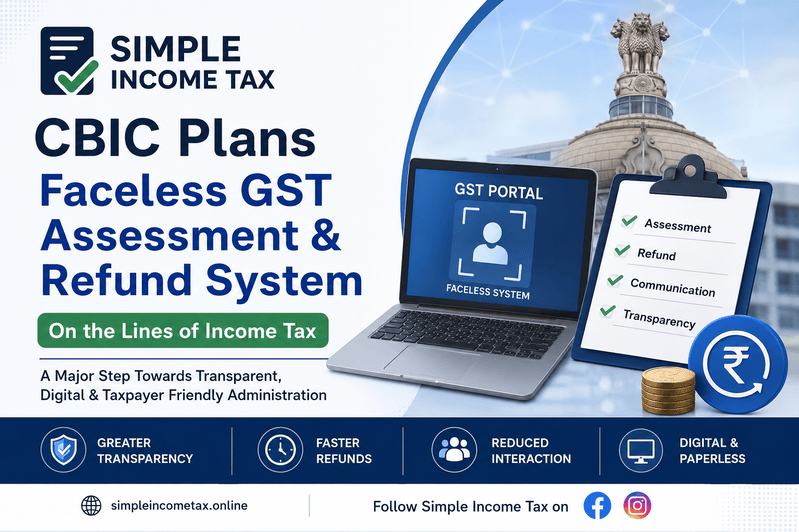

In a significant move towards digital tax administration, the Central Board of Indirect Taxes and Customs (CBIC) is reportedly working on a proposal to introduce a faceless GST assessment and refund mechanism, similar to the faceless system implemented in the Income Tax Department.
The proposal is aimed at reducing physical interaction between taxpayers and tax officers, promoting transparency, ensuring uniformity in decision-making and improving the ease of doing business in India.
Although no formal notification has yet been issued, reports indicate that the proposal is under active consideration as part of CBIC’s broader digital transformation strategy.
Why is CBIC Considering Faceless GST Assessment?
Since the introduction of GST in 2017, most compliance activities such as:
- GST Registration
- Return Filing
- Tax Payment
- E-way Bills
- E-Invoicing
have become almost completely digital.
However, several important functions still involve interaction with jurisdictional officers, including:
- GST scrutiny
- Assessments
- Refund verification
- Audit proceedings
- Clarification notices
CBIC believes that adopting a faceless model may further modernize tax administration by making these processes more objective and technology-driven.
What is a Faceless Assessment?
A faceless assessment is a system where:
- taxpayers do not physically visit the tax office,
- officers and taxpayers generally do not know each other’s identities during processing,
- communications are conducted electronically through an online portal,
- cases are allocated electronically based on automated systems, and
- decisions are passed digitally.
The Income Tax Department introduced faceless assessment to improve transparency and minimize discretionary interactions. CBIC is now exploring a similar framework for GST administration.
Proposed Areas Covered
According to reports, the proposed system may initially cover:
1. GST Assessments
Assessment proceedings may be handled digitally without requiring physical appearance before officers.
2. GST Refund Processing
Refund applications may be examined electronically by officers located anywhere in the country instead of only the jurisdictional office.
3. Online Communication
All notices, replies, documents and orders may be exchanged electronically through the GST portal.
Expected Benefits
1. Greater Transparency
Reduced personal interaction can minimize allegations of bias and improve taxpayer confidence.
2. Uniform Decision Making
Cases can be handled under standardized procedures leading to greater consistency across Commissionerates.
3. Faster Refunds
Centralized digital processing may reduce delays in sanctioning legitimate GST refunds.
4. Better Utilization of Officers
Cases can be distributed across different formations depending upon workload instead of being confined to a single jurisdiction.
5. Reduced Compliance Cost
Businesses may no longer need repeated physical visits to GST offices for routine proceedings.
6. Improved Ease of Doing Business
A transparent online system can enhance India’s tax administration framework and support investment.
Possible Challenges
While the proposal offers several advantages, experts also point out practical challenges:
Complex Investigations
Some GST matters involve verification of:
- physical stock,
- manufacturing activities,
- movement of goods,
- business premises,
- transport documents.
Such matters may still require jurisdictional officers.
Technical Infrastructure
The GST portal will require significant upgrades to support:
- digital allocation,
- document management,
- secure communication,
- video hearings (where required),
- automated workflows.
Training of Officers
Successful implementation will depend on proper training and standard operating procedures.
Natural Justice
The system must ensure:
- adequate opportunity of hearing,
- transparent communication,
- reasoned orders,
- effective grievance redressal.
Similar Reforms Already Being Considered
The proposed faceless GST assessment is part of a larger modernization exercise within CBIC.
Recent reports also indicate that CBIC has constituted a high-level working group to examine centralised GST administration for taxpayers having multiple GST registrations under one PAN, with the objective of simplifying compliance and improving ease of doing business.
Is the System Effective in Income Tax?
The Income Tax Department’s faceless initiatives significantly increased digital processing of assessments and appeals. While the system improved transparency and reduced physical interface, courts and stakeholders also highlighted areas requiring procedural safeguards, effective hearings and better communication.
These experiences are likely to help CBIC design a more balanced faceless GST framework.
Current Status
At present:
- No official notification has been issued introducing faceless GST assessments.
- The proposal is reportedly under examination by CBIC.
- Any implementation would require appropriate legal, procedural and technological changes before rollout.
Conclusion
The proposed faceless GST assessment and refund system represents another major step in India’s journey toward digital tax administration. If implemented effectively, it could reduce compliance burdens, improve transparency and ensure more uniform tax administration across the country.
However, balancing automation with taxpayer rights and practical realities of GST enforcement will be essential. Businesses should monitor official announcements from CBIC before making any compliance-related assumptions.
Frequently Asked Questions (FAQs)
Q1. Has CBIC officially launched faceless GST assessment?
No. As of now, CBIC is examining the proposal. No official notification has been issued.
Q2. Will GST refunds become faceless?
Reports suggest that GST refund processing may also become part of the proposed faceless framework.
Q3. Will taxpayers need to visit GST offices?
If implemented, most communications are expected to take place electronically through the GST portal.
Q4. Will this apply to all GST cases?
The final scope will depend on the framework notified by CBIC.
Q5. Why is CBIC planning this reform?
The objective is to improve transparency, reduce physical interaction, ensure uniformity and enhance ease of doing business.
Suggested Tags (comma separated):
CBIC, GST Assessment, Faceless GST Assessment, GST Refund, GST Refund System, GST News, GST Latest Update, Indirect Tax, Goods and Services Tax, CBIC Update, GST Compliance, Ease of Doing Business, Digital Tax Administration, GST Portal, Tax News India, Simple Income Tax
Source : (The Economic Times)
For more taxpayer-related updates, visit our dedicated Taxpayer’s News section where we regularly publish the important tax reforms, CBDT and CBIC updates, compliance guides and practical explanations.
About the Author




1 thought on “CBIC Plans Faceless GST Assessment & Refund System: What It Means for Businesses and Taxpayers”