
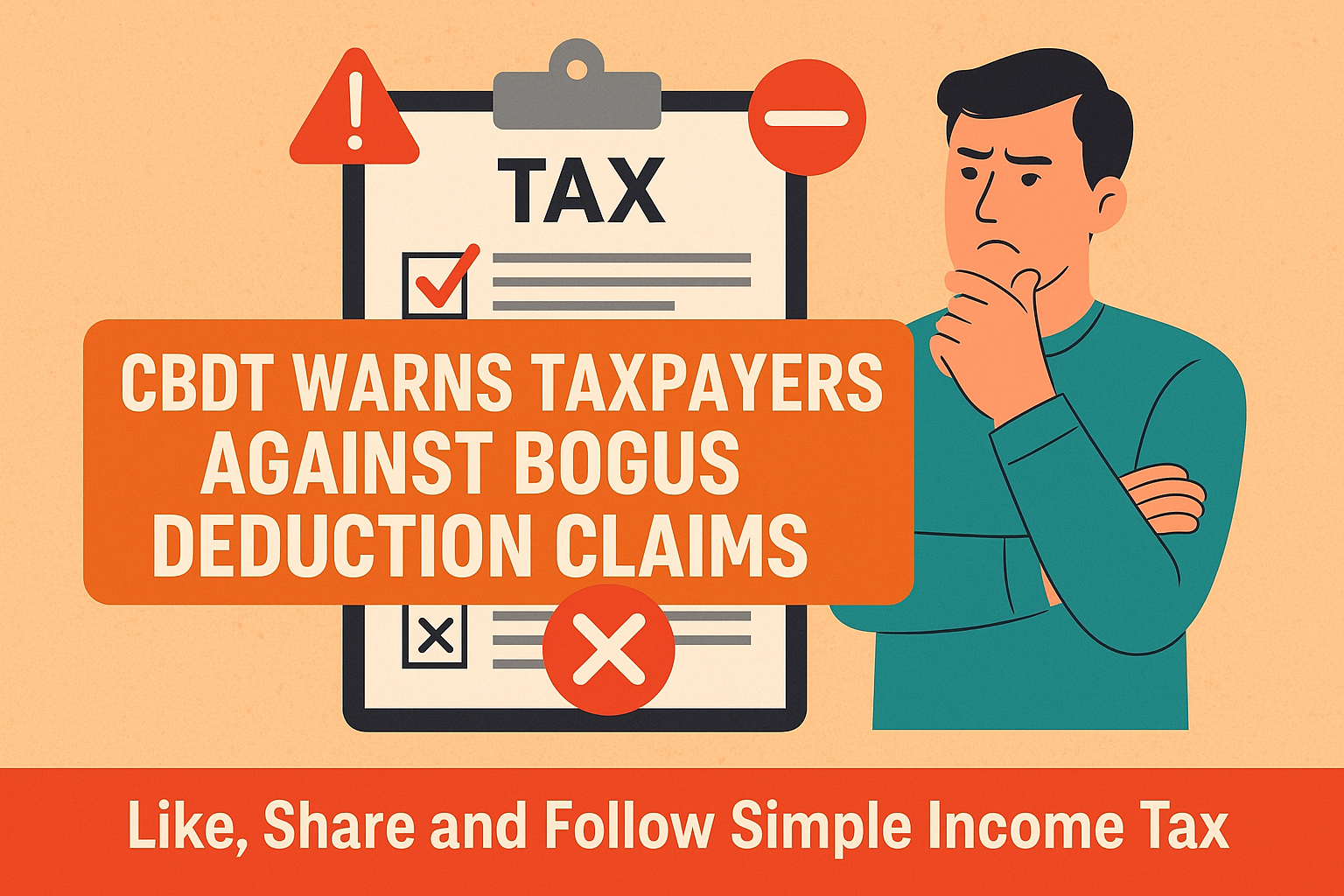
CBDT warns taxpayers against bogus claims

The Central Board of Direct Taxes (CBDT) has issued a strong advisory regarding bogus deduction claims and urged taxpayers to exercise caution while claiming deductions and exemptions in their Income Tax Returns (ITRs). The advisory follows investigations that uncovered widespread misuse of the Income Tax Act, 1961 through fraudulent deduction claims made with the assistance of certain intermediaries and return preparers.
According to the CBDT, some intermediaries have been filing Income Tax Returns containing fictitious deductions, fabricated donation claims and unsupported exemptions with the objective of obtaining higher refunds or reducing tax liability. In many cases, taxpayers were either unaware of the incorrect claims made in their returns or were persuaded to make such claims in exchange for promises of larger tax refunds.
The Department has emphasised that every taxpayer is ultimately responsible for the correctness of the information furnished in the Income Tax Return. Therefore, taxpayers should carefully verify all deductions and exemptions before filing their returns and preserve documentary evidence to support every claim.
Why Has CBDT Issued This Warning?
The Income Tax Department has significantly strengthened its technology-driven compliance framework over the last few years. Information received from banks, employers, financial institutions, reporting entities and various government agencies is now matched electronically with the information disclosed in Income Tax Returns.
Investigations conducted by the Department revealed organised networks of intermediaries operating across different parts of the country who were filing fraudulent returns by claiming bogus deductions and exemptions. Many such cases involved fabricated donation receipts, fictitious charitable contributions and unsupported political donations.
Further searches and enquiries conducted by the Department reportedly revealed incriminating evidence relating to bogus Corporate Social Responsibility (CSR) activities, fake donation receipts and entities allegedly being used for routing unaccounted funds through hawala transactions and cross-border remittances disguised as charitable donations.
The CBDT has clarified that strict enforcement action has already been initiated against such entities and individuals.
Common Types of Bogus Deduction Claims
Taxpayers should be aware of the deductions that are often misused. Some common examples include:
| Deduction | Common Incorrect Practice |
| Section 80G | Claiming donations without genuine receipts or donations made to ineligible institutions. |
| Section 80GGC | Claiming deduction for political contributions without satisfying the prescribed conditions or without actual payment. |
| Section 80C | Claiming investments that were never actually made. |
| Section 80D | Claiming health insurance deductions without making eligible premium payments. |
| HRA Exemption | Claiming rent payments despite residing in self-owned accommodation or without paying actual rent. |
Taxpayers should remember that every deduction claimed must satisfy the conditions prescribed under the Income Tax Act, 1961 and should be supported by proper documentary evidence.
Understanding Section 80G and Section 80GGC
Section 80G
Section 80G provides deduction for eligible donations made to specified charitable institutions, relief funds and approved organisations. However, the deduction is available only if the donation satisfies the conditions prescribed under the Act and is supported by valid documentary evidence.
Before claiming deduction under Section 80G, taxpayers should verify:
- Whether the institution is eligible for deduction.
- The percentage of deduction allowable.
- Availability of valid donation receipts.
- Compliance with payment conditions prescribed under the law.
Section 80GGC
Section 80GGC provides deduction in respect of contributions made by individuals to registered political parties or electoral trusts, subject to the conditions specified in the Income Tax Act.
The deduction is available only where the contribution is made through permissible banking channels and all statutory conditions are fulfilled. Unsupported or fictitious claims may attract verification by the Department.
How Does the Income Tax Department Detect Incorrect Deduction Claims?
The Income Tax Department now relies extensively on technology and data analytics to identify suspicious return filings.
Information is verified using multiple sources, including:
- Annual Information Statement (AIS)
- Form 26AS
- Employer reporting
- Banking information
- PAN-based reporting
- Information received from charitable institutions and reporting entities
- Risk-based data analytics
Any inconsistency between the deductions claimed and the information available with the Department may result in verification proceedings or notices seeking clarification.
CBDT’s Data-Driven Compliance Initiative
The CBDT has intensified its data-driven monitoring mechanism to identify high-risk deduction claims.
One such pattern has been noticed in returns claiming deductions under provisions such as Section 80G and Section 80GGC without adequate documentary support.
To encourage voluntary compliance, the Department launched a “NUDGE” campaign under which emails and SMS messages were issued to taxpayers reminding them to review their deduction claims and ensure correctness before any enforcement action becomes necessary.
This initiative reflects the Department’s increasing emphasis on taxpayer education alongside technology-driven compliance.
Practical Examples of Incorrect Claims
Example 1
A taxpayer claims deduction under Section 80G on the basis of a donation receipt issued by an institution that is not eligible for deduction.
Example 2
An intermediary files an Income Tax Return claiming a political donation under Section 80GGC without any actual contribution being made.
Example 3
A taxpayer signs and files the return without verifying the deductions entered by the tax consultant.
In all such situations, taxpayers may be required to explain the claim and produce supporting documents if called upon by the Department.
Consequences of Incorrect Deduction Claims
Claiming deductions without satisfying the legal conditions may have several consequences depending upon the facts of each case.
These may include:
- Disallowance of the deduction claimed.
- Additional tax liability.
- Levy of applicable interest under the Income Tax Act.
- Verification or scrutiny proceedings.
- Penalty wherever legally attracted.
- Delay in processing of refunds.
Taxpayers should therefore exercise due diligence while filing their returns.
How Taxpayers Can Avoid Such Issues
Before filing the Income Tax Return, every taxpayer should ensure the following:
✔ Verify all deductions claimed.
✔ Match information with Form 16, AIS and Form 26AS.
✔ Preserve original receipts and supporting documents.
✔ Confirm the eligibility of charitable institutions before claiming deduction.
✔ Avoid relying solely on intermediaries without reviewing the return.
✔ Read the completed Income Tax Return carefully before submitting it.
✔ File a revised or updated return, wherever permissible, if any genuine mistake is discovered.
CBDT’s Advisory to Taxpayers
The CBDT has advised taxpayers to keep their registered mobile number and email address updated with the Income Tax Department so that important communications are not missed.
Taxpayers have also been encouraged to obtain information only from authentic sources and refer to the official Income Tax Department portal for updates relating to deductions, filing requirements and Updated Returns.
Our Analysis
The latest advisory demonstrates the Income Tax Department’s growing reliance on technology-driven compliance and risk-based verification. With the availability of extensive third-party information and advanced data analytics, unsupported deduction claims are increasingly likely to be detected during processing or subsequent verification.
Taxpayers should therefore treat Income Tax Return filing as an important compliance exercise rather than a routine annual formality. Every deduction or exemption should be claimed only after ensuring that all statutory conditions are fulfilled and proper documentary evidence is available.
Careful review of the return before filing can help taxpayers avoid unnecessary notices, disputes and delays in processing refunds.
Frequently Asked Questions (FAQs)
1. What is a bogus deduction claim?
A bogus deduction claim refers to claiming a deduction or exemption without satisfying the legal conditions or without possessing valid supporting documents.
2. Can the Income Tax Department verify deductions claimed in my ITR?
Yes. The Department uses data received from various reporting entities, AIS, Form 26AS and other information systems to verify return disclosures.
3. Can I claim a deduction without a receipt?
Generally, deductions should be supported by appropriate documentary evidence. Taxpayers should preserve receipts and other supporting records wherever required under the law.
4. What should I do if I discover an incorrect deduction after filing my return?
If permissible under the Income Tax Act, you should consider filing a revised or updated return after evaluating the facts of your case.
5. Am I responsible if my tax consultant filed the return incorrectly?
Yes. The taxpayer remains responsible for the correctness of the Income Tax Return submitted in their name. Therefore, the return should always be reviewed before filing.
Conclusion
The CBDT’s advisory serves as an important reminder that deductions and exemptions should be claimed only after verifying eligibility and maintaining proper supporting documentation. As the Income Tax Department increasingly relies on technology and data analytics for return verification, taxpayers should exercise greater caution while filing their Income Tax Returns.
Accurate return filing, proper record keeping and reliance on authentic information remain the best safeguards against unnecessary disputes and compliance issues.
Related Article on Simple Income Tax
Common Income Tax Mistakes Every Taxpayer Should Avoid
Readers may refer to the relevant provisions of the Income Tax Act, 2025, CBDT notifications, rules and circulars available on the official Income Tax Department website for the latest amendments and procedural guidance.
About the Author



1 thought on “Bogus Deduction Claims – CBDT Warns Taxpayers”