
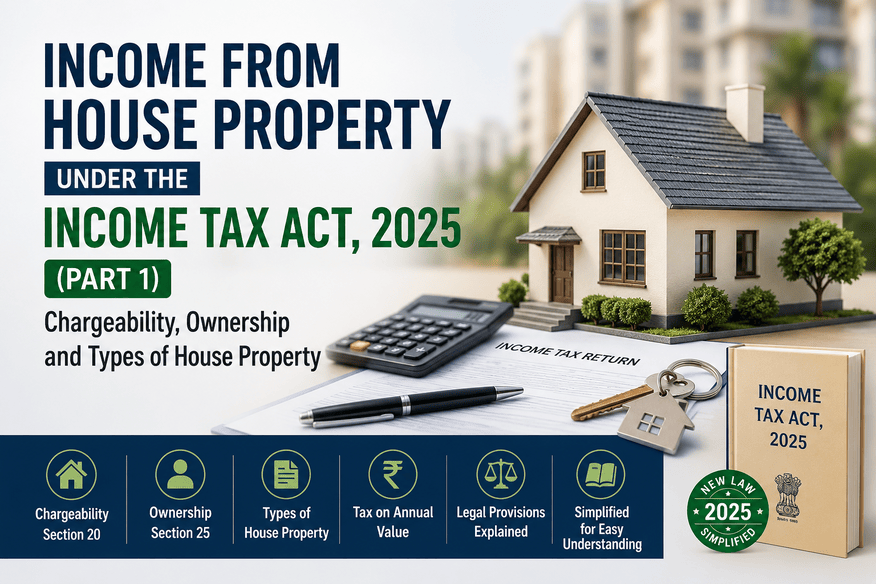

Income from House Property is one of the five heads of income under the Income Tax Act, 2025. Although many taxpayers assume that only rent actually received is taxable, the law taxes the annual value of certain properties owned by a taxpayer, irrespective of the actual rent received in some cases.
The Income Tax Act, 2025 has retained the basic principles of taxation under this head while reorganising and simplifying the provisions. Understanding these provisions is essential for every homeowner, landlord, co-owner, and investor in real estate.
In this first part of our comprehensive series, we discuss the scope of taxation, chargeability, ownership, and the types of properties covered under the Income Tax Act, 2025.
Mapping Provisions
| Section under the Income Tax Act, 2025 | Corresponding Section under the Income-tax Act, 1961 | Subject Matter |
| Section 20 | Section 22 | Income from House Property – Chargeability |
| Section 21 | Section 23 | Determination of Annual Value |
| Section 22(1) | Section 24(a) | Standard Deduction (30% of Net Annual Value) |
| Section 22(2) | Section 24(b) | Deduction for Interest on Borrowed Capital |
| Section 23 | Section 25A | Arrears of Rent and Unrealised Rent Received Subsequently |
| Section 24 | Section 26 | Property Owned by Co-owners |
| Section 25 | Section 27 | Interpretation – Meaning of Owner and Deemed Owner |
What is Income from House Property?
Income from House Property refers to income arising from the ownership of a building or land attached to such building. The tax is levied not merely because rent is received, but because the taxpayer owns property capable of generating income.
Thus, even where no rent is actually received, income may still be taxable depending upon the statutory provisions governing annual value.
Chargeability under Section 20 of the Income Tax Act, 2025
Section 20 provides that the annual value of property consisting of any building or lands appurtenant thereto shall be chargeable to income tax under the head “Income from House Property”, provided certain conditions are satisfied.
However, where the property is occupied by the owner for the purposes of any business or profession carried on by him and the profits of such business or profession are chargeable to tax, such property is excluded from taxation under this head.
The provision substantially corresponds to Section 22 of the Income-tax Act, 1961, with simplified legislative drafting.
Essential Conditions for Taxability
For income to be taxable under this head, all the following conditions should generally be satisfied:
1. There must be a building
The property should consist of a building.
Examples include:
- Residential house
- Flat
- Apartment
- Office building
- Factory building
- Shop
- Warehouse
- Commercial complex
- Godown
A building may be residential or commercial.
2. Land must be appurtenant to the building
The land attached to and forming part of the enjoyment of the building is also covered.
Examples include:
- Garden
- Courtyard
- Parking area
- Compound
- Driveway
- Open space surrounding the building
However, vacant land not attached to any building is generally not assessed under this head.
3. The taxpayer must be the owner
Tax under this head is based on ownership, not possession.
Therefore:
✔ A tenant is not taxable under this head.
✔ A caretaker is not taxable.
✔ A licence holder is not taxable.
The owner of the property is liable to tax, subject to the provisions relating to deemed ownership.
4. The property should not be used by the owner for his own taxable business or profession
If the owner occupies the property for carrying on his own business or profession, and the income from such business is taxable, the property is excluded from taxation under the head “Income from House Property.”
For example, a doctor using his own clinic building for his medical practice would not compute income from that property under this head.
Meaning of Building
The Act does not define “building” exhaustively. In common understanding, it refers to a permanent structure constructed for residential, commercial, industrial, institutional, or other lawful purposes.
Examples include:
- House
- Flat
- Office
- Shopping complex
- Factory
- Hotel building
- Cinema hall
- School building
- Hospital building
Temporary sheds or movable structures may require examination of facts and judicial principles to determine whether they qualify as buildings.
What is Land Appurtenant?
The expression “land appurtenant thereto” refers to land that is attached to and necessary for the beneficial enjoyment of the building.
Examples include:
- Garden attached to a bungalow
- Internal roads
- Parking spaces
- Compound wall area
- Children’s play area within the premises
Agricultural land situated separately from the building is not covered merely because the owner also owns the building.
Who is an Owner?
Ownership under the Income Tax Act is wider than mere registration in some situations. Courts have recognised that beneficial ownership may be relevant in determining liability under this head.
Generally, the owner is the person who is entitled to receive income from the property in his own right.
Deemed Owner
The Act also recognises certain persons as deemed owners in specified situations. These provisions prevent tax avoidance by transferring legal ownership while retaining beneficial enjoyment.
Examples include certain transfers without adequate consideration and other situations specifically recognised by law.
A detailed discussion on deemed ownership, judicial precedents, and practical scenarios will be covered separately in a dedicated article because of its importance.
Property Used for Own Business
One important exception is where the owner uses the property for carrying on his own business or profession.
Examples:
✔ A chartered accountant uses his own office.
✔ A doctor runs his clinic from his own building.
✔ A trader uses his own godown for storing stock.
Since the business income is taxable under the head Profits and Gains of Business or Profession, the same property is not taxed again under the head Income from House Property.
Properties Covered Under This Head
The following properties generally fall under this head:
- Residential house
- Independent bungalow
- Apartment
- Office premises
- Commercial complex
- Shop
- Warehouse
- Factory building (if not used by owner for own business)
- Guest house (subject to applicable provisions)
- Let-out portion of a building
Properties Generally Not Covered
The following are generally outside the scope of this head:
- Vacant land without any building
- Agricultural land
- Property used for owner’s own taxable business or profession
- Property held merely as stock-in-trade (subject to specific provisions governing annual value, discussed in later parts)
Practical Illustrations
Illustration 1
Mr. A owns a residential flat and lets it out for Rs. 25,000 per month.
The income will be computed under the head Income from House Property.
Illustration 2
Mrs. B owns a commercial office and uses it for her own architectural practice.
The property will not be assessed under this head because it is occupied for her own profession.
Illustration 3
Mr. C owns a warehouse but leases it to another company.
The annual value of the property will generally be taxable under the head Income from House Property, subject to the specific facts and applicable provisions.
Illustration 4
Mr. D owns only an open plot of land without any building.
Income arising from such land is generally not taxable under this head merely because the land is owned by him.
Common Misconceptions
Misconceptions : Only rented houses are taxable.
Reality: Even self-occupied or vacant properties may require consideration under the statutory scheme relating to annual value.
Misconceptions : Only residential houses are covered.
Reality: Commercial buildings are also covered.
Misconceptions : Registration alone always decides ownership.
Reality: In certain situations, beneficial ownership and deemed ownership provisions may become relevant.
Misconceptions : Every property owned is taxed under this head.
Reality: Properties used for the owner’s own taxable business or profession are excluded.
Key Takeaways
- Income from House Property is based primarily on ownership.
- Both residential and commercial buildings may be taxable.
- Land attached to the building is also covered.
- Property used for the owner’s own business or profession is generally excluded.
- The concept of annual value forms the basis of taxation and will be discussed in the next part.
- Deemed ownership provisions play an important role in determining tax liability.
Frequently Asked Questions
1. Is actual rent always necessary for taxation under this head?
No. The law taxes the annual value of the property in accordance with the statutory provisions.
2. Is commercial property covered?
Yes. Both residential and commercial buildings may be covered.
3. Is agricultural land taxable under this head?
No. Agricultural land by itself is not covered under “Income from House Property.”
4. Can a tenant be taxed under this head?
No. Liability generally arises on the owner or deemed owner.
5. Is a vacant plot taxable under this head?
A vacant plot without a building is generally outside the scope of this head.
Conclusion
The taxation of house property under the Income Tax Act, 2025 begins with a simple but important principle—ownership of a building. Whether the property is residential or commercial, self-occupied or let out, understanding the scope of Section 20 is the first step towards accurate tax computation. Equally important is recognising the exceptions, particularly where a property is used for the owner’s own business or profession.
Suggested Article on Simple Income Tax
Departmental Examination 2026 Study Materials
Visit Official website of Income Tax Department
About the Author




2 thoughts on “Income from House Property Under the Income Tax Act, 2025 (Part 1): Chargeability, Ownership and Types of House Property”