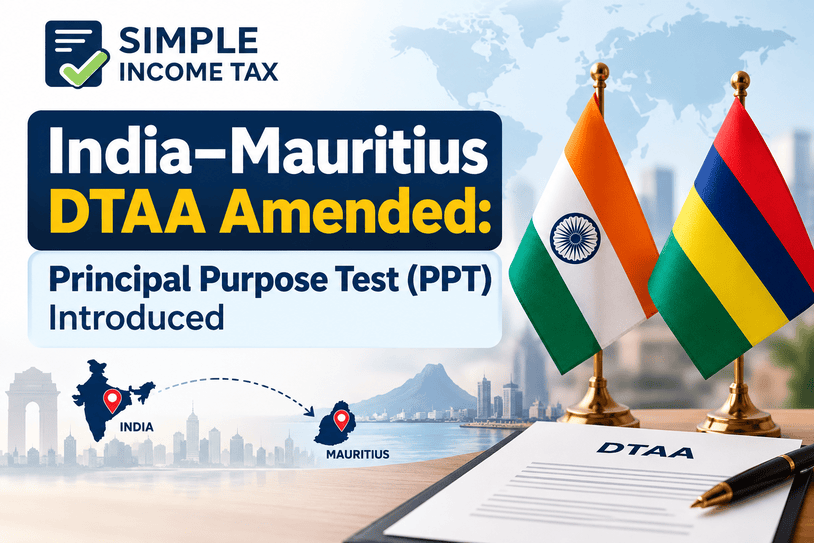

The India–Mauritius DTAA Principal Purpose Test (PPT) has been introduced through an important amendment to the India–Mauritius Double Taxation Avoidance Agreement (DTAA), marking a significant step in India’s efforts to prevent tax treaty abuse and strengthen international tax compliance. The amendment empowers tax authorities to deny treaty benefits where obtaining such benefits is one of the principal purposes of an arrangement lacking genuine commercial substance. At the same time, the revised treaty continues to protect legitimate cross-border investments and aligns India’s tax framework with the OECD Base Erosion and Profit Shifting (BEPS) Project, reinforcing transparency and fairness in international taxation.
What is the India–Mauritius DTAA?
The Double Taxation Avoidance Agreement (DTAA) between India and Mauritius is a tax treaty that prevents the same income from being taxed in both countries.
The treaty also provides certainty regarding taxation of:
- Capital gains
- Dividend income
- Interest income
- Royalty
- Fees for technical services
- Business profits
For several years, Mauritius has been one of the preferred jurisdictions for foreign investment into India because of the benefits available under this treaty.
What is the Principal Purpose Test (PPT)?
The Principal Purpose Test (PPT) is an anti-abuse rule.
It provides that treaty benefits may be denied if obtaining those benefits was one of the principal purposes of an arrangement or transaction, unless granting such benefits is consistent with the object and purpose of the treaty.
In simple words,
If an arrangement is created mainly to save tax without having genuine commercial reasons, tax authorities may refuse treaty benefits.
Why Has the PPT Been Introduced?
The amendment has been introduced to:
- Prevent treaty shopping.
- Discourage artificial tax structures.
- Promote genuine foreign investment.
- Align Indian tax treaties with international anti-avoidance standards.
- Implement India’s commitments under the OECD BEPS framework.
What is Treaty Shopping?
Treaty shopping occurs when a person establishes a company in another country mainly to claim tax treaty benefits without carrying out genuine business activities there.
For example,
A company from Country A forms a shell company in Mauritius only to avail tax benefits under the India–Mauritius DTAA.
If the company has no real commercial substance and its principal purpose is merely obtaining treaty benefits, the PPT may deny such benefits.
How Does the PPT Work?
While examining a transaction, tax authorities may consider factors such as:
- Commercial substance of the arrangement.
- Business purpose.
- Economic activity.
- Nature of investments.
- Whether tax benefit was one of the principal purposes.
If the arrangement appears artificial, treaty benefits may be denied.
Does PPT Affect Genuine Investors?
No.
The objective is not to deny benefits to genuine investors or businesses.
Businesses having real commercial operations and legitimate investment objectives should normally continue to receive treaty benefits, provided the arrangement is consistent with the purpose of the treaty.
Relation with India’s Anti-Avoidance Framework
India already has several anti-avoidance measures, including:
- General Anti-Avoidance Rules (GAAR)
- Specific Anti-Avoidance Rules (SAAR)
- Beneficial ownership provisions
- Transfer pricing regulations
- Economic substance requirements
The PPT further strengthens this framework in relation to international tax treaties.
Impact on Tax Planning
Businesses using treaty jurisdictions should now carefully evaluate whether their structures have:
- Genuine commercial purpose.
- Adequate economic substance.
- Real business activities.
- Proper documentation.
Merely creating entities to obtain tax benefits may no longer be sufficient.
Impact on Existing Investments
The amendment is expected to apply prospectively in accordance with the terms of the treaty and related notifications.
Investors should review existing structures to ensure continued compliance with the revised treaty provisions.
Key Takeaways
- India has introduced the Principal Purpose Test (PPT) in the India–Mauritius DTAA.
- PPT is an internationally accepted anti-tax avoidance rule.
- Treaty benefits can be denied where obtaining tax benefits is one of the principal purposes of an arrangement.
- Genuine commercial transactions remain protected.
- Businesses and investors should review cross-border structures for adequate commercial substance.
Conclusion
The introduction of the Principal Purpose Test represents another important milestone in India’s evolving international tax regime. Rather than targeting genuine investment, the amendment seeks to ensure that treaty benefits are available only where transactions have real commercial substance and are consistent with the objectives of the tax treaty.
Taxpayers, multinational enterprises, tax professionals and foreign investors should review their cross-border arrangements to ensure that their investment structures remain commercially justifiable and compliant with the revised treaty provisions.
Frequently Asked Questions (FAQs)
Q1. What is the Principal Purpose Test (PPT)?
It is an anti-abuse rule that allows tax authorities to deny treaty benefits if obtaining those benefits was one of the principal purposes of an arrangement.
Q2. Does PPT affect all taxpayers?
No. It primarily affects arrangements created mainly to obtain treaty benefits without genuine commercial substance.
Q3. Is PPT applicable only to the India–Mauritius DTAA?
No. Similar provisions are being incorporated into several of India’s tax treaties to align with international anti-avoidance standards.
Q4. Is treaty shopping permitted after the amendment?
Artificial treaty shopping intended primarily to obtain tax benefits may be denied under the PPT.
Related Article in Simple Income Tax
NCERT Introduces Personal Income Tax in Class 9
Delhi High Court Sets Aside 7 ITAT Orders in Patanjali Tax Case: What Taxpayers Should Know
Source
Double Taxation Avoidance Agreements
India notifies amended tax treaty with Mauritius, introduces principal purpose test
About the Author