
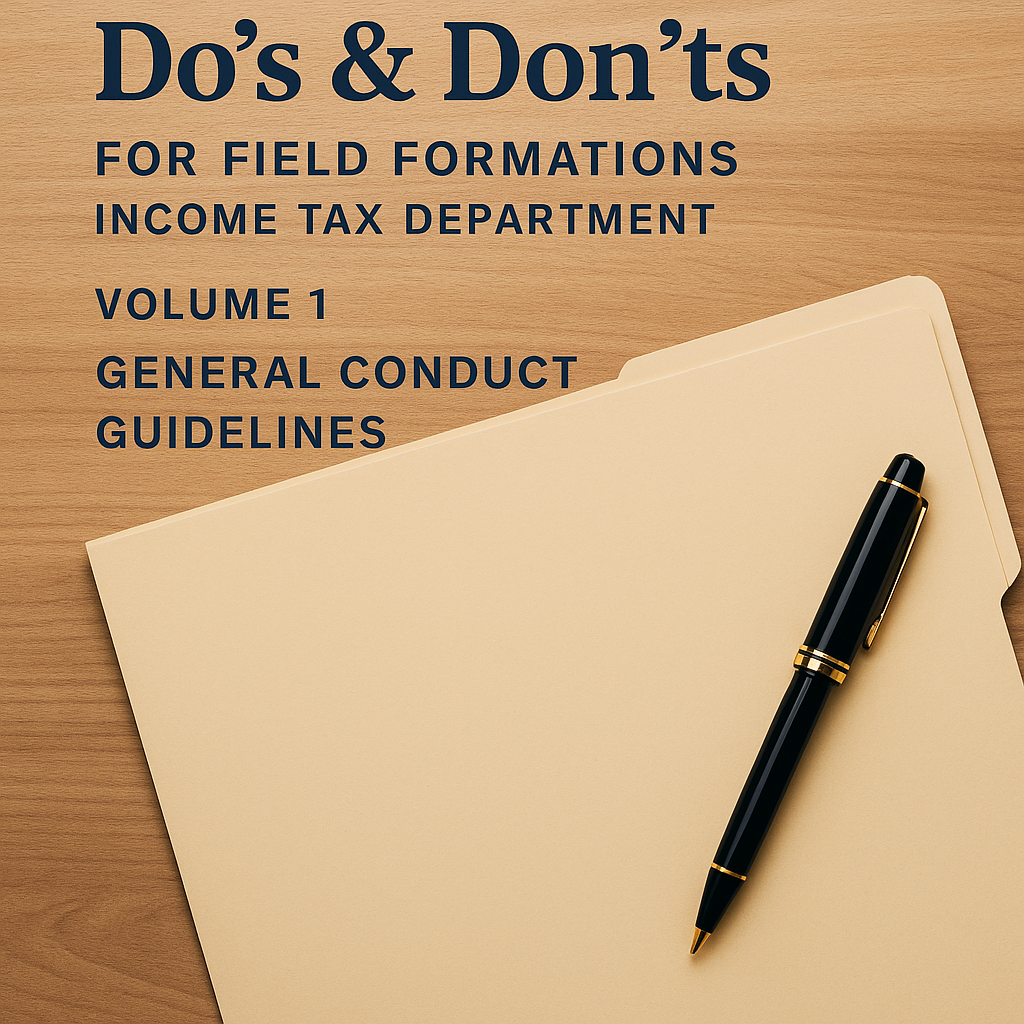

General Conduct Guidelines for Income Tax Department Officers & Staff
The Central Board of Direct Taxes (CBDT) as the apex body for direct tax administration in India periodically issues instructions and handbooks to ensure that officers of the Income Tax Department maintain the highest standards of professionalism and integrity.
One of its most practical and insightful documents is the “Handbook of Do’s & Don’ts for Field Formations.” It is a ready reference for officers and staff, reminding them that every action performed in service – however routine – carries a public trust.
This first volume of our series summarizes the General Conduct Guidelines from the handbook. It explains what every public servant should do and what they must avoid to preserve transparency, efficiency, and ethical governance.
✅ SECTION I — DO’S: RECOMMENDED PRACTICES
The “Do’s” section of the CBDT handbook defines how an officer should act, behave, and think while performing official duties. These are not just administrative norms—they form the ethical DNA of civil service.
1. Embrace Your Role as a Public Servant
Remember that your employment is funded by public money. Every task you perform should reflect honesty, accountability and service orientation.
Your behaviour must align with laws such as the Prevention of Corruption Act, 1988 and the Bharatiya Nyaya Sanhita 2024 both of which emphasize fairness and propriety in public conduct. Contribute meaningfully to your office’s vision, mission and objectives ensuring impartial decisions and ethical leadership.
2. Maintain a Positive Public Image
You are the face of the department. Whether interacting with taxpayers, colleagues or the general public, be polite, honest, and fair. A respectful attitude and a transparent approach foster trust, reduce complaints and enhance departmental reputation.
3. Practice Fairness and Courtesy
Equality before the law must translate into fairness in every administrative action. Treat the public, seniors and subordinates alike -with dignity and patience. Courtesy should never be mistaken for weakness; it reflects inner strength and professionalism.
4. Uphold Integrity and Transparency
Integrity is your most valuable asset. Let every decision be guided by conscience and logic.
Maintain clear and reasoned notings in files to make the decision-making trail transparent for audit and vigilance review.
5. Seek Permissions Promptly
Before leaving headquarters or taking up any assignment outside office, obtain prior approval from your controlling officer. Keeping your superiors informed ensures administrative control and accountability.
6. Think Before You Act – But Act When Required
Thoughtful reflection avoids errors, but decisive execution ensures progress. Balance analysis with action.
7. Admit and Learn from Mistakes
Perfection is desirable but learning from imperfection is invaluable. Admit errors gracefully, correct them and move forward.
8. Follow Instructions Faithfully
Comply with written and oral instructions from superiors in both letter and spirit. Diligent implementation builds reliability.
9. Stay Within Legal Boundaries
Avoid any act prohibited by law – be it accepting illegal gratification, involvement in dowry, gambling, or substance abuse. Compliance with statutory and departmental rules shields you from disciplinary consequences.
10. Handle Financial Matters Prudently
Avoid borrowing or lending money to individuals who have official dealings with you. Financial independence safeguards impartiality.
11. Submit Genuine Claims Only
Ensure correctness in all claims – medical, LTC, TA/DA or reimbursement. False or inflated bills can lead to serious disciplinary and legal action.
12. Demonstrate Punctuality and Preparedness
Respect official timings, respond to letters and calls promptly and come to meetings prepared. Timeliness builds confidence.
13. Foster a Positive Work Culture
Encourage teamwork, guide juniors and appreciate good work. Mutual respect and motivation improve performance.
14. Promote Transparency and Vigilance Awareness
Be fair and consistent in your official dealings. A vigilance-friendly environment begins with individual integrity.
15. Maintain Confidentiality and Secure Documents
Handle sensitive information carefully. Seal confidential files properly, prevent unauthorized access and maintain a record of transfers or handovers.
16. Observe IT Security Protocols
Use only licensed software and official networks. Protect your passwords and follow data-safety measures prescribed by the Directorate of Systems.
17. Keep Your Workspace Organized
A clean and orderly workstation promotes efficiency and conveys professionalism.
18. Keep Personal Records Updated
Inform the department promptly of any change in address, marital status, or family details for administrative accuracy.
19. Submit APARs Timely
Timely completion of Annual Performance Appraisal Reports (APARs) – both self and subordinate—is a key responsibility reflecting discipline and leadership.
🚫 SECTION II — DON’TS: PRACTICES TO AVOID
While the “Do’s” define desired conduct, the “Don’ts” act as guardrails. They warn against behaviours that can damage credibility, violate rules or invite disciplinary action.
1. Don’t Neglect Duties
Casual or careless attitude towards work can harm departmental efficiency. Perform each assignment sincerely.
2. Don’t Make Arbitrary Decisions
Unrecorded or illogical decisions raise questions of bias or favouritism. Always document reasoning.
3. Don’t Depend Excessively on Others
Consultation is healthy but blind reliance on colleagues for judgment or responsibility can lead to errors. Exercise independent thinking.
4. Don’t Mix Personal Interests with Official Work
Keep friendships, family ties or financial interests away from official dealings to avoid conflicts of interest.
5. Don’t Circumvent Rules
Rules exist to protect both the public and the officer. Following them is the simplest form of self-protection.
6. Don’t Live Beyond Your Means
Maintain a lifestyle proportionate to your known income. Unexplained wealth invites suspicion and possible vigilance scrutiny.
7. Don’t Disclose Unauthorized Information
Official information is confidential. Sharing it with outsiders can jeopardize investigations and breach the Official Secrets Act.
8. Don’t Falsify or Back-Date Documents
Signing documents with incorrect dates or fabricating information undermines legal validity and may attract prosecution.
9. Don’t Accept Favours or Gifts
Refuse gifts, hospitality, or obligations from taxpayers, contractors, or subordinates. Even small favours can imply bias.
10. Don’t Submit False or Inflated Claims
Never falsify TA, medical, hotel or LTC claims. CBDT treats such misconduct with zero tolerance.
11. Don’t Be Habitually Late or Absent
Frequent late coming or unauthorized absence disrupts workflow and invites disciplinary action.
12. Don’t Participate in Disruptive Activities
Avoid demonstrations or group actions that disturb office harmony. Grievances must be addressed through proper channels.
13. Don’t Misuse Departmental Property
Office vehicles, telephones and computers are public assets – use them judiciously and for official purposes only.
14. Don’t Ignore Thefts or Losses
Immediately report theft, pilferage or damage to government property. Delays can imply negligence or complicity.
15. Don’t Waste Time Online
Restrict personal social-media or browsing activities during office hours. Time management reflects professionalism.
16. Don’t Pursue Litigation Prematurely
Use the CBDT Grievance Redressal Mechanism first. Litigation should be the last resort not the first step.
17. Don’t Be Careless with Official Deliveries
Reject tampered or open envelopes. Reporting such incidents protects departmental security.
18. Don’t Exceed Your Authority
Stick to your delegated powers. If unavoidable, seek post-facto approval immediately with proper justification.
19. Don’t Delay Meeting Records
Minutes of official meetings must be drafted and circulated within 48 hours to ensure accountability and institutional memory.
20. Don’t Ignore Ethical Obligations
Integrity once lost is difficult to regain. Uphold the dignity of your position through consistent ethical behaviour.
Conclusion
The General Conduct Guidelines form the cornerstone of professional life in the Income Tax Department. They are not merely rules but a philosophy of service – balancing authority with humility, power with responsibility and decision-making with fairness.
By practising these Do’s and avoiding the Don’ts, officers contribute to:
- Building public confidence in tax administration,
- Maintaining internal harmony and discipline, and
- Upholding the honour of the department.
In the next part of this series — Volume 2, we will cover DOS AND DONTS FOR FIELD FORMATION “SEARCH ASSESSMENTS”
About the Author



3 thoughts on “Do’s & Don’ts for Field Formations (Income Tax Department) – Volume 1”