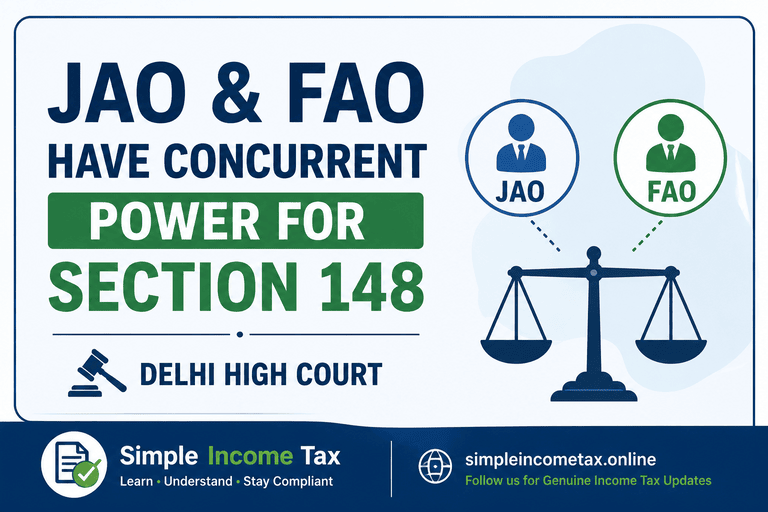

The Delhi High Court has once again reaffirmed an important legal position concerning reassessment proceedings under the Income Tax Act, 1961. In a recent judgment, the Court held that both the Jurisdictional Assessing Officer (JAO) and the Faceless Assessing Officer (FAO) possess concurrent jurisdiction to initiate reassessment proceedings by issuing notices under Section 148. JAO & FAO Have Concurrent Power for Section 148
The ruling is significant because it addresses a controversy that has led to numerous writ petitions across different High Courts after the implementation of the faceless reassessment scheme.
Background of the Dispute
The Finance Act, 2021 introduced a new reassessment framework under Sections 147 to 151 of the Income Tax Act, 1961. Subsequently, the CBDT notified the E-Assessment of Income Escaping Assessment Scheme, 2022 under Section 151A, which introduced automated allocation and faceless reassessment.
Following these changes, taxpayers questioned whether only the Faceless Assessing Officer had the authority to issue notices under Section 148 or whether the Jurisdictional Assessing Officer continued to possess such powers.
Different High Courts expressed differing opinions, resulting in uncertainty on the issue. (Delhi High Court)
What Was Before the Delhi High Court?
The petitioners challenged reassessment notices issued by the Jurisdictional Assessing Officer. Their principal contention was that once the faceless reassessment scheme became operational, only the Faceless Assessing Officer could issue notices under Section 148.
According to the petitioners, notices issued by the Jurisdictional Assessing Officer were without jurisdiction and therefore liable to be quashed.
Revenue’s Stand
The Income Tax Department argued that the faceless scheme did not completely take away the powers of the Jurisdictional Assessing Officer.
It was submitted that the Delhi High Court had already settled this issue in earlier decisions, particularly TKS Builders Pvt. Ltd., where it was held that both officers possess concurrent jurisdiction.
The Revenue also pointed out that although appeals against certain judgments are pending before the Supreme Court, no stay has been granted against the Delhi High Court’s earlier decisions. (Delhi High Court)
Delhi High Court’s Findings
The Delhi High Court rejected the writ petitions and reaffirmed its earlier view.
The Court observed that:
- Earlier judgments of the Delhi High Court continue to be binding within its territorial jurisdiction.
- The absence of any stay by the Supreme Court means those judgments continue to operate.
- A non-speaking dismissal of a Special Leave Petition does not amount to a declaration of law under Article 141 of the Constitution.
- Therefore, reassessment notices issued by either the JAO or the FAO cannot be held invalid merely because they were issued by one instead of the other. (Delhi High Court)
Why Is This Judgment Important?
The decision provides much-needed clarity for reassessment proceedings within the jurisdiction of the Delhi High Court.
It confirms that:
- Jurisdictional Assessing Officers continue to retain reassessment powers.
- The faceless reassessment scheme does not automatically exclude the JAO.
- Notices issued by the JAO are not invalid solely because the proceedings are conducted under the faceless framework.
This ruling is particularly relevant for taxpayers who have challenged reassessment notices solely on the ground of jurisdiction.
Position in Other High Courts
The legal position is not entirely uniform across India.
Certain High Courts have previously taken the view that reassessment notices should only be issued through the faceless mechanism, while the Delhi High Court has consistently held that both the JAO and FAO have concurrent jurisdiction.
Consequently, the issue has generated substantial litigation across different jurisdictions.
Subsequent Developments
The controversy has continued to evolve. Legislative amendments introduced through the Finance Act, 2026, specifically addressed the issue of concurrent jurisdiction, and the Supreme Court has remitted several connected matters to the respective High Courts for consideration in light of the amended provisions.
Key Takeaways
- The Delhi High Court has reaffirmed that both the JAO and FAO have concurrent jurisdiction to issue notices under Section 148.
- Earlier Delhi High Court judgments remain binding unless stayed or overturned.
- A mere dismissal of an SLP without reasons does not constitute binding precedent.
- Taxpayers should evaluate reassessment notices on all legal and factual grounds rather than relying solely on objections regarding the officer’s jurisdiction.
Disclaimer
This article is intended solely for educational and informational purposes. The issue relating to reassessment jurisdiction has witnessed divergent judicial views and subsequent legislative amendments. Readers should consult the latest statutory provisions, judicial decisions, and professional advice before taking any legal position.
Read related Article on Simple Income Tax
About the Author