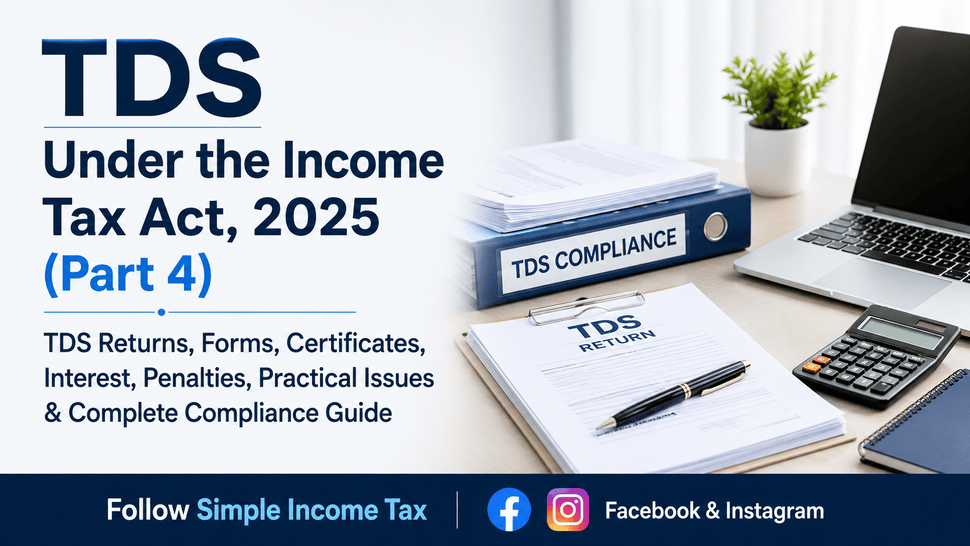

This is the fourth and final article in our series on Tax Deducted at Source (TDS) under the Income Tax Act, 2025. In the previous parts, we discussed the concept of TDS, provisions relating to salary and non-salary payments, and business-related transactions. This article focuses on the practical aspects of TDS compliance, including filing of TDS statements, issue of TDS certificates, lower or nil deduction, interest, penalties, consequences of default and best practices for ensuring compliance.
Throughout this article, references are primarily made to the Income Tax Act, 2025. Wherever relevant, the corresponding provisions of the Income-tax Act, 1961 have also been mentioned to facilitate the transition to the new law.
TDS Compliance Cycle
A deductor should follow the following sequence:
- Determine whether TDS is applicable.
- Identify the correct provision under Section 392 or Section 393 of the Income Tax Act, 2025 (corresponding to Sections 192 and 193 to 194T of the Income-tax Act, 1961).
- Verify the PAN of the deductee.
- Deduct tax at the prescribed rate.
- Deposit the tax within the prescribed due date.
- File the quarterly TDS statement.
- Issue the TDS certificate.
- Rectify errors, if any.
- Maintain proper records.
Deposit of TDS
Once tax has been deducted, it must be deposited with the Central Government within the prescribed time.
Delay in depositing TDS may attract:
- Interest
- Penalty
- Prosecution in specified cases
Timely payment also ensures that the deductee receives credit in Form 26AS/AIS.
Quarterly TDS Statements
Every deductor is required to furnish quarterly TDS statements containing details of:
- Deductor
- Deductee
- PAN
- Amount paid
- Amount deducted
- Amount deposited
- Challan details
Incorrect statements may require correction statements.
TDS Certificates
After filing the TDS statement, the deductor should issue the prescribed TDS certificate.
The commonly used certificates include:
- Form 16 – Salary payments under Section 392 (corresponding to Section 192 of the Income-tax Act, 1961).
- Form 16A – Non-salary payments under Section 393 (corresponding to Sections 193 to 194T of the Income-tax Act, 1961).
These certificates enable taxpayers to claim credit while filing the Income Tax Return.
Form No. 121
The Income Tax Act, 2025 introduces Form No. 121 as the unified declaration for eligible taxpayers seeking non-deduction of tax at source.
Form No. 121 replaces the declarations earlier furnished under Sections 197A, Forms 15G and 15H of the Income-tax Act, 1961.
Eligible persons should furnish the declaration before the payment is made so that tax is not deducted where permitted by law.
Lower or Nil Deduction Certificate
Where a taxpayer expects that the tax deductible is higher than the actual tax liability, an application may be made to the Income Tax Department for a certificate authorising deduction at a lower rate or at nil rate, subject to the prescribed conditions.
The deductor should verify the validity of the certificate before applying a reduced rate.
Consequences of Failure to Deduct or Deposit TDS
Failure to comply with TDS provisions may result in:
- Interest for late deduction.
- Interest for late payment.
- Penalty under the Income Tax Act, 2025.
- Disallowance of specified expenditure.
- Recovery proceedings.
- Prosecution in serious cases.
Common Errors in TDS Returns
Some frequently noticed mistakes include:
- Incorrect PAN.
- Wrong section code.
- Incorrect challan details.
- Mismatch in amount deducted.
- Wrong assessment year.
- Duplicate entries.
- Incorrect deductee details.
- Failure to file correction statements.
Best Practices for Deductors
- Verify PAN before payment.
- Identify the correct TDS provision.
- Check threshold limits.
- Apply the correct rate.
- Deposit tax within the due date.
- File quarterly statements promptly.
- Issue TDS certificates on time.
- Reconcile with books of account.
- Match TDS with AIS and Form 26AS.
- Preserve records for future verification.
Practical Case Studies
Case Study 1
A company pays consultancy charges exceeding the prescribed threshold.
Applicable Provision:
Section 393 (corresponding to Section 194J of the Income-tax Act, 1961).
Case Study 2
A company purchases an office building for Rs. 80 lakh.
Applicable Provision:
Section 393 (corresponding to Section 194-IA of the Income-tax Act, 1961).
Case Study 3
An e-commerce operator facilitates online sales of Rs. 7 lakh by an individual seller.
Applicable Provision:
Section 393 (corresponding to Section 194-O of the Income-tax Act, 1961).
Frequently Asked Questions (FAQs) on TDS Under the Income Tax Act, 2025
1. What is Tax Deducted at Source (TDS)?
Tax Deducted at Source (TDS) is a mechanism under the Income Tax Act, 2025 whereby the person making specified payments deducts tax at the prescribed rate before making the payment to the recipient and deposits it with the Central Government. It ensures timely collection of tax and reduces tax evasion.
2. Who is liable to deduct TDS?
Every person specified under the Income Tax Act, 2025, including Government departments, companies, firms, co-operative societies and specified individuals or Hindu Undivided Families (HUFs), is required to deduct TDS while making specified payments if the prescribed conditions are satisfied.
3. What is TAN?
Tax Deduction and Collection Account Number (TAN) is a ten-digit alphanumeric number allotted by the Income Tax Department to every person responsible for deducting or collecting tax at source. Except in specified cases, obtaining TAN is mandatory before deducting TDS.
4. Is PAN mandatory for TDS purposes?
Yes. The deductee should furnish a valid Permanent Account Number (PAN) to the deductor. Failure to quote PAN may result in deduction of tax at a higher rate as prescribed under the Act.
5. What is Form No. 121?
Form No. 121 is the unified declaration introduced under the Income Tax Act, 2025 for eligible taxpayers seeking non-deduction of tax at source. It replaces the declarations that were earlier furnished through Forms 15G and 15H under Section 197A of the Income-tax Act, 1961.
6. Who can submit Form No. 121?
Eligible resident individuals and other eligible persons whose estimated total income satisfies the prescribed conditions may furnish Form No. 121 to the deductor for non-deduction of tax, subject to the provisions of the Act.
7. What is a Lower Deduction Certificate?
A Lower Deduction Certificate is issued by the Income Tax Department permitting deduction of tax at a lower rate or at nil rate where the taxpayer demonstrates that the normal rate of TDS would result in excess deduction.
8. When should TDS be deposited?
TDS should be deposited with the Central Government within the due dates prescribed under the Income Tax Act, 2025 and the Income Tax Rules. Delay in depositing TDS may attract interest and other consequences.
9. What is Form 16?
Form 16 is the TDS certificate issued by an employer to an employee in respect of tax deducted from salary under Section 392 of the Income Tax Act, 2025 (corresponding to Section 192 of the Income-tax Act, 1961).
10. What is Form 16A?
Form 16A is the TDS certificate issued for tax deducted from payments other than salary under Section 393 of the Income Tax Act, 2025 (corresponding to Sections 193 to 194T of the Income-tax Act, 1961).
11. What happens if TDS is deducted late?
If TDS is deducted after the prescribed time, the deductor may be liable to pay interest as prescribed under the Act. Delay may also result in compliance issues and notices from the Income Tax Department.
12. What happens if TDS is deposited late?
Late deposit of TDS attracts interest and may also result in penalty, recovery proceedings or prosecution in appropriate cases, depending upon the nature and extent of the default.
13. Can a TDS return be revised?
Yes. If any error is noticed after filing the original TDS statement, the deductor may file a correction statement to rectify mistakes such as incorrect PAN, challan details, amount or deductee information.
14. What is a correction statement?
A correction statement is a revised TDS statement filed to correct errors in the original TDS return, such as incorrect PAN, challan details, deduction amount, deductee particulars or other reporting mistakes.
15. Can TDS be claimed while filing the Income Tax Return?
Yes. A taxpayer can claim credit for TDS deducted and deposited with the Government while filing the Income Tax Return, subject to the TDS being reflected in the prescribed statements.
16. How is TDS reflected in AIS?
The Annual Information Statement (AIS) displays details of TDS reported by deductors and received by the Income Tax Department. Taxpayers should reconcile AIS with their own records before filing the Income Tax Return.
17. What is Form 26AS?
Form 26AS is a consolidated tax statement reflecting TDS, Tax Collected at Source (TCS), advance tax, self-assessment tax, refunds and certain specified financial transactions linked with the taxpayer’s PAN.
18. Is TDS applicable on all payments?
No. TDS is applicable only on payments specifically covered under the Income Tax Act, 2025, subject to prescribed thresholds, exemptions and conditions.
19. Can excess TDS be refunded?
Yes. If excess tax has been deducted, the taxpayer may claim a refund by filing the Income Tax Return, provided the tax has been duly deposited and reflected in the tax records.
20. Is TDS applicable to Government payments?
Yes. Government departments are also required to deduct TDS on specified payments wherever the provisions of the Income Tax Act, 2025 apply.
21. What records should a deductor maintain?
A deductor should maintain copies of invoices, agreements, PAN details, challans, TDS returns, TDS certificates, payment records, correspondence and any other documents relevant to TDS compliance.
22. What are the consequences of quoting an incorrect PAN?
Quoting an incorrect or invalid PAN may result in higher deduction of tax, mismatch in tax credit, rejection of TDS statements, notices from the Income Tax Department and difficulties for the deductee in claiming TDS credit.
23. How can a deductor avoid notices from the Income Tax Department?
A deductor should ensure correct classification of payments, timely deduction and deposit of TDS, accurate filing of TDS statements, proper quoting of PAN and TAN, prompt issuance of TDS certificates and regular reconciliation of records with AIS and Form 26AS.
24. Can a deductee seek rectification of TDS errors?
Yes. If TDS has been incorrectly reported or credit is not reflected, the deductee should first approach the deductor for filing a correction statement. If the issue persists, the taxpayer may seek appropriate relief as provided under the Act.
25. Where can taxpayers verify TDS details?
Taxpayers can verify TDS details through Form 26AS, the Annual Information Statement (AIS) and the Taxpayer Information Summary (TIS) available after logging into the Income Tax Department’s e-filing portal. They should periodically reconcile these records with Form 16, Form 16A and their books of account to ensure that the correct TDS credit is available while filing the Income Tax Return.
Complete Old vs New Section Mapping
| Subject | Income Tax Act, 2025 | Income-tax Act, 1961 |
| Salary TDS | Section 392 | Section 192 |
| Non-Salary TDS | Section 393 | Sections 193–194T |
| TCS | Section 394 | Section 206C |
| Unified Declaration | Form No. 121 | Forms 15G, 15H / Section 197A |
Key Takeaways
- Always identify the correct TDS provision before making a payment.
- Verify threshold limits, applicable rates and deductee details.
- Deposit TDS within the prescribed due date.
- File accurate quarterly TDS statements.
- Issue TDS certificates promptly.
- Reconcile TDS data with Form 26AS and AIS.
- Maintain complete records to avoid future disputes.
Conclusion
Tax Deducted at Source is one of the most important mechanisms for collection of Income Tax in India. While the Income Tax Act, 2025 has streamlined and consolidated the TDS provisions, timely compliance remains the responsibility of every deductor. Proper understanding of the law, accurate deduction of tax, timely deposit, filing of TDS statements and maintenance of records not only ensure statutory compliance but also reduce litigation and facilitate smooth tax administration.
This concludes the four-part series on TDS under the Income Tax Act, 2025, designed to provide a practical and comprehensive guide for taxpayers, businesses, tax professionals, departmental officers and students.
Related Article on Simple Income Tax
- TDS Under the Income Tax Act, 2025 (Part 1): Basics, Applicability, Compliance & Transition from the Income-tax Act, 1961
- TDS Under the Income Tax Act, 2025 (Part 2): TDS on Salary, Interest, Dividends, Winnings & Other Common Payments
- TDS Under the Income Tax Act, 2025 (Part 3) : TDS on Business Payments
Readers may refer to the relevant provisions of the Income Tax Act, 2025, CBDT notifications, rules and circulars available on the official Income Tax Department website for the latest amendments and procedural guidance.
About the Author