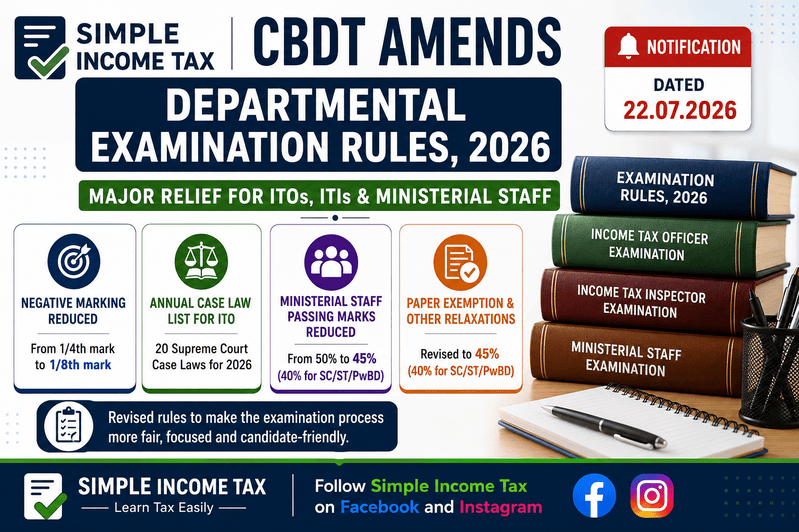

The Central Board of Direct Taxes (CBDT) has issued a partial amendment to the Departmental Examination Rules, 2026 for Income Tax Officers (ITOs), Income Tax Inspectors (ITIs), and Ministerial Staff (MS). The amendments have been notified through a Notification dated 22 July 2026 after a review of the Examination Rules published on 29 May 2026.
The latest amendments bring significant relief to departmental candidates by reducing negative marking, revising qualifying marks for Ministerial Staff, and introducing an annual case law list for ITO Paper-I.
Highlights of the CBDT Notification
The important changes notified by the CBDT are:
- Negative marking reduced from 1/4th mark to 1/8th mark for objective papers.
- Separate annual Supreme Court case law list to be issued for ITO Examination every year.
- Qualifying marks for Ministerial Staff Examination reduced from 50% to 45%.
- Similar relaxation extended to SC/ST/PwBD candidates.
- Rules regarding paper exemption, old pattern candidates, and Rajbhasha Hindi paper have also been amended.
1. Negative Marking Reduced for Objective Papers
One of the biggest changes is the reduction in negative marking.
Earlier Rule
- 1/4th mark was deducted for every incorrect answer.
Revised Rule
- Only 1/8th mark will now be deducted for every incorrect answer.
This amendment applies to:
- Income Tax Officer Examination
- Income Tax Inspector Examination
- Ministerial Staff Examination
This is expected to encourage candidates to attempt more questions with reduced risk of losing marks.
2. Important Change in ITO Paper-I (IT Law & Taxpayer Services)
Earlier, the syllabus prescribed broad subject-wise categories of Supreme Court judgments such as:
- Business expenditure/disallowance
- Capital gains
- Exemption and deduction
- Cash credits/unexplained income
- Reassessment
- Search assessments
- Revisional jurisdiction
The amended rule removes this topic-based approach.
Instead, the CBDT will now issue a separate list of case laws every examination year, and candidates will be required to study only those notified decisions.
3. CBDT Issues 20 Supreme Court Case Laws for ITO Examination 2026
Along with the notification, Annexure-A prescribes 20 important case laws for the ITO Departmental Examination 2026.
Some important judgments include:
- CIT (Exemption) v. International Health Care Education and Research Institute
- Assessing Officer (International Taxation) v. Nestle SA
- CIT (Exemptions) v. Ahmedabad Urban Development Authority
- Mansarovar Commercial (P) Ltd. v. CIT
- DCIT v. Mastech Technologies (P) Ltd.
- Union of India v. Baba Banda Singh Bahadur Education Trust
- Checkmate Services (P) Ltd. v. CIT
- PCIT v. Abhisar Buildwell Pvt. Ltd.
- N.K. Proteins Ltd. v. CIT
- CIT v. Poddar Cement Ltd.
The notification contains the complete list of 20 judgments to be studied for the 2026 examination.
4. Ministerial Staff Examination – Passing Marks Reduced
CBDT has also relaxed the qualifying standards for Ministerial Staff.
Earlier
- Minimum 50% marks
- 45% for SC/ST/PwBD candidates
Revised
- Minimum 45% marks
- 40% for SC/ST/PwBD candidates
No additional relaxation beyond these revised standards will be available.
5. Paper-wise Exemption Also Modified
Candidates securing the prescribed qualifying marks in one or more papers will continue to receive exemption from those papers in future examinations.
However, the qualifying benchmark has now been revised to:
- 45% for General candidates
- 40% for SC/ST/PwBD candidates
instead of the earlier 50% and 45% respectively.
6. Relief for Candidates Qualified Under Old Examination Rules
The amendment also benefits candidates who had partially qualified under the Departmental Examination Rules, 1998.
Such candidates will now be treated as having qualified under the new rules provided they secure:
- 45% marks
- 40% for SC/ST/PwBD candidates
in the remaining paper(s).
7. Rajbhasha Hindi Paper
The qualifying marks for the Rajbhasha Hindi paper have also been revised.
Now the pass marks will be:
- 45%
- 40% for SC/ST/PwBD candidates
After passing this paper, the prescribed entry will continue to be made in the candidate’s service record.
Comparative Table: Old vs New Rules
| Particular | Earlier Rule | Amended Rule |
| Negative marking | 1/4th mark | 1/8th mark |
| ITO Paper-I case laws | Topic-based Supreme Court judgments | Annual notified case law list |
| Ministerial Staff passing marks | 50% | 45% |
| SC/ST/PwBD passing marks | 45% | 40% |
| Paper exemption | Based on 50%/45% | Based on 45%/40% |
| Rajbhasha Hindi | 50% / 45% | 45% / 40% |
Why These Amendments Matter
The latest amendments make the Departmental Examination more candidate-friendly. Reduction in negative marking will allow candidates to attempt objective questions more confidently, while the annual notification of Supreme Court case laws will make preparation for ITO Paper-I more focused. The relaxation in qualifying marks for Ministerial Staff candidates is also expected to improve pass percentages without compromising examination standards.
Conclusion
The CBDT Notification dated 22 July 2026 introduces important changes to the Departmental Examination Rules, 2026 applicable to Income Tax Officers, Income Tax Inspectors, and Ministerial Staff. Candidates preparing for the upcoming departmental examinations should carefully note these amendments, particularly the revised negative marking scheme and the newly notified case law list for the ITO Examination. Keeping these changes in mind will help aspirants plan their preparation more effectively and improve their performance in the examination.
Frequently Asked Questions (FAQs)
Q1. What is the new negative marking in the Departmental Examination 2026?
Negative marking has been reduced from 1/4th mark to 1/8th mark for every incorrect answer in objective-type papers.
Q2. Does the reduced negative marking apply to Income Tax Inspectors?
Yes. It applies to ITOs, ITIs, and Ministerial Staff objective papers.
Q3. What are the new qualifying marks for Ministerial Staff?
General candidates require 45%, while SC/ST/PwBD candidates require 40% in each paper.
Q4. What is the major change in ITO Paper-I syllabus?
Instead of studying broad categories of Supreme Court judgments, candidates will now study the annual case law list notified by CBDT for that examination year.
Q5. How many case laws have been prescribed for the ITO Examination 2026?
CBDT has notified 20 case laws in Annexure-A for the 2026 Departmental Examination.
Readers may refer to the relevant provisions of the Income Tax Act, CBDT notifications, rules and circulars available on the official Income Tax Department website for the latest amendments and procedural guidance.
About the Author