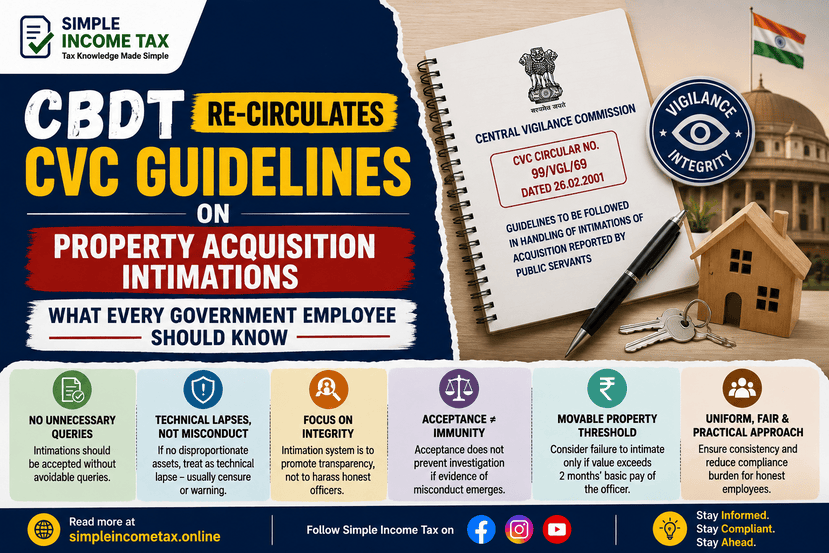

In an important development for government employees, the Directorate General of Income Tax (Vigilance) has circulated the Central Vigilance Commission (CVC) Circular No. 99/VGL/69 dated 26 February 2001 to all Principal Chief Commissioners/Chief Commissioners and Principal Director Generals/Director Generals of Income Tax through a communication dated 05 August 2026. The objective is to ensure uniform implementation of the CVC guidelines while dealing with intimations relating to the acquisition of movable and immovable property by public servants. CBDT Re-Circulates CVC Guidelines on Property Acquisition Intimations.
The communication highlights that these long-standing CVC instructions continue to be relevant and must be followed in letter and spirit to avoid unnecessary hardship to honest officers while maintaining vigilance standards.
Background
Every government servant is required to comply with the applicable Conduct Rules relating to acquisition or disposal of movable and immovable property. Depending upon the nature and value of the transaction, an employee may be required to either submit an intimation or obtain prior permission from the competent authority.
Over the years, however, instances were noticed where supervisory authorities raised repeated queries or delayed disposal of property intimations, even in routine cases where the information furnished by the employee was complete. Such practices not only delayed administrative decisions but also caused avoidable inconvenience to honest public servants.
To address these concerns, the Directorate General of Income Tax (Vigilance) has once again reminded all authorities to follow the CVC guidelines uniformly.
Purpose of the CVC Guidelines
The principal objective of the CVC guidelines is to ensure that:
- Honest officers are not subjected to unnecessary procedural harassment.
- Property acquisition intimations are dealt with promptly and consistently.
- Vigilance machinery focuses on genuine cases involving integrity issues rather than technical lapses.
- Uniform practices are followed across all formations of the Department.
The guidelines seek to strike a balance between administrative vigilance and fair treatment of public servants.
Key Highlights of the Guidelines
1. Avoid Raising Unnecessary Queries
The CVC has advised that authorities should not routinely raise repeated or avoidable queries after receiving a property acquisition intimation.
If the prescribed information has been furnished and there is no apparent irregularity, the intimation should ordinarily be accepted instead of initiating prolonged correspondence.
2. Technical Lapses Should Not Be Viewed as Serious Misconduct
One of the most significant aspects of the CVC guidelines is the distinction between technical non-compliance and vigilance misconduct.
Where there is no indication that the officer possesses assets disproportionate to known sources of income, mere failure to intimate a property transaction should generally be treated as a technical lapse.
In such cases, the CVC recommends that the matter may ordinarily be closed with a censure or administrative warning, instead of initiating disciplinary proceedings.
This approach recognizes that procedural mistakes should not automatically be equated with lack of integrity.
3. Vigilance Should Focus on Integrity Issues
The circular reiterates that the property intimation mechanism exists to promote transparency, accountability and integrity in public administration.
Its purpose is not to create unnecessary procedural hurdles for honest employees.
Authorities should therefore distinguish between:
- genuine vigilance concerns,
- disproportionate assets,
- unexplained wealth,
- and simple procedural omissions.
Only the former ordinarily warrant serious vigilance action.
4. Acceptance of Intimation Does Not Prevent Future Investigation
Another important clarification contained in the CVC guidelines is that acceptance of a property acquisition intimation does not amount to a clean chit.
If credible material subsequently comes to light indicating:
- possession of disproportionate assets,
- corruption,
- concealment of facts, or
- any other misconduct,
the Department remains fully empowered to conduct an independent vigilance inquiry in accordance with law.
Thus, acceptance of an intimation and vigilance investigation operate independently.
5. Movable Property Transactions
The guidelines also clarify that in respect of movable property, failure to intimate should generally be considered only where the value of the property exceeds two months’ basic pay of the concerned public servant.
This helps avoid unnecessary proceedings in respect of routine or insignificant transactions.
Why Has DGIT (Vigilance) Re-Circulated These Guidelines?
The recent communication indicates that there was a need to remind field authorities about the correct approach while dealing with property acquisition intimations.
The intention appears to be:
- ensuring consistency across formations,
- reducing avoidable correspondence,
- avoiding unnecessary disciplinary action,
- protecting honest officers from procedural harassment, and
- enabling vigilance authorities to concentrate on serious integrity-related matters.
Practical Implications for Government Employees
The circular provides reassurance to public servants that:
- Routine property intimations should normally be processed without unnecessary objections.
- Minor procedural lapses are not intended to attract harsh disciplinary consequences in the absence of integrity issues.
- Authorities are expected to adopt a practical and balanced approach while examining such intimations.
However, employees should continue to comply with the applicable Conduct Rules by submitting timely and accurate intimations wherever required.
Practical Implications for Supervisory Authorities
For supervisory officers, the circular serves as a reminder to:
- examine property intimations objectively;
- avoid mechanical or repetitive queries;
- distinguish between technical lapses and vigilance misconduct;
- ensure uniform implementation of CVC instructions; and
- process cases expeditiously.
This approach improves administrative efficiency while maintaining accountability.
Why These Guidelines Are Important
The re-circulation of these instructions is significant because they reinforce a fundamental principle of good governance: vigilance administration should target corruption and integrity issues—not honest procedural mistakes.
By discouraging unnecessary scrutiny in routine matters, the guidelines:
- improve administrative efficiency;
- reduce avoidable litigation and disciplinary proceedings;
- enhance employee confidence;
- promote transparency; and
- allow vigilance authorities to focus on serious misconduct.
Official CVC Resources
Readers who wish to refer to the Commission’s role, circulars and vigilance guidelines may visit the official website of the Central Vigilance Commission (CVC).
You can also explore the CVC’s circulars, manuals, annual reports and vigilance publications available on the official portal.
Conclusion
The latest communication issued by the Directorate General of Income Tax (Vigilance) is an important administrative reminder that the CVC’s long-standing principles continue to govern the handling of property acquisition intimations by public servants. The emphasis is on fairness, proportionality and consistency.
Honest officers who comply with the Conduct Rules should not face unnecessary procedural hurdles, while vigilance authorities must remain vigilant against genuine cases involving disproportionate assets or corruption. The re-circulation of these guidelines is therefore a welcome step towards strengthening both administrative efficiency and ethical governance within the Income Tax Department.
About the Author