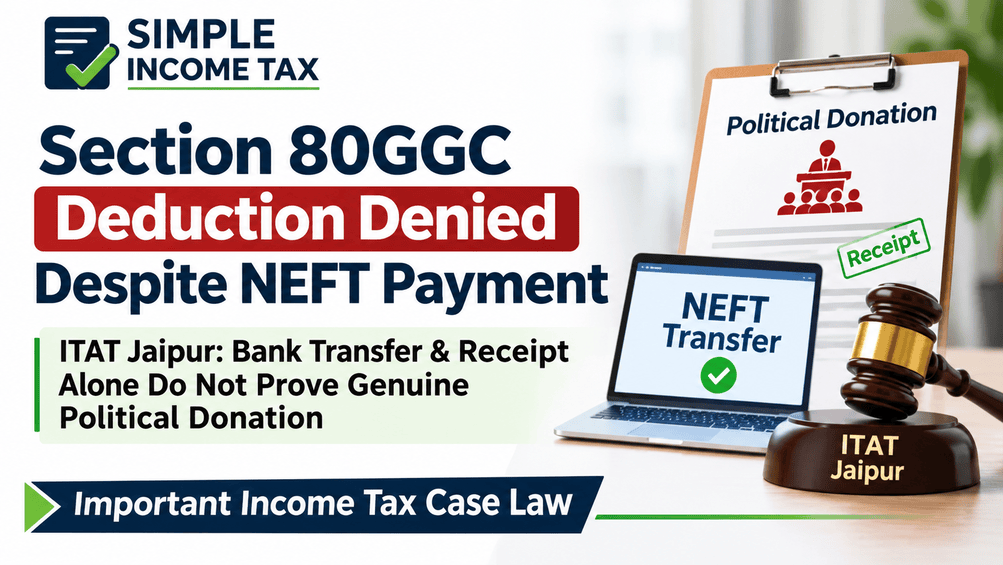
Many taxpayers believe that once a political donation is made through a bank transfer and a receipt is obtained, the deduction under Section 80GGC of the Income-tax Act is automatically available. A recent decision of the Income Tax Appellate Tribunal (ITAT), Jaipur shows that this is not always true.
In Dinesh Singhal vs. Assessment Unit, Income Tax Department (ITA No. 199/JPR/2026, order dated 5 November 2026), the Tribunal upheld the disallowance of a deduction of ₹1.51 lakh claimed under Section 80GGC. The ruling highlights that the genuineness of a donation is as important as the mode of payment.
Background of the Case
The assessee filed his income tax return for AY 2019-20 and claimed a deduction of ₹1,51,000 under Section 80GGC for a donation made through NEFT to a registered unrecognised political party, Rashtriya Samajwadi Party (Secular). He supported the claim with the bank transaction details and the donation receipt issued by the political party.
Later, the Income Tax Department reopened the assessment after conducting search operations on several registered unrecognised political parties. During the investigation, the Department allegedly discovered a systematic arrangement where donations were first received through banking channels and then returned to donors in cash after deducting a commission. According to the Department, such transactions were accommodation entries designed to help donors claim tax deductions without making genuine political contributions.
What Was the Taxpayer’s Argument?
The taxpayer argued that:
- The donation was made through a banking channel.
- No cash payment was made.
- The political party had issued a valid receipt.
- Therefore, all conditions of Section 80GGC had been fulfilled.
The assessee contended that once these basic requirements were satisfied, the deduction should not be denied merely because allegations had been made against the political party.
What Did the Income Tax Department Say?
The Department relied upon the material collected during the search operation. According to the Revenue, the investigation had revealed that the political party was engaged in returning donated amounts in cash after retaining a small commission.
The Department argued that although the money initially moved through the banking system, the transaction lacked genuine substance because the donor allegedly received the amount back in cash. Consequently, the deduction claimed under Section 80GGC was not allowable.
ITAT Jaipur’s Decision
The Tribunal agreed with the Department and upheld the disallowance.
According to the ITAT, a bank transfer only proves that money was transferred to the political party. It does not automatically prove that the donation was genuine. Where the Revenue produces credible evidence suggesting that the transaction formed part of a bogus donation arrangement, the taxpayer cannot rely only on the NEFT transaction and the donation receipt.
The Tribunal observed that once the Department produced search-based evidence, the burden shifted to the assessee to explain why the donation should still be treated as genuine. Since no convincing material was produced to rebut the investigation findings, the deduction was rightly disallowed.
Important Legal Principle
The judgment lays down an important principle regarding the burden of proof.
Normally, a taxpayer claiming a deduction must establish that the statutory conditions are satisfied. However, where the Department produces credible investigation material indicating that a transaction is merely an accommodation entry, the taxpayer must produce additional evidence to establish its genuineness.
Therefore, a bank transfer and donation receipt may prove the mode of payment, but they do not conclusively establish the genuineness of the donation if contrary evidence exists.
Practical Takeaways for Taxpayers
This judgment provides several practical lessons:
- Always ensure that political donations are made to eligible political parties in accordance with Section 80GGC.
- Preserve complete documentary evidence relating to the donation.
- A banking transaction alone may not be sufficient if the Department produces credible evidence suggesting that the donation was not genuine.
- If a political party is later found to have operated accommodation-entry arrangements, the taxpayer may have to establish that his or her own donation was genuine and not part of such a scheme.
Conclusion
The Jaipur ITAT has clarified that Section 80GGC is intended to encourage genuine political contributions, not paper transactions carried out merely to claim tax benefits. While payment through banking channels remains a mandatory requirement, it is not the only requirement. The genuineness of the transaction is equally important.
The decision serves as a reminder that tax deductions are available only when the underlying transaction is genuine. Where the Revenue supports its case with credible investigation material and the taxpayer is unable to rebut it, the deduction can be denied even if the payment was made through NEFT and a donation receipt was issued.
Case Details
- Case: Dinesh Singhal vs. Assessment Unit, Income Tax Department
- Court: ITAT Jaipur
- Appeal No.: ITA No. 199/JPR/2026
- Assessment Year: 2019-20
- Date of Order: 5 November 2026
Disclaimer: This article is for educational purposes only and should not be treated as legal or tax advice. Readers should refer to the complete judgment before taking any decision.
Read Also :
Statutory Status Is Not Enough: ITAT Explains Conditions for Registration under Section 12AB
About the Author