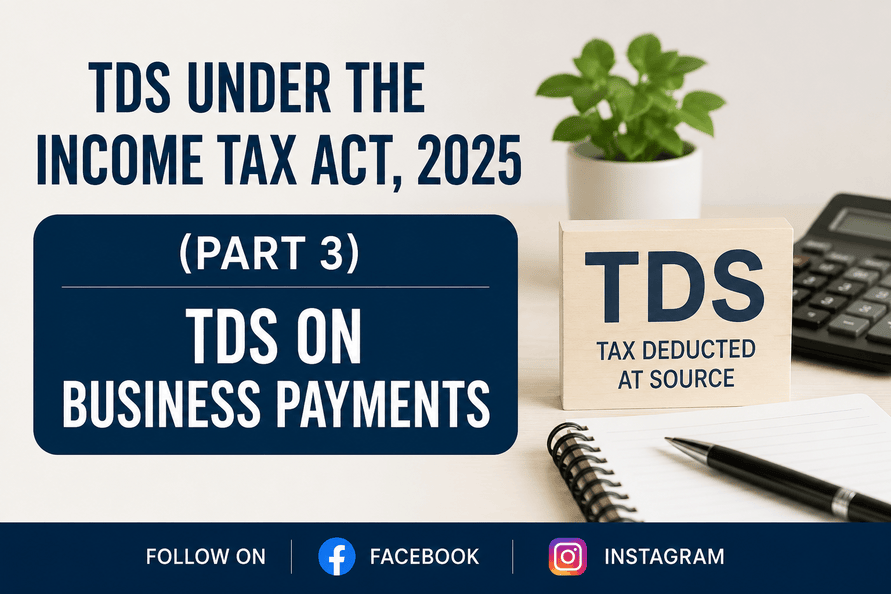

After discussing the basic principles of Tax Deducted at Source (TDS) in Part 1 and TDS on salary, interest, dividends and other common payments in Part 2, this article explains the provisions relating to business and commercial payments under the Income Tax Act, 2025.
Business entities, Government departments, companies, partnership firms, co-operative societies and specified individuals frequently make payments towards contracts, professional services, rent, commission, brokerage and purchase of immovable property. Such payments may attract TDS under Section 393 of the Income Tax Act, 2025 (corresponding to various provisions ranging from Sections 193 to 194T of the Income-tax Act, 1961), subject to the prescribed conditions, thresholds and rates.
Understanding these provisions is essential for deductors to avoid interest, penalties and other consequences arising from non-compliance. Similarly, deductees should understand when tax is deductible and how to claim credit while filing the Income Tax Return.
Transition Note: Throughout this article, references are primarily made to the Income Tax Act, 2025. Wherever relevant, the corresponding provisions of the Income-tax Act, 1961 have also been mentioned to assist readers during the transition to the new law.
TDS on Contractor Payments
One of the most common business transactions requiring deduction of tax is payment made to contractors and sub-contractors.
Under Section 393 of the Income Tax Act, 2025 (corresponding to Section 194C of the Income-tax Act, 1961), specified persons making payments to contractors for carrying out any work, including supply of labour for carrying out any work, are required to deduct tax at source where the prescribed conditions are satisfied.
The expression “work” generally includes contracts relating to advertising, broadcasting, telecasting, carriage of goods or passengers, catering and manufacturing or supplying a product according to the requirement or specification of a customer using material purchased from such customer. The applicability of TDS depends upon factors such as the nature of the contract, status of the deductor and deductee, threshold limits and the timing of payment or credit.
Practical Issues in Contractor Payments
While deducting TDS on contractor payments, deductors should carefully examine:
- Whether the payment is made under a contract.
- Whether the prescribed monetary threshold has been crossed.
- Whether the contractor is a transporter eligible for any specific relaxation.
- Whether GST is included in the value on which TDS is to be deducted.
- Whether separate contracts are artificially split to avoid TDS.
TDS on Professional and Technical Services
Payments made for professional services and technical services are also subject to TDS.
Under Section 393 of the Income Tax Act, 2025 (corresponding to Section 194J of the Income-tax Act, 1961), tax is deductible on specified payments made to resident professionals such as:
- Chartered Accountants
- Advocates
- Doctors
- Architects
- Engineers
- Interior Decorators
- Company Secretaries
- Technical Consultants
- Information Technology Professionals
- Other notified professionals
The section also covers specified technical services, royalty and certain other payments as prescribed under the Act.
Points to Remember
Before deducting tax on professional fees, the deductor should verify:
- Nature of service.
- Residential status of the payee.
- Applicable threshold.
- Applicable rate of deduction.
- Availability of lower or nil deduction certificate, if any.
TDS on Rent
Payments towards rent may also attract TDS under Section 393 of the Income Tax Act, 2025 (corresponding to Sections 194-I and 194-IB of the Income-tax Act, 1961). Tax is required to be deducted where the prescribed conditions are satisfied. For specified persons, TDS is applicable where the aggregate rent exceeds Rs. 50,000 for a month or part of a month. The applicable rate is 2% for the use of machinery, plant or equipment and 10% for the use of land, building (including factory building), land appurtenant to a building, furniture or fittings. For certain individuals and Hindu Undivided Families who are not otherwise liable to deduct tax, TDS is also applicable where the monthly rent exceeds Rs. 50,000, subject to the specific provisions of the Act.
| Nature of Payment | Income Tax Act, 2025 | Income-tax Act, 1961 | Threshold | Rate |
| Rent paid by specified persons | Section 393 | Section 194-I | Rs. 50,000 per month or part thereof | 2% (Plant/Machinery/Equipment); 10% (Land, Building, Furniture, Fittings) |
| Rent paid by specified Individuals/HUF | Section 393 | Section 194-IB | Rs. 50,000 per month or part thereof | 2% |
The term “rent” generally includes payments for use of:
- Land
- Building
- Factory Building
- Office Premises
- Furniture
- Plant
- Machinery
- Equipment
The deductor should examine the nature of the asset and the applicable provisions before deducting tax.
TDS on Purchase of Immovable Property
The purchase of immovable property is another important transaction covered under the TDS provisions. Under Section 393 of the Income Tax Act, 2025 (corresponding to Section 194-IA of the Income-tax Act, 1961), every buyer (transferee) is required to deduct tax at source at the prescribed rate from the consideration payable to a resident seller (transferor) for the transfer of an immovable property, where the sale consideration or the stamp duty value of the property, whichever is higher, is Rs. 50 lakh or more. TDS is required to be deducted at the time of credit of the amount to the seller’s account or at the time of payment, whichever is earlier. However, these provisions do not apply to the transfer of agricultural land, as defined under the Act.
While determining the applicability of TDS, the buyer should consider:
- Whether the sale consideration or stamp duty value, whichever is higher, is Rs. 50 lakh or more.
- The applicable rate of TDS under the Act.
- The nature of the property and whether it qualifies as an immovable property covered by the provision.
- Whether the property is agricultural land, which is excluded from the scope of this provision.
- Availability and correctness of the PAN of both the buyer and the seller.
- The requirement to deduct tax at the time of credit or payment, whichever is earlier.
TDS on Commission and Brokerage
Payments towards commission and brokerage also fall within the TDS framework. Under Section 393 of the Income Tax Act, 2025 (corresponding to Section 194H of the Income-tax Act, 1961), specified persons are required to deduct tax at source on commission or brokerage paid to a resident where the aggregate amount credited or paid during the financial year exceeds Rs. 20,000. Tax is required to be deducted at the rate of 2% at the time of credit of such income to the account of the payee or at the time of payment, whichever is earlier. The provisions also apply to specified individuals and Hindu Undivided Families whose turnover or gross receipts exceeded the prescribed limits in the immediately preceding financial year.
Common examples of commission or brokerage include:
- Sales commission.
- Agency commission.
- Brokerage on purchase or sale transactions.
- Marketing and referral commission.
- Incentive commission paid to agents or intermediaries.
TDS on E-commerce Transactions
The rapid growth of digital commerce has resulted in specific TDS obligations for e-commerce operators. Under Section 393 of the Income Tax Act, 2025 (corresponding to Section 194-O of the Income-tax Act, 1961), an e-commerce operator is required to deduct tax at source at the rate of 1% on the gross amount of sales of goods or provision of services, or both, facilitated through its digital or electronic platform and payable to an e-commerce participant. Tax is required to be deducted at the time of credit of the amount to the account of the e-commerce participant or at the time of payment, whichever is earlier. However, where the e-commerce participant is an individual or a Hindu Undivided Family, no tax is required to be deducted if the gross amount of sales or services during the financial year does not exceed Rs. 5 lakh and the participant has furnished his or her Permanent Account Number (PAN) or Aadhaar number to the e-commerce operator.
These provisions are applicable to a wide range of digital platforms facilitating online transactions, including:
- Online marketplaces for goods.
- E-commerce platforms providing services.
- Food delivery and restaurant aggregator platforms.
- Cab and transport aggregation platforms.
- Hotel and travel booking platforms.
- Digital marketplaces connecting buyers and sellers.
Common Compliance Requirements
Every deductor should ensure that:
- PAN of the deductee is correctly obtained.
- TAN is quoted correctly.
- TDS is deducted at the applicable rate.
- Tax is deposited within the prescribed due date.
- Quarterly TDS statements are filed accurately.
- TDS certificates are issued within the prescribed time.
- Records supporting the deduction are properly maintained.
Common Mistakes Made by Deductors
Some common errors include:
- Treating professional fees as contractor payments or vice versa.
- Deducting TDS under an incorrect provision.
- Ignoring threshold limits.
- Applying incorrect TDS rates.
- Deducting tax after the prescribed time.
- Delayed deposit of TDS.
- Incorrect PAN reporting.
- Errors in TDS returns.
- Incorrect treatment of GST for TDS purposes.
- Failure to issue TDS certificates.
Comparison of Important Business TDS Provisions
| Subject | Income Tax Act, 2025 | Income-tax Act, 1961 |
| Contractor Payments | Section 393 | Section 194C |
| Professional Fees | Section 393 | Section 194J |
| Rent | Section 393 | Section 194-I |
| Commission/Brokerage | Section 393 | Section 194H |
| Purchase of Property | Section 393 | Section 194-IA |
| E-commerce Payments | Section 393 | Section 194-O |
Key Takeaways
- Section 393 of the Income Tax Act, 2025 consolidates several business-related TDS provisions that were previously contained in separate sections of the Income-tax Act, 1961.
- Deductors should identify the correct nature of payment before deducting TDS.
- Correct classification of payments helps avoid disputes, interest and penalties.
- Proper documentation, timely deposit of TDS and accurate filing of TDS statements are essential for compliance.
Related Article on Simple Income Tax
- TDS Under the Income Tax Act, 2025 (Part 1): Basics, Applicability, Compliance & Transition from the Income-tax Act, 1961
- TDS Under the Income Tax Act, 2025 (Part 2): TDS on Salary, Interest, Dividends, Winnings & Other Common Payments
Readers may refer to the relevant provisions of the Income Tax Act, 2025, CBDT notifications, rules and circulars available on the official Income Tax Department website for the latest amendments and procedural guidance.
About the Author