
Introduction
In Part 1 of this series, we discussed the fundamentals of business income, the meaning of business and profession, and examined the initial categories of income chargeable under Section 26 of the Income Tax Act, 2025, including ordinary business profits, specified compensation, export incentives and business-related benefits.
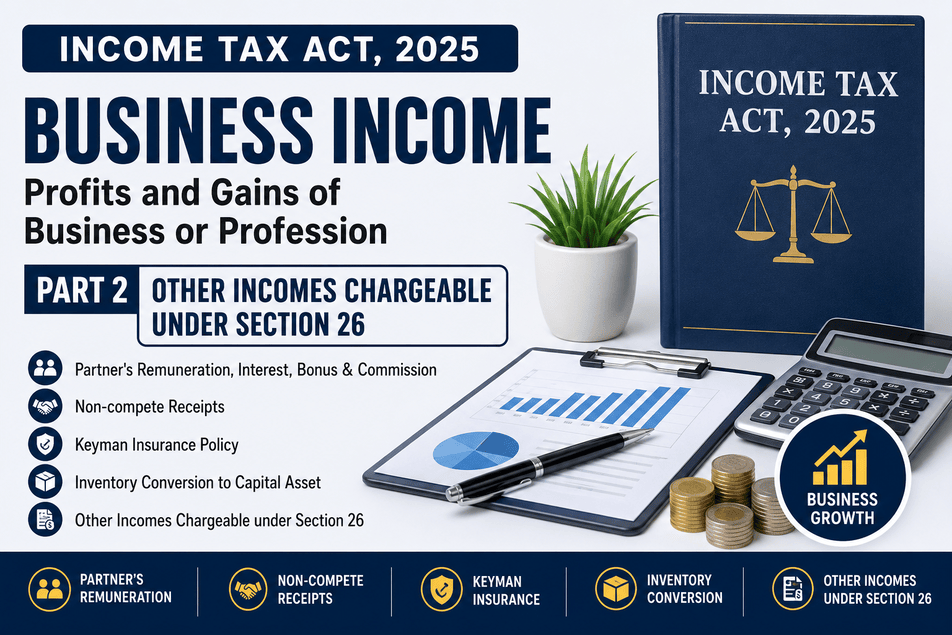
In this part, we continue our discussion by examining the remaining important categories of income specifically chargeable under Section 26. These provisions ensure that certain receipts, though not forming part of normal trading receipts, are nevertheless taxed under the head “Profits and Gains of Business or Profession.”
Understanding these provisions is essential for taxpayers, Chartered Accountants, tax practitioners, departmental officers and students because many of these receipts are frequently encountered during assessments and tax audits.
Provisions Covered in this Article
| Income Tax Act, 2025 | Corresponding Provision under Income-tax Act, 1961 | Subject |
| Section 26(2)(g) onwards | Section 28(v) onwards | Partner’s remuneration, interest, bonus and commission |
| Section 26 | Section 28(va) | Non-compete receipts |
| Section 26 | Section 28(vi) | Keyman Insurance Policy |
| Section 26 | Section 28(via)/(vii)/(viia) etc. | Other specified business receipts |
Partner’s Remuneration, Interest, Salary, Bonus and Commission
One of the important provisions of Section 26 relates to income received by a partner from a partnership firm.
Where a partner receives any of the following from a firm:
- Salary
- Bonus
- Commission
- Remuneration
- Interest on capital
such receipts are chargeable under the head Profits and Gains of Business or Profession, subject to the provisions of the Act.
It is important to note that although these receipts may appear similar to salary income, they are not taxable under the head “Salary.” Since a partnership firm and its partners are not regarded as employer and employee, such payments retain the character of business income.
Illustration
Mr. A is a partner in XYZ & Co.
During the tax year he receives:
- Interest on capital – Rs. 2,00,000
- Remuneration – Rs. 8,00,000
Both amounts are taxable under the head Profits and Gains of Business or Profession.
Why are Partner’s Receipts Taxed as Business Income?
A partner is not an employee of the partnership firm.
The remuneration paid to a working partner is merely a method of distributing the firm’s business profits subject to statutory conditions.
Accordingly, Section 26 specifically includes these receipts within business income.
Non-compete Receipts
Businesses frequently enter into agreements restraining a person from carrying on a competing business.
A person may receive consideration for:
- Agreeing not to carry on a competing business.
- Agreeing not to manufacture specified products.
- Agreeing not to provide specified services.
- Agreeing not to share business know-how.
Such receipts are generally known as non-compete fees.
Section 26 specifically includes such receipts within business income wherever the statutory conditions are satisfied.
Illustration
ABC Ltd. pays Mr. X Rs. 50,00,000 for agreeing not to establish a competing manufacturing unit for five years.
Subject to the applicable provisions of the Act, the receipt is taxable as business income.
Why was this Provision Introduced?
Prior to the specific statutory provision, disputes frequently arose regarding whether non-compete receipts were capital receipts or revenue receipts.
The Legislature specifically brought such receipts within the scope of business income to provide certainty and avoid litigation.
Keyman Insurance Policy
Many businesses obtain Keyman Insurance Policies on the lives of key personnel whose services are vital for the business.
The maturity proceeds or other sums received under such policies are specifically dealt with under Section 26.
Example
A company obtains a Keyman Insurance Policy on its Managing Director.
The policy matures and the company receives Rs. 40 lakh.
Subject to the applicable provisions of the Act, such amount is taxable under the head Profits and Gains of Business or Profession.
Conversion of Inventory into Capital Asset
The Income Tax Act also contains provisions relating to situations where inventory is converted into a capital asset.
Such transactions may have tax consequences under both:
- Business Income
- Capital Gains
The business income component is governed by the provisions of Section 26, while the capital gains implications arise when the capital asset is subsequently transferred.
Practical Example
A builder converts unsold flats held as stock-in-trade into investment property.
The Act contains specific provisions governing the tax treatment of such conversion.
Recovery of Earlier Deductions
Business deductions allowed in earlier years may subsequently be recovered.
Examples include:
- Recovery of bad debts previously allowed.
- Recovery of expenditure earlier claimed.
- Refund of trading liabilities.
To prevent double benefit, the Act specifically taxes certain recoveries as business income.
Illustration
A trader claimed deduction of a trading liability in an earlier year.
Subsequently, the creditor waives the liability.
The amount may become taxable as business income in accordance with the applicable provisions.
Business Perquisites
Business income is not confined only to cash receipts.
Benefits received in connection with business may also be taxable.
Examples include:
- Free machinery.
- Foreign tour sponsored by supplier.
- Valuable gifts received in business.
- Assets transferred free of cost.
- Incentives received otherwise than in cash.
The valuation is carried out in accordance with the relevant provisions.
Common Practical Situations
| Transaction | Head of Income |
| Profit from business | Business Income |
| Professional fees | Business Income |
| Partner’s remuneration | Business Income |
| Partner’s interest | Business Income |
| Non-compete fee | Business Income (subject to conditions) |
| Export incentives | Business Income |
| Keyman Insurance receipts | Business Income |
| Business benefit in kind | Business Income |
Common Mistakes
Taxpayers frequently commit the following mistakes:
- Treating partner’s remuneration as salary.
- Ignoring taxability of business perquisites.
- Not reporting non-compete receipts.
- Incorrectly classifying Keyman Insurance receipts.
- Assuming all compensation receipts are capital receipts.
- Ignoring recovery provisions relating to earlier deductions.
Proper classification is essential to avoid litigation and penalties.
Conclusion
Section 26 of the Income Tax Act, 2025 is the charging provision for income taxable under the head “Profits and Gains of Business or Profession.” While the primary objective of this section is to tax the profits and gains arising from business or professional activities, it also brings within its ambit several other receipts that are specifically deemed to be business income. Understanding the scope of Section 26 is therefore essential before proceeding to the computation provisions contained in the subsequent sections of the Act.
The following categories of income are specifically chargeable under Section 26:
- Profits and gains from any business or profession carried on during the tax year.
- Compensation or other payments received on termination or modification of management, agency, office or business contracts.
- Compensation received on vesting of the management of any property or business in the Government or a Government-owned or controlled corporation.
- Income of trade, professional or similar associations from specific services rendered to their members.
- Export incentives, including profit on sale of import licence, cash assistance, duty drawback, duty remission and other export-related incentives.
- Benefits or perquisites arising from business or profession, whether received in cash, kind or partly in both, and whether convertible into money or not.
- Interest, salary, bonus, commission or remuneration received by a partner from a partnership firm, to the extent allowable as a deduction to the firm under the Act.
- Non-compete receipts, including sums received for agreeing not to carry on a business or profession or for not sharing know-how, patents, trademarks, licences, franchises or similar commercial rights, subject to the specified exceptions.
- Amounts received under a Keyman Insurance Policy, including any bonus allocated under the policy.
- Fair Market Value (FMV) of inventory on the date it is converted into or treated as a capital asset.
- Amounts received in respect of specified business assets where the entire expenditure on such assets had earlier been allowed as a deduction under the Act.
Apart from specifying the above categories of income, Section 26 also contains two important deeming provisions:
- Speculation Business: Where speculative transactions constitute a business, such speculation business is deemed to be a separate and distinct business for the purposes of the Act.
- Residential House Property: Income from letting out a residential house or part thereof by its owner shall not be taxed under the head “Profits and Gains of Business or Profession” and shall instead be chargeable only under the head “Income from House Property.”
Key Takeaways
- Section 26 is the charging section for business and professional income under the Income Tax Act, 2025.
- It covers both ordinary business profits and several specified receipts deemed to be business income.
- Correct classification of receipts under Section 26 is the first step in determining taxable business income.
- The computation of taxable business income, including deductions, depreciation and disallowances, can be undertaken only after identifying whether a receipt falls within the scope of Section 26.
Read Related Article in Simple Income Tax
Disclaimer
This article is intended solely for educational and informational purposes to help readers understand the provisions of the Income Tax Act, 2025 relating to the taxation of business and professional income. Every effort has been made to ensure the accuracy of the information presented. However, readers are advised to refer to the official text of the Income Tax Act, 2025, the rules made thereunder, and the latest notifications, circulars and instructions issued by the Central Board of Direct Taxes (CBDT) and the Income Tax Department before taking any tax or legal decision. The discussion in this article is of a general nature and may not cover every factual situation. In case of any inconsistency or conflict, the provisions of the Income Tax Act, 2025 and other applicable laws shall prevail. For the latest and authentic information, readers may visit the official website of the Income Tax Department.
About the Author