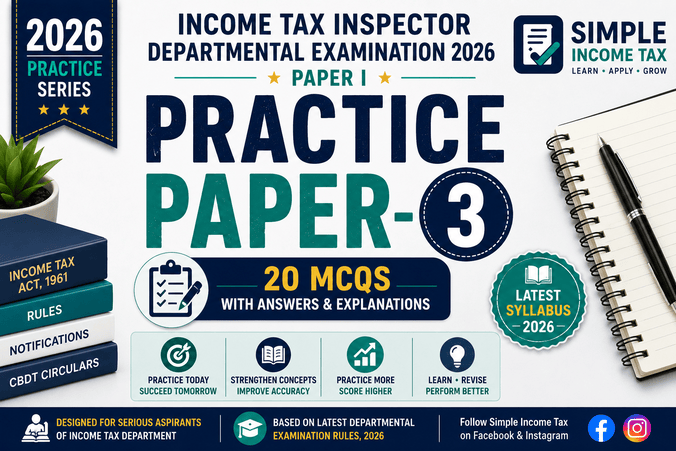

Every practice session is an opportunity to improve your knowledge and examination skills. If you have already attempted the previous Practice Papers, you are steadily building the confidence and accuracy required to succeed in the Income Tax Inspector Departmental Examination. To help you continue this journey, Simple Income Tax presents Practice Paper-3, another set of carefully prepared multiple-choice questions based on the latest Departmental Examination Rules, 2026 and the prescribed syllabus.
This Practice Paper consists of 20 original MCQs covering important topics from Paper I. The questions have been designed to test your conceptual understanding, practical application and analytical thinking, while remaining different from those asked in the 2025 Departmental Examination. Detailed answers and explanations have been provided for every question to help you understand the concepts thoroughly and learn from any mistakes.
Treat this Practice Paper as a mini mock test. Attempt all the questions without referring to the answers, note your score, and then carefully review the explanations. Consistent practice and regular revision are the keys to mastering the syllabus and performing confidently in the departmental examination.
1. Mr. A filed his return of income within the due date. Subsequently, he received an intimation highlighting a mismatch between the income reported in the return and the information available with the Department. Before taking any further action, the taxpayer should:
a) Ignore the communication because the return has already been filed.
b) Verify the information available in AIS/Form 26AS and maintain supporting records before taking appropriate action.
c) File another original return immediately.
d) Pay the additional tax without verifying the information.
Answer: (b)
Explanation:
The taxpayer should first reconcile the information available in AIS/Form 26AS with his books and records. Any corrective action should be based on proper verification.
2. Consider the following statements regarding PAN:
Statement I: PAN serves as a unique identifier for taxpayers under the Income Tax Act.
Statement II: A taxpayer may obtain multiple PANs for different businesses.
Choose the correct option.
a) Both statements are true.
b) Both statements are false.
c) Statement I is true but Statement II is false.
d) Statement I is false but Statement II is true.
Answer: (c)
Explanation:
Only one PAN is allotted to a person. Separate businesses of the same person do not require separate PANs.
3. Which of the following best reflects the objective of the Annual Information Statement (AIS)?
a) To levy tax on every financial transaction.
b) To assist taxpayers in correctly reporting income by providing comprehensive financial information.
c) To replace the Income Tax Return.
d) To issue refunds automatically.
Answer: (b)
Explanation:
AIS is intended to improve voluntary compliance by enabling taxpayers to verify information before filing their return.
4. Consider the following statements:
Statement I: Tax deducted at source is treated as payment of tax on behalf of the taxpayer.
Statement II: Credit of TDS is generally available subject to the provisions of the Income Tax Act.
Choose the correct option.
a) Both statements are true.
b) Both statements are false.
c) Statement I is true but Statement II is false.
d) Statement I is false but Statement II is true.
Answer: (a)
Explanation:
TDS is a mode of tax collection, and the taxpayer is generally entitled to claim credit, subject to statutory provisions.
5. Which one of the following is the most important responsibility of an Income Tax Inspector during assessment proceedings?
a) To pass assessment orders independently.
b) To assist the Assessing Officer by collecting facts, verifying records and performing duties assigned under the Act and departmental instructions.
c) To approve refunds.
d) To impose penalties independently.
Answer: (b)
Explanation:
The Inspector assists the Assessing Officer by conducting enquiries, verification, inspections and other duties assigned under the Income Tax Act and departmental instructions.
6. Mr. X receives a notice requiring him to furnish certain information electronically. He is unable to respond immediately. Which of the following is the most appropriate course of action?
a) Ignore the notice.
b) Respond within the prescribed time or seek appropriate relief wherever permitted.
c) Wait until a penalty is imposed.
d) Visit the office without replying online.
Answer: (b)
Explanation:
Taxpayers should comply within the prescribed time. Where permitted, an extension or appropriate relief may be sought.
7. Consider the following statements:
Statement I: Every deduction available under Chapter VI-A is automatic.
Statement II: Deductions are generally available only when the prescribed conditions are satisfied.
Choose the correct option.
a) Both statements are true.
b) Both statements are false.
c) Statement I is false but Statement II is true.
d) Statement I is true but Statement II is false.
Answer: (c)
Explanation:
Deductions under Chapter VI-A are available only if all statutory conditions are fulfilled and the necessary evidence is maintained.
8. Which of the following best describes voluntary tax compliance?
a) Paying tax only after receiving a notice.
b) Filing returns, paying taxes, maintaining records and responding to departmental communications within the prescribed time.
c) Filing return only when refund is expected.
d) Filing return only after scrutiny notice.
Answer: (b)
Explanation:
Voluntary compliance includes timely filing, payment of taxes, record maintenance and prompt response to statutory communications.
9. Mr. A receives interest income on fixed deposits. Tax has been deducted at source by the bank. Which statement is correct?
a) The interest becomes exempt because TDS has been deducted.
b) TDS is only a mode of collection of tax and the interest continues to be taxable according to the Act.
c) The taxpayer should not disclose the interest in the return.
d) The interest is taxable only if it exceeds Rs. 10 lakh.
Answer: (b)
Explanation:
TDS is only a mechanism for collection of tax. The taxpayer must report the interest income and claim credit for the TDS, if eligible.
10. Consider the following statements:
Statement I: Digital initiatives of the Income Tax Department aim to improve taxpayer services.
Statement II: Faceless proceedings seek to enhance transparency and reduce unnecessary physical interface between taxpayers and the Department.
Choose the correct option.
a) Both statements are true.
b) Both statements are false.
c) Statement I is true but Statement II is false.
d) Statement I is false but Statement II is true.
Answer: (a)
Explanation:
The Department’s digital transformation—including e-filing, AIS, online grievance redressal and faceless proceedings—is intended to improve efficiency, transparency and taxpayer convenience.
11. Mr. A filed his return of income within the due date. While preparing for a housing loan, he noticed that interest income of Rs. 95,000 from a bank fixed deposit was inadvertently omitted from his return. The time limit for filing a revised return is still available. What should he do?
a) File an Updated Return.
b) Wait for a notice from the Department.
c) File a Revised Return.
d) No action is necessary because TDS has already been deducted.
Answer: (c) File a Revised Return.
Explanation:
When the statutory time limit for filing a revised return is still available, a revised return is the appropriate remedy for correcting omissions or wrong statements.
12. Consider the following statements regarding PAN:
Statement I: Every person can possess only one Permanent Account Number (PAN).
Statement II: If a duplicate PAN has been allotted inadvertently, the duplicate PAN should be surrendered as per the prescribed procedure.
Choose the correct option.
a) Both statements are true.
b) Both statements are false.
c) Statement I is true but Statement II is false.
d) Statement I is false but Statement II is true.
Answer: (a)
Explanation:
A person should have only one PAN. Where multiple PANs have been allotted, the duplicate PAN should be surrendered.
13. Which of the following statements regarding Form 26AS and AIS is correct?
a) Form 26AS has completely replaced AIS.
b) AIS and Form 26AS serve different purposes and complement each other.
c) Only AIS is legally recognized.
d) Neither AIS nor Form 26AS can be relied upon by taxpayers.
Answer: (b)
Explanation:
Form 26AS and AIS contain different categories of tax and financial information and are intended to be used together for accurate tax compliance.
14. A taxpayer receives a notice electronically from the Income Tax Department. Which of the following actions is most appropriate?
a) Wait until a physical copy is delivered.
b) Ignore the notice if no SMS is received.
c) Verify its authenticity through the e-Filing portal and respond within the prescribed time.
d) Reply only after consulting the bank.
Answer: (c)
Explanation:
Official communications should be verified through the registered e-Filing account, and replies should be furnished within the prescribed time.
15. Consider the following statements:
Statement I: TDS deducted by the deductor is treated as tax paid on behalf of the deductee.
Statement II: Mere deduction of TDS automatically exempts the corresponding income from taxation.
Choose the correct option.
a) Both statements are true.
b) Both statements are false.
c) Statement I is true but Statement II is false.
d) Statement I is false but Statement II is true.
Answer: (c)
Explanation:
TDS is only a mode of tax collection. The underlying income remains taxable according to the provisions of the Income Tax Act.
16. Which of the following best reflects the objective of faceless assessment?
a) To increase personal interaction between taxpayers and tax authorities.
b) To eliminate the right of hearing.
c) To improve transparency, accountability and efficiency by using technology.
d) To replace the Income Tax Act.
Answer: (c)
Explanation:
Faceless assessment is intended to reduce physical interface while promoting transparency, efficiency and accountability.
17. Consider the following statements regarding the Taxpayers’ Charter:
Statement I: The Department is committed to providing fair, courteous and reasonable treatment to taxpayers.
Statement II: Taxpayers are expected to maintain accurate records and comply honestly with tax laws.
Choose the correct option.
a) Both statements are true.
b) Both statements are false.
c) Statement I is true but Statement II is false.
d) Statement I is false but Statement II is true.
Answer: (a)
Explanation:
The Taxpayers’ Charter creates reciprocal obligations—fair administration by the Department and honest compliance by taxpayers.
18. Which of the following statements is correct regarding self-assessment tax?
a) It is payable only after assessment is completed.
b) It is paid voluntarily before filing the return wherever tax remains payable after considering prepaid taxes.
c) It is payable only after receipt of a demand notice.
d) It is applicable only to companies.
Answer: (b)
Explanation:
Self-assessment tax is paid before filing the return whenever the total tax liability exceeds advance tax, TDS/TCS and other available credits.
19. Mr. B received a refund from the Income Tax Department through direct credit into his bank account. Which statement is correct?
a) Every refund is exempt from verification.
b) Taxpayers should verify that the refund corresponds with the return processed by the Department.
c) Refund once received can never be adjusted in future.
d) Refunds are issued only after scrutiny assessment.
Answer: (b)
Explanation:
Taxpayers should always verify that the refund received agrees with the processed return or the relevant order issued by the Department.
20. Consider the following statements:
Statement I: Voluntary compliance is one of the primary objectives of tax administration.
Statement II: Digital services such as e-Filing, AIS, e-Verification and online grievance redressal are intended to improve taxpayer services.
Choose the correct option.
a) Both statements are true.
b) Both statements are false.
c) Statement I is true but Statement II is false.
d) Statement I is false but Statement II is true.
Answer: (a)
Explanation:
Modern tax administration emphasizes voluntary compliance through digital governance, taxpayer-friendly services and transparent procedures.
You have now completed Practice Paper-3, bringing you another step closer to achieving your goal. Remember, success in the Income Tax Inspector Departmental Examination comes from consistent practice, careful revision, and learning from every attempt. Take time to analyse the explanations, revisit the topics where you made mistakes, and strengthen your understanding before moving ahead. Continue with the next Practice Paper in this series to maintain your momentum and improve your overall performance. If you found this practice paper useful, consider sharing it with your colleagues and fellow aspirants. Simple Income Tax wishes you continued success in your preparation and the very best for the departmental examination.
Disclaimer
This Practice Paper has been prepared by Simple Income Tax for educational and self-practice purposes only. The questions, answers and explanations are original and based on the latest syllabus and relevant provisions available at the time of publication. This content is not an official question paper or answer key issued by the Income Tax Department or any Government authority. Candidates are advised to refer to the latest official notifications, rules and instructions for authentic guidance.
Related Article on Simple Income Tax
- ITI Departmental Examination 2025 (Paper I): Solved Previous Year Question Paper with Answers & Explanations (PART-1)
- ITI Departmental Examination 2025 (Paper I): Solved Previous Year Question Paper with Answers & Explanations (Part-2)
- ITI Departmental Examination 2025 (Paper I): Solved Previous Year Question Paper with Answers & Explanations (Part – 3)
Always refer official website of Income Tax Department
About the Author