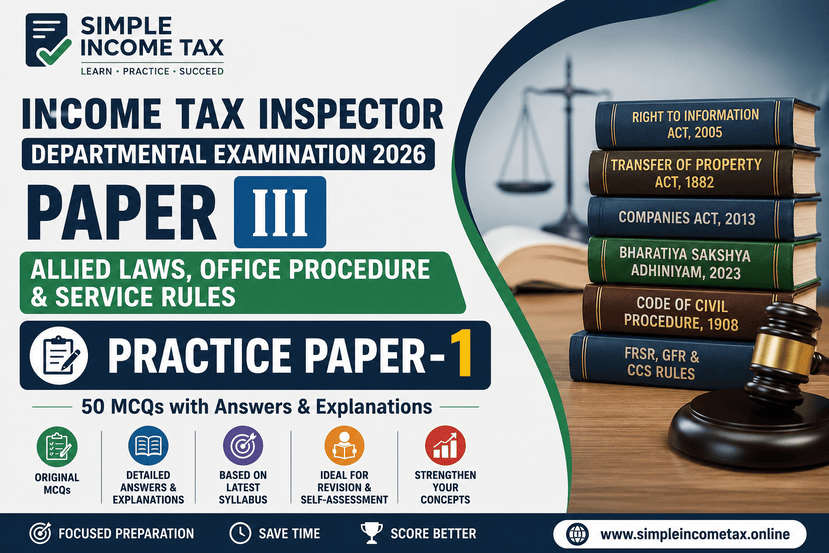
Welcome to Practice Paper–1 of our Income Tax Inspector Departmental Examination 2026 – Paper III series. This practice paper has been prepared to help aspirants strengthen their understanding of the Allied Laws, Office Procedure and Service Rules prescribed under the latest Departmental Examination syllabus. The questions are designed to test both conceptual clarity and practical knowledge, enabling candidates to assess their preparation and identify areas that require further revision.
Whether you are preparing for the examination for the first time or revising before the exam, this practice paper will serve as a valuable self-assessment tool.
Income Tax Inspector Departmental Examination 2026
Paper III – Allied Laws, Office Procedure & Service Rules
Sample Paper–3 [PART-1]
Q.1. Under the Right to Information Act, 2005, information should ordinarily be provided within:
A. 15 days
B. 30 days
C. 45 days
D. 60 days
Q.2. Which authority hears the first appeal under the Right to Information Act, 2005?
A. Central Information Commission
B. Public Information Officer
C. First Appellate Authority
D. Chief Commissioner
Q.3. Under the Transfer of Property Act, 1882, a transfer of ownership in exchange for a price paid or promised is called:
A. Mortgage
B. Lease
C. Sale
D. Gift
Q.4. A document relating to the transfer of immovable property exceeding the prescribed value is compulsorily registrable under the:
A. Indian Stamp Act
B. Registration Act, 1908
C. Bharatiya Sakshya Adhiniyam, 2023
D. Companies Act, 2013
Q.5. Which of the following is not a mode of transfer under the Transfer of Property Act, 1882?
A. Sale
B. Mortgage
C. Lease
D. Succession
Q.6. The Companies Act, 2013 primarily governs:
A. Banking transactions
B. Companies incorporated in India
C. Civil Courts
D. Income Tax Assessments
Q.7. The Bharatiya Sakshya Adhiniyam, 2023 primarily deals with:
A. Criminal offences
B. Rules relating to evidence
C. Income Tax procedure
D. Company audit
Q.8. Electronic records are recognized as evidence under:
A. Transfer of Property Act
B. Registration Act
C. Bharatiya Sakshya Adhiniyam, 2023
D. Specific Relief Act
Q.9. The Code of Civil Procedure, 1908 mainly lays down:
A. Criminal procedure
B. Civil court procedure
C. Tax assessment procedure
D. Departmental inquiry procedure
Q.10. Which Act governs the protection of women from sexual harassment at the workplace?
A. POSH Act, 2013
B. RTI Act, 2005
C. RPwD Act, 2016
D. Companies Act, 2013
Q.11. The General Financial Rules (GFR) mainly relate to:
A. Income Tax computation
B. Financial management in Government
C. Company audit
D. Criminal investigation
Q.12. The Delegation of Financial Powers Rules deal with:
A. Transfer of property
B. Financial powers of Government authorities
C. Registration of companies
D. Court procedures
Q.13. The CCS (Conduct) Rules primarily prescribe:
A. Tax rates
B. Conduct of Government servants
C. Civil procedure
D. Audit procedure
Q.14. The CCS (CCA) Rules, 1965 mainly relate to:
A. Leave
B. Pension
C. Discipline and appeals
D. Income Tax assessments
Q.15. Which CCS Rules govern leave admissible to Central Government employees?
A. CCS (Pension) Rules
B. CCS (Leave) Rules, 1972
C. CCS (CCA) Rules
D. CCS (Conduct) Rules
Q.16. The Manual of Office Procedure mainly deals with:
A. Filing and office management
B. Tax computation
C. Property registration
D. Company incorporation
Q.17. The Rights of Persons with Disabilities Act, 2016 aims to:
A. Levy tax
B. Protect rights of persons with disabilities
C. Register companies
D. Conduct departmental examinations
Q.18. The Fundamental Rules and Supplementary Rules (FRSR) primarily govern:
A. Company law
B. Service conditions of Government employees
C. Civil litigation
D. Income Tax proceedings
Q.19. Travelling Allowance Rules are contained in:
A. FRSR Part I
B. FRSR Part II
C. FRSR Part III
D. FRSR Part IV
Q.20. Leave Rules are covered in:
A. FRSR Part I
B. FRSR Part II
C. FRSR Part III
D. FRSR Part IV
Q.21. The CCS (Pension) Rules, 2021 apply to:
A. Private employees
B. Central Government employees
C. State Government employees only
D. Public Sector Undertakings only
Q.22. Which rule book contains provisions relating to House Rent Allowance (HRA)?
A. FRSR Part I
B. FRSR Part II
C. FRSR Part III
D. FRSR Part IV
Q.23. The primary objective of the Right to Information Act, 2005 is to:
A. Increase tax collection
B. Promote transparency and accountability
C. Regulate companies
D. Control Government expenditure
Q.24. Which authority is empowered to impose penalties under the RTI Act on a Public Information Officer?
A. District Court
B. Central Information Commission
C. Supreme Court
D. Ministry of Finance
Q.25. A gift of immovable property under the Transfer of Property Act, 1882 must be:
A. Oral
B. Registered
C. Notarised only
D. Published in a newspaper
Q.26. A lease of immovable property creates:
A. Ownership
B. Possession for a specified period
C. Mortgage rights
D. Easement only
Q.27. Under the Companies Act, 2013, every company must have:
A. PAN only
B. Certificate of Incorporation
C. GST Registration only
D. Import Export Code
Q.28. The Companies Act, 2013 is administered by the:
A. CBDT
B. Ministry of Corporate Affairs
C. Ministry of Finance
D. RBI
Q.29. The Bharatiya Sakshya Adhiniyam, 2023 replaced the:
A. Indian Penal Code
B. Indian Evidence Act, 1872
C. Code of Civil Procedure
D. Companies Act
Q.30. Evidence which directly proves a fact in issue is called:
A. Secondary evidence
B. Circumstantial evidence
C. Direct evidence
D. Documentary presumption
Q.31. The Code of Civil Procedure, 1908 primarily applies to:
A. Criminal cases
B. Civil disputes
C. Income Tax appeals
D. Departmental enquiries
Q.32. Execution of a civil decree is governed by the:
A. Companies Act
B. Code of Civil Procedure
C. RTI Act
D. Registration Act
Q.33. The Manual of Office Procedure mainly promotes:
A. Uniform office procedures
B. Tax computation
C. Criminal investigation
D. Banking operations
Q.34. Government records should be maintained as per:
A. Manual of Office Procedure
B. Companies Act
C. RTI Rules only
D. CPC
Q.35. Which Rules regulate the conduct expected from Central Government employees?
A. CCS (CCA) Rules
B. CCS (Conduct) Rules
C. CCS (Leave) Rules
D. Pension Rules
Q.36. Minor and major penalties on Government servants are prescribed under:
A. CCS (CCA) Rules
B. CCS (Conduct) Rules
C. GFR
D. FRSR
Q.37. Which Rules regulate Government expenditure?
A. Income Tax Rules
B. General Financial Rules
C. CCS Leave Rules
D. CPC
Q.38. The Delegation of Financial Powers Rules deal with:
A. Delegation of financial authority
B. Leave matters
C. Income Tax assessment
D. Company audit
Q.39. The Rights of Persons with Disabilities Act, 2016 aims to ensure:
A. Higher taxation
B. Equal opportunity
C. Company registration
D. Property transfer
Q.40. The POSH Act, 2013 requires every eligible establishment to constitute:
A. Audit Committee
B. Internal Committee
C. Vigilance Committee
D. Finance Committee
Q.41. The Right to Information Act, 2005 applies to:
A. Public Authorities
B. Private companies only
C. NGOs only
D. Cooperative societies only
Q.42. The Registration Act, 1908 mainly provides for:
A. Company incorporation
B. Registration of documents
C. Property taxation
D. Income Tax assessment
Q.43. Which Act governs mortgages, gifts and leases?
A. Companies Act
B. Transfer of Property Act
C. RTI Act
D. CPC
Q.44. The Information Technology Act primarily deals with:
A. Electronic governance and cyber laws
B. Income Tax
C. Property transfer
D. Company audit
Q.45. Which publication contains rules relating to Government advances?
A. CCS Leave Rules
B. Compendium of Rules on Advances
C. Companies Act
D. CPC
Q.46. FRSR mainly relates to:
A. Service conditions of Government employees
B. Income Tax assessments
C. Registration of companies
D. Court procedure
Q.47. The Manual of Office Procedure is intended to improve:
A. Office efficiency
B. Tax collection
C. Judicial proceedings
D. Audit reports
Q.48. The CCS (Leave) Rules, 1972 regulate:
A. Salary
B. Leave
C. Pension
D. Discipline
Q.49. The General Financial Rules are applicable primarily to:
A. Government Departments
B. Private companies
C. Banks only
D. Cooperative societies
Q.50. Which of the following is NOT an Allied Law prescribed for Paper III?
A. Companies Act, 2013
B. Transfer of Property Act, 1882
C. Goods and Services Tax Act, 2017
D. Registration Act, 1908
Answer Key with Explanations
Q.1 Answer: B. 30 days
Explanation: Under the RTI Act, information is generally required to be provided within 30 days from the receipt of the application.
Q.2 Answer: C. First Appellate Authority
Explanation: If an applicant is dissatisfied with the decision of the Public Information Officer (PIO), the first appeal lies before the First Appellate Authority.
Q.3 Answer: C. Sale
Explanation: A transfer of ownership of property in exchange for a price paid or promised is known as a sale under the Transfer of Property Act, 1882.
Q.4 Answer: B. Registration Act, 1908
Explanation: Certain documents relating to immovable property are compulsorily registrable under the Registration Act, 1908.
Q.5 Answer: D. Succession
Explanation: Succession takes place by operation of law and is not a mode of transfer under the Transfer of Property Act, 1882.
Q.6 Answer: B. Companies incorporated in India
Explanation: The Companies Act, 2013 governs the incorporation, management and regulation of companies in India.
Q.7 Answer: B. Rules relating to evidence
Explanation: The Bharatiya Sakshya Adhiniyam, 2023 lays down the law relating to evidence in judicial proceedings.
Q.8 Answer: C. Bharatiya Sakshya Adhiniyam, 2023
Explanation: The Act recognizes electronic records as admissible evidence, subject to the prescribed conditions.
Q.9 Answer: B. Civil court procedure
Explanation: The Code of Civil Procedure, 1908 prescribes the procedure to be followed in civil courts.
Q.10 Answer: A. POSH Act, 2013
Explanation: The POSH Act protects women against sexual harassment at the workplace and provides a mechanism for redressal.
Q.11 Answer: B. Financial management in Government
Explanation: The General Financial Rules (GFR) regulate Government financial management, expenditure and procurement.
Q.12 Answer: B. Financial powers of Government authorities
Explanation: The Delegation of Financial Powers Rules specify the financial powers delegated to various Government authorities.
Q.13 Answer: B. Conduct of Government servants
Explanation: The CCS (Conduct) Rules prescribe the standards of conduct expected from Central Government employees.
Q.14 Answer: C. Discipline and appeals
Explanation: The CCS (CCA) Rules, 1965 deal with disciplinary proceedings, penalties and appeals.
Q.15 Answer: B. CCS (Leave) Rules, 1972
Explanation: These Rules govern the grant and regulation of leave to Central Government employees.
Q.16 Answer: A. Filing and office management
Explanation: The Manual of Office Procedure lays down procedures relating to file management, record keeping and office work.
Q.17 Answer: B. Protect rights of persons with disabilities
Explanation: The Rights of Persons with Disabilities Act, 2016 safeguards the rights and interests of persons with disabilities.
Q.18 Answer: B. Service conditions of Government employees
Explanation: The Fundamental Rules and Supplementary Rules (FRSR) regulate the service conditions of Central Government employees.
Q.19 Answer: B. FRSR Part II
Explanation: Part II of the FRSR contains the Travelling Allowance Rules.
Q.20 Answer: C. FRSR Part III
Explanation: Part III of the FRSR deals with the Leave Rules applicable to Central Government employees.
Q.21 Answer: B. Central Government employees
Explanation: The CCS (Pension) Rules, 2021 regulate pensionary benefits of eligible Central Government employees.
Q.22 Answer: D. FRSR Part IV
Explanation: FRSR Part IV contains provisions relating to Dearness Allowance (DA), Dearness Relief (DR) and House Rent Allowance (HRA).
Q.23 Answer: B. Promote transparency and accountability
Explanation: The RTI Act aims to promote transparency and accountability in the functioning of public authorities.
Q.24 Answer: B. Central Information Commission
Explanation: The Central Information Commission can impose penalties on a Central Public Information Officer for non-compliance with the RTI Act.
Q.25 Answer: B. Registered
Explanation: A gift of immovable property must be made through a registered instrument signed by the donor.
Q.26 Answer: B. Possession for a specified period
Explanation: A lease transfers the right to enjoy immovable property for a specified period in consideration of rent or premium.
Q.27 Answer: B. Certificate of Incorporation
Explanation: Every company comes into existence only after the issue of a Certificate of Incorporation.
Q.28 Answer: B. Ministry of Corporate Affairs
Explanation: The Companies Act, 2013 is administered by the Ministry of Corporate Affairs (MCA).
Q.29 Answer: B. Indian Evidence Act, 1872
Explanation: The Bharatiya Sakshya Adhiniyam, 2023 replaced the Indian Evidence Act, 1872.
Q.30 Answer: C. Direct evidence
Explanation: Direct evidence directly proves a fact in issue without requiring inference.
Q.31 Answer: B. Civil disputes
Explanation: The Code of Civil Procedure, 1908 governs the procedure followed in civil courts.
Q.32 Answer: B. Code of Civil Procedure
Explanation: The CPC contains provisions relating to the execution of civil decrees.
Q.33 Answer: A. Uniform office procedures
Explanation: The Manual of Office Procedure ensures uniformity and efficiency in Government offices.
Q.34 Answer: A. Manual of Office Procedure
Explanation: Government records and files are maintained in accordance with the Manual of Office Procedure.
Q.35 Answer: B. CCS (Conduct) Rules
Explanation: These Rules prescribe ethical standards and conduct for Central Government employees.
Q.36 Answer: A. CCS (CCA) Rules
Explanation: The CCS (CCA) Rules, 1965 provide for disciplinary proceedings and penalties.
Q.37 Answer: B. General Financial Rules
Explanation: The GFR lays down principles for Government financial management and expenditure.
Q.38 Answer: A. Delegation of financial authority
Explanation: The Delegation of Financial Powers Rules specify the financial powers delegated to different authorities.
Q.39 Answer: B. Equal opportunity
Explanation: The Rights of Persons with Disabilities Act, 2016 promotes equality, non-discrimination and accessibility.
Q.40 Answer: B. Internal Committee
Explanation: The POSH Act requires every eligible establishment to constitute an Internal Committee to address complaints of sexual harassment.
Q.41 Answer: A. Public Authorities
Explanation: The RTI Act applies to public authorities as defined under the Act.
Q.42 Answer: B. Registration of documents
Explanation: The Registration Act, 1908 provides for the registration of specified documents affecting property and other rights.
Q.43 Answer: B. Transfer of Property Act
Explanation: The Transfer of Property Act governs transfers such as sale, mortgage, lease, exchange and gift.
Q.44 Answer: A. Electronic governance and cyber laws
Explanation: The Information Technology Act provides legal recognition to electronic records and deals with cyber-related matters.
Q.45 Answer: B. Compendium of Rules on Advances
Explanation: This publication contains the rules governing various advances admissible to Government employees.
Q.46 Answer: A. Service conditions of Government employees
Explanation: The Fundamental Rules and Supplementary Rules regulate important service matters of Central Government employees.
Q.47 Answer: A. Office efficiency
Explanation: The Manual of Office Procedure standardizes office work to improve efficiency and record management.
Q.48 Answer: B. Leave
Explanation: The CCS (Leave) Rules, 1972 govern the grant, regulation and admissibility of leave.
Q.49 Answer: A. Government Departments
Explanation: The General Financial Rules primarily regulate financial management in Government Departments.
Q.50 Answer: C. Goods and Services Tax Act, 2017
Explanation: The GST Act is not one of the prescribed Allied Laws for Paper III of the Income Tax Inspector Departmental Examination.
We hope Practice Paper–3 has helped you evaluate your preparation and strengthen your understanding of the important topics covered in Paper III. Regular practice is the key to success in departmental examinations, and solving topic-based MCQs is an effective way to improve both accuracy and confidence.
Stay connected with Simple Income Tax for more practice papers, solved previous year question papers, daily MCQs, study material and the latest updates related to the Income Tax Inspector Departmental Examination 2026.
Disclaimer
Disclaimer: This practice paper has been prepared by Simple Income Tax solely for educational and practice purposes. The questions are original and intended to simulate the pattern and standard of the departmental examination. While every effort has been made to ensure accuracy, candidates should always refer to the latest Acts, Rules, departmental instructions and official notifications for authoritative guidance.
Suggested Article on Simple Income Tax
Departmental Examination 2026 Study Materials
Visit Official website of Income Tax Department
About the Author