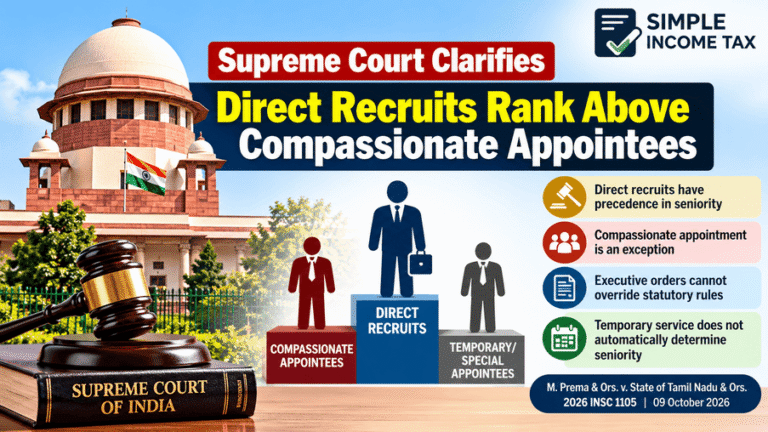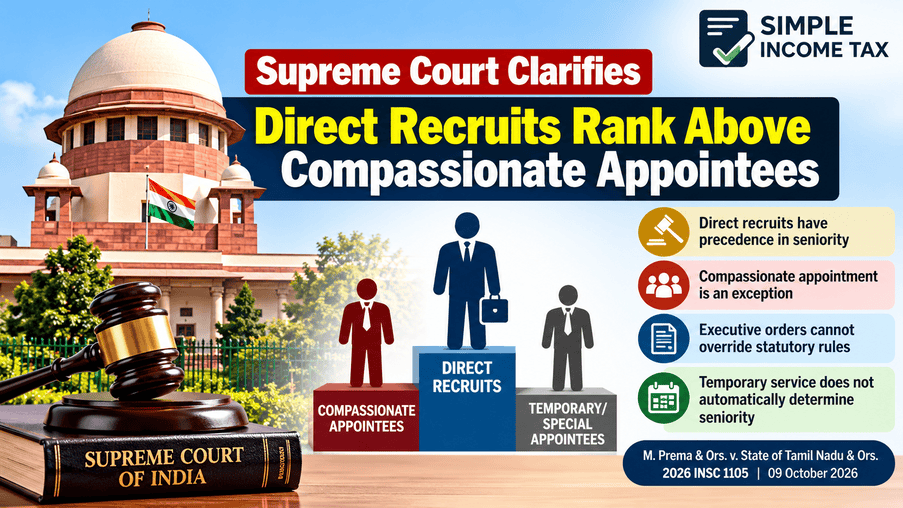

The Supreme Court of India has delivered a significant judgment holding that Direct Recruits Rank Above Compassionate Appointees in matters of seniority governed by the applicable statutory service rules. In M. Prema & Ors. v. State of Tamil Nadu & Ors., 2026 INSC 1105 (decided on 09 October 2026), the Court clarified that appointments made through the regular recruitment process cannot ordinarily be placed below compassionate appointees in the seniority list merely because the latter joined service earlier. The judgment reaffirms the constitutional principles of equality in public employment and emphasizes that compassionate appointment, being an exception to the normal recruitment process, does not confer a preferential right to seniority over direct recruits.
Although the dispute arose under the Tamil Nadu Ministerial Service Rules, the judgment reiterates well-settled principles of service jurisprudence that may be relevant in similar disputes across Government departments.
Background of the Case
The litigation involved a dispute regarding the determination of seniority among three categories of employees:
- Direct recruits selected through the Tamil Nadu Public Service Commission (TNPSC).
- Compassionate appointees appointed to provide immediate financial assistance to the family of a deceased Government employee.
- Special or temporary appointees whose services were later regularised.
The primary issue before the Supreme Court was whether compassionate or temporary appointees could claim seniority over direct recruits merely because they entered service earlier.
Supreme Court’s Key Findings
After examining the applicable statutory service rules and earlier judicial precedents, the Supreme Court laid down the following important principles:
1. Direct recruits have precedence in seniority
The Court held that employees appointed through the regular recruitment process are entitled to seniority in accordance with the applicable recruitment rules. Compassionate appointees cannot automatically rank above direct recruits simply because they joined service earlier.
2. Compassionate appointment is an exception
Compassionate appointment is intended solely to provide immediate financial relief to the family of a deceased Government employee. It is an exception to the normal recruitment process and does not constitute an independent source of recruitment equivalent to competitive selection.
3. Executive Orders cannot override statutory rules
The Court reiterated that an Executive Order issued under Article 162 of the Constitution cannot override statutory service rules framed under law. Whenever there is any conflict, the statutory rules prevail.
4. Temporary service does not automatically determine seniority
The Court observed that although temporary or ad hoc service may, in certain situations, be recognised for limited purposes where permitted by law, such service does not automatically confer seniority over employees appointed through regular recruitment.
Constitutional Principles Reaffirmed
The judgment strengthens the constitutional guarantee of equality in public employment under Articles 14 and 16 of the Constitution of India.
The Supreme Court observed that:
- Public employment should ordinarily be filled through a transparent recruitment process.
- Compassionate appointment remains a humanitarian exception.
- Seniority must be determined strictly in accordance with the applicable statutory recruitment rules.
Why This Judgment is Important
This decision is significant because disputes relating to seniority frequently arise in Central Government Departments, State Governments, Public Sector Undertakings and other public authorities.
The judgment provides clarity on several important issues:
- Seniority of direct recruits.
- Rights of compassionate appointees.
- Effect of regularisation of temporary employees.
- Applicability of executive instructions.
- Interpretation of statutory service rules.
Departments dealing with seniority disputes may rely upon this judgment while preparing or revising seniority lists wherever applicable.
Practical Impact on Government Employees
Government employees involved in promotion or seniority disputes should note the following principles emerging from the judgment:
- Entry into service alone does not determine seniority.
- Statutory service rules remain the governing factor.
- Compassionate appointment does not create a preferential claim over regularly recruited employees.
- Executive instructions cannot alter statutory provisions governing service conditions.
Since service rules differ from one department or cadre to another, the applicability of the judgment will depend upon the relevant statutory rules governing the concerned service.
Official Case Details
Case: M. Prema & Ors. v. State of Tamil Nadu & Ors.
Neutral Citation: 2026 INSC 1105
Court: Supreme Court of India
Date of Judgment: 09 October 2026
Official Judgment Search: https://www.sci.gov.in/judgments/
Conclusion
The Supreme Court has reaffirmed that regular recruitment through a competitive process remains the primary mode of appointment in public service. Compassionate appointment is a welfare measure intended to provide immediate relief and cannot override the statutory principles governing seniority.
The judgment reinforces the supremacy of statutory service rules and provides valuable guidance for Government departments, employees and service law practitioners dealing with seniority disputes.
Disclaimer
This article is intended solely for educational and informational purposes. It provides a general summary of the Supreme Court judgment and should not be construed as legal advice. Readers are advised to refer to the complete judgment and the applicable service rules before taking any decision or forming any legal opinion.
Related Article in Simple Income Tax
CBDT Clarifies Inter-se Seniority of Promote Inspectors
Supreme Court’s Judgment on Seniority Dispute – What Government Employees Must Know
Source : Indian Kanoon
About the Author