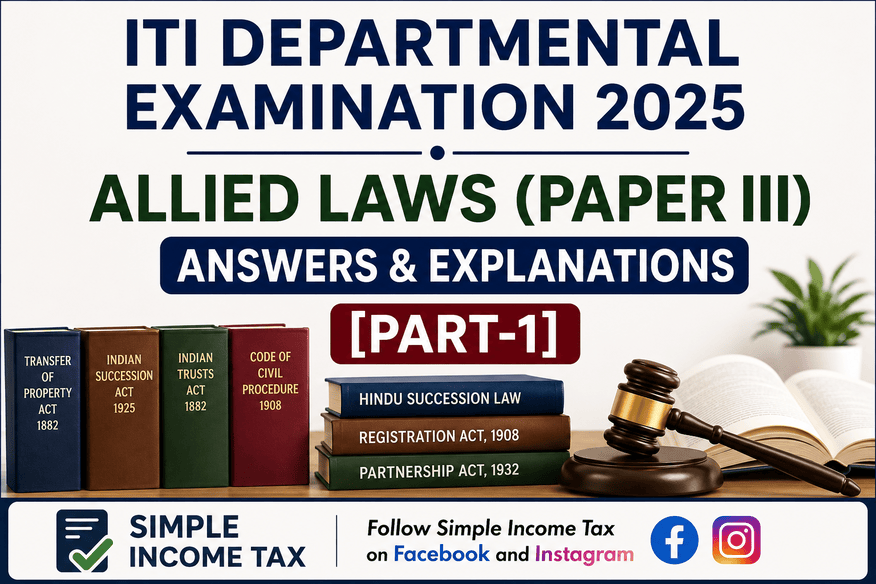

The Allied Laws paper is one of the most important subjects in the Income Tax Inspector ITI Departmental Examination 2025. Unlike the Income Tax Act, this paper evaluates a candidate’s understanding of various supporting legislations that are frequently encountered while discharging official duties in the Income Tax Department. Questions are designed to test both conceptual clarity and practical application of legal provisions.
This paper covers important provisions of the Transfer of Property Act, 1882, Indian Succession Act, 1925, Indian Trusts Act, 1882, Code of Civil Procedure, 1908 (CPC), and Hindu Succession Law, among other allied statutes. A thorough knowledge of these laws helps departmental officers understand issues relating to property transfers, succession, trusts, execution of decrees, civil procedures, and legal rights that often arise during assessment, recovery, investigation, attachment proceedings, and other departmental functions.
To assist aspirants preparing for the ITI Departmental Examination 2025, this article provides the official objective questions (MCQs) from Paper III – Allied Laws, along with the correct answers and brief explanations for quick revision. Practicing these questions will help candidates understand the examination pattern, identify important legal provisions, and strengthen their conceptual foundation for future departmental examinations.
Question 1. In the context of a joint property, a co-owner can transfer his share under Section 44 of the Transfer of Property Act. However, the transferee:
a) Becomes a joint owner with the remaining owners
b) Acquires the right to possess the entire property
c) Has no rights in the property
d) Must pay compensation to other co-owners
Correct Answer: (a) Becomes a joint owner with the remaining owners
Explanation: Under Section 44 of the Transfer of Property Act, the transferee steps into the shoes of the transferor and becomes a co-owner to the extent of the transferred share.
Question 2. Which of the following statements regarding the Transfer of Property Act, 1882, is incorrect?
a) Section 5 defines the term “transfer of property” as an act by which a living person conveys property to one or more living persons or to themselves and one or more other living persons.
b) Section 6 states that all properties can be transferred, along with interest in property restricted in its enjoyment to the owner personally.
c) Section 7 provides that any person competent to contract and entitled to transferable property can transfer such property.
d) Section 11 allows the transferor to impose conditions that absolutely restrict the transferee from further transferring the property.
Correct Answer: (d) Section 11 allows the transferor to impose conditions that absolutely restrict the transferee from further transferring the property.
Explanation: Section 11 does not permit an absolute restraint on alienation; such conditions are generally void.
Question 3. Under Section 6 of the Transfer of Property Act, which property cannot be transferred?
a) An easement apart from the dominant heritage
b) Property held by a minor
c) Leasehold property
d) Agricultural land
Correct Answer: (a) An easement apart from the dominant heritage
Explanation: An easement cannot be transferred independently from the dominant heritage to which it is attached.
Question 4. Under the Transfer of Property Act, 1882, if a leased property is destroyed due to fire or other calamity, the lessee may:
a) Continue to pay rent without right to terminate
b) Claim insurance from the lessor
c) Terminate the lease without further liability
d) Request a rent reduction
Correct Answer: (c) Terminate the lease without further liability
Explanation: Under Section 108(e), destruction of leased property by fire or other specified causes gives the lessee the option to avoid the lease.
Question 5. Which of the following characteristics are true about a lease transaction as contained in Section 105 of the Transfer of Property Act, 1882?
Statements:
- A lease is a transfer of the right to enjoy immovable property for a certain time or in perpetuity.
- Consideration for a lease is usually in the form of a premium or rent.
- The lessor must transfer ownership of the property to the lessee for the period of the lease.
- A lease transaction can only be created through a registered document, regardless of its term.
Select the correct option:
a) 1 and 2
b) 2 and 3
c) 1, 2, and 4
d) 3 and 4
Correct Answer: (a) 1 and 2
Explanation: A lease transfers only the right to enjoy the property, not ownership, and registration depends upon the duration and nature of the lease.
Question 6. Which of the following statements are correct regarding the transfer of actionable claims under Section 130 of the Transfer of Property Act, 1882?
Statements:
- An actionable claim cannot be transferred without consideration.
- A transfer of an actionable claim is complete and effective only when notice of the transfer is given to the debtor.
- A transfer of an actionable claim must be effected through a written instrument signed by the transferor or their authorized agent.
- The transfer of actionable claims includes a transfer of the right to sue for the claim.
Choose the correct option:
a) Only 1 and 2 are correct
b) Only 2 and 4 are correct
c) Only 3 and 4 are correct
d) Only 1, 3, and 4 are correct
Correct Answer: (c) Only 3 and 4 are correct
Explanation: Section 130 requires a written instrument signed by the transferor, and the assignee acquires the right to enforce the claim.
Question 7. Which of the following statements about mortgages under Section 58 of the Transfer of Property Act, 1882, is incorrect?
a) In a simple mortgage, the borrower keeps possession of the property.
b) In a usufructuary mortgage, the lender can take the property’s rent or profits instead of interest.
c) In an English mortgage, the lender gets complete ownership of the property but must return it when the loan is repaid.
d) In a mortgage by conditional sale, the lender becomes the permanent owner of the property as soon as the loan is given.
Correct Answer: (d) In a mortgage by conditional sale, the lender becomes the permanent owner of the property as soon as the loan is given.
Explanation: Ownership does not become absolute immediately; it depends upon fulfillment of the mortgage conditions.
Question 8. Under Section 53 (Fraudulent Transfers) of the Transfer of Property Act, which of the following statements are true regarding the rights of creditors?
Statements:
- If a debtor transfers immovable property to delay creditors, the transfer is automatically void.
- A fraudulent transfer is voidable at the option of any creditor who is prejudiced by it.
- A transferee acting in good faith and for valid consideration can still retain ownership, even if the transferor’s intent was fraudulent.
Choose the correct option:
a) Only 1 and 2 are correct
b) Only 2 and 3 are correct
c) Only 1 and 3 are correct
d) All 1, 2, and 3 are correct
Correct Answer: (b) Only 2 and 3 are correct
Explanation: Fraudulent transfers are voidable—not automatically void—and bona fide transferees for consideration are protected.
Question 9. A transfers a life estate to B with a provision that if B alienates the property, it shall revert to A’s heirs. Under the Transfer of Property Act, what is the status of this condition?
a) It is valid under the doctrine of reversion.
b) It is enforceable only if B consents.
c) It is void as a restraint on alienation under Section 10.
d) It depends on the nature of the transfer under Section 8.
Correct Answer: (c) It is void as a restraint on alienation under Section 10.
Explanation: An absolute restraint on alienation is void under Section 10 of the Transfer of Property Act.
Question 10. Under Section 49 of the Transfer of Property Act, how does fire insurance on immovable property affect a transferee’s rights?
Statements:
- If the property is insured at the time of transfer, the transferee inherits the benefits of the insurance policy, in the absence of a contract to the contrary.
- The transferor is obligated to use any insurance payout for reinstating the property, provided no contrary contract exists.
- The transferee can claim direct compensation from the insurance company after transfer without the transferor’s involvement.
Choose the correct option:
a) Only 1 and 2 are correct
b) Only 2 and 3 are correct
c) Only 1 and 3 are correct
d) All 1, 2, and 3 are correct
Correct Answer: (a) Only 1 and 2 are correct
Explanation: Section 49 protects the transferee’s equitable interest in insurance proceeds but does not create a direct contractual right against the insurer.
Question 11. When can a charge on an immovable property be enforced as per the Transfer of Property Act, 1882?
a) Only upon court order
b) Upon agreement between the parties
c) Upon default of payment
d) Upon the sale of property
Correct Answer: (c) Upon default of payment
Explanation: A charge becomes enforceable when the secured obligation is not discharged, subject to the provisions of Section 100 of the Transfer of Property Act.
Question 12. Under Section 52 of the Transfer of Property Act, 1882, a property that is subject to a pending court case cannot be transferred. This concept is referred to as:
a) Doctrine of Estoppel
b) Doctrine of Lis Pendens
c) Doctrine of Constructive Notice
d) Doctrine of Priority
Correct Answer: (b) Doctrine of Lis Pendens
Explanation: Section 52 embodies the doctrine of Lis Pendens, which prevents transfer of property during the pendency of litigation affecting that property.
Question 13. Which of the following is an essential condition for applying the doctrine of part performance under Section 53A of the Transfer of Property Act, 1882?
a) The transferee must have filed a suit for specific performance.
b) The transferor must have received full consideration.
c) The contract must be written and the transferee must have acted in furtherance of the contract.
d) The property must have already been registered in the transferee’s name.
Correct Answer: (c) The contract must be written and the transferee must have acted in furtherance of the contract.
Explanation: Section 53A requires a written contract and acts done by the transferee in furtherance of that contract.
Question 14. What happens when an actionable claim is transferred according to Section 130 of the Transfer of Property Act?
a) The transfer is complete once the transfer document is signed, even if the debtor doesn’t know about it.
b) The debtor can ignore the transfer if they haven’t received notice about it.
c) The transferor must agree before the transferee can sue the debtor.
d) The same is valid if fire insurance policy is also transferred the same way as other claims under Section 130.
Correct Answer: (a) The transfer is complete once the transfer document is signed, even if the debtor doesn’t know about it.
Explanation: Transfer of an actionable claim is complete on execution of the written instrument; notice to the debtor is not essential for validity of the transfer.
Question 15. A, B and C have interest in a property in the ratio of 1:1:1 while D’s interest in the property is twice that of A and the said property is sold for Rs. 3 crore without mentioning the share of each person in such consideration in the contract, then which of the statements are true in relation to their share in the consideration for the transfer of property?
a) D shall be entitled to Rs. 1.2 crores in the property.
b) A, B and C shall be entitled to Rs. 50 lakhs each in the property.
c) Cannot say as the consideration has to be divided based on the terms and conditions mentioned in the contract and therefore such contract needs to be revised to explicitly mention the share of consideration for all the transferors.
d) Only (a) and (c) are correct.
Correct Answer: (a) D shall be entitled to Rs. 1.2 crores in the property.
Explanation: In the absence of a contrary contract, sale consideration is distributed according to the proportionate ownership interests.
Question 16. Under Section 55 of the Transfer of Property Act, which of the following statements regarding the rights and liabilities of a seller are correct?
Statements:
- The seller must disclose all material defects in the property, even if the buyer could have discovered them with reasonable diligence.
- The seller must deliver the property to the buyer only after full payment of the purchase price, unless agreed otherwise.
- If multiple buyers acquire different parts of the same property, the buyer of the highest-value lot is entitled to retain the original title documents.
Choose the correct option:
a) Only 1 and 2 are correct
b) Only 2 and 3 are correct
c) Only 1 and 3 are correct
d) All 1, 2, and 3 are correct
Correct Answer: (b) Only 2 and 3 are correct
Explanation: Section 55 obliges delivery as agreed and provides that the buyer of the largest share is entitled to retain title documents; Statement 1 is incorrect.
Question 17. A, B, C, and D jointly own an immovable property with unequal interests. Their ownership is as follows:
- A owns 40%
- B owns 25%
- C owns 20%
- D owns 15%
They sell the property for Rs. 36,00,000, but before the sale, C and D agree in a separate contract to swap their shares equally in another property, but the swap has not been legally recorded. In the absence of any contract to the contrary, how should the sale proceeds be distributed?
a) A gets Rs. 14,40,000, B gets Rs. 9,00,000, C gets Rs. 7,20,000, and D gets Rs. 5,40,000.
b) A gets Rs. 14,40,000, B gets Rs. 9,00,000, C gets Rs. 6,30,000, and D gets Rs. 6,30,000.
c) The proceeds must be split equally among A, B, C, and D since they jointly owned the property.
d) A gets Rs. 14,00,000, B gets Rs. 9,00,000, C gets Rs. 7,00,000, and D gets Rs. 6,00,000.
Correct Answer: (a) A gets Rs. 14,40,000, B gets Rs. 9,00,000, C gets Rs. 7,20,000, and D gets Rs. 5,40,000.
Explanation: Distribution follows the legally recognized ownership shares since the proposed swap was never legally recorded.
Question 18. Under Section 122 of the Transfer of Property Act, regarding the transfer of property by gift, examine the following statements.
- A gift, whether of movable or immovable property, can be made by a donor at any time, and it is valid as long as the donee expresses acceptance during the donor’s lifetime while the donor is capable of giving.
- A gift made after the donor’s death, or if the donor is incapable of giving, is valid if the donee accepts the gift in writing within a specified period.
- If the donee dies before accepting the gift, the gift is still valid if donor regains capability of giving.
- Acceptance of the gift must be made during the donor’s lifetime and while the donor is capable of giving, and failure to accept the gift in this period renders it void.
Choose the correct option:
a) 1 and 3 are correct
b) 3 and 4 are correct
c) 2 and 3 are correct
d) 1 and 4 are correct
Correct Answer: (d) 1 and 4 are correct
Explanation: A gift is valid only if accepted during the donor’s lifetime while the donor is capable of making the gift.
Question 19. Divya has leased office space of 200 sq. metres from Ankush for a monthly rent of Rs. 50,000. As her business was going in loss, rent of 10 months remained unpaid. Ankush sold the property to Mohit on 01.04.2025 without informing Divya. On 02.04.2025, Divya paid Rs. 5 lakhs to Ankush towards the pending rent. Which statement is correct under Section 50 of the Transfer of Property Act, 1882?
a) Divya is liable to pay Rs. 5 lakhs to Mohit as he is the rightful owner.
b) Divya is not liable to Mohit because the rent related to the period before transfer.
c) Since Divya paid Ankush in good faith without notice of the transfer, she is not liable to pay the rent again.
d) All are correct.
Correct Answer: (c) Since Divya paid Ankush in good faith without notice of the transfer, she is not liable to pay the rent again.
Explanation: A payment made in good faith to the transferor without notice of the transfer protects the payer under Section 50.
Question 20. Which of the following is true about devolution of property of an intestate as per the Indian Succession Act, 1925?
Statements:
(i) Where the intestate leaves a widow and lineal descendants, one-fourth of the property belongs to the widow and the remaining three-fourths to the lineal descendants.
(ii) Where the intestate leaves only a widow and no kindred, the whole property belongs to the widow.
Select the correct option:
a) Only (i) is true
b) Both (i) and (ii) are true
c) Only (ii) is true
d) None of the above
Correct Answer: (b) Both (i) and (ii) are true
Explanation: Both statements correctly reflect the succession rules under the Indian Succession Act, 1925.
Question 21. Which of the following are correct regarding the capacity of a person to make a Will?
(i) A married woman may dispose by Will of any property which she could alienate during her lifetime.
(ii) Persons who are deaf, dumb or blind are not thereby incapacitated from making a Will if they understand its nature.
(iii) A person who is ordinarily insane cannot make a Will during an interval in which he is of sound mind.
(iv) No person can make a Will while in such a state of mind due to intoxication, illness or any other cause that he does not know what he is doing.
Select the correct option:
a) Only (i), (ii) & (iv)
b) Only (iii) & (iv)
c) Only (ii), (iii) & (iv)
d) All of the above
Correct Answer: (a) Only (i), (ii) & (iv)
Explanation: A person ordinarily insane may validly make a Will during a lucid interval; therefore Statement (iii) is incorrect.
Question 22. Which of the following is not a valid Will under the Indian Succession Act, 1925?
(i) A can perceive what is happening around him and answer familiar questions but has no competent understanding of the nature of his property.
(ii) A executes an instrument purporting to be his Will but does not understand the nature of the instrument or the effect of its provisions.
Select the correct option:
a) (i)
b) (ii)
c) Both (i) & (ii)
d) Neither (i) nor (ii)
Correct Answer: (c) Both (i) & (ii)
Explanation: A valid Will requires that the testator understand both the nature of his property and the legal effect of the Will.
Question 23. Under the Indian Succession Act, 1925, who among the following has power to sue or prosecute any suit, or otherwise act as representative of the deceased?
(i) Children of the deceased
(ii) Person who has been granted probate
(iii) Person who has been issued letters of administration
(iv) Appointed officials of the State Government
Select the correct answer:
a) (i) & (ii)
b) (i), (ii) & (iv)
c) (ii) & (iii)
d) All of the above
Correct Answer: (c) (ii) & (iii)
Explanation: The legal representative empowered to sue is the executor (probate holder) or administrator (holder of letters of administration).
Question 24. As per the Indian Succession Act, 1925, succession to the movable property of a deceased person is regulated by:
a) The law of the country of which the deceased was a citizen at the time of death.
b) The law of the country where the kindred were domiciled.
c) The law of the country where the deceased was domiciled when the property was acquired.
d) The law of the country where the deceased was domiciled at the time of death.
Correct Answer: (d) The law of the country where the deceased was domiciled at the time of death.
Explanation: Succession to movable property is governed by the law of the deceased’s domicile at the time of death.
Question 25. A bequeaths property to B in trust to carry on the business of stealing cars, refurbishing the stolen cars and selling them for profit. The profits are to support A’s family. The trust created by A is:
a) Valid
b) Void
c) Voidable
d) Partly Void
Correct Answer: (b) Void
Explanation: A trust created for an unlawful object is void under the Indian Trusts Act.
Question 26. As per Section 303 of the Indian Succession Act, 1925, who is an Executor of his own wrong?
a) Intermeddling with the goods of the deceased for the purpose of preserving them.
b) Intermeddling with the goods of the deceased for the purpose of providing for his funeral.
c) Intermeddling with the goods of the deceased for the immediate necessities of his property.
d) Intermeddling with the goods of the deceased for the purpose of satisfying his own debts.
Correct Answer: (d) Intermeddling with the goods of the deceased for the purpose of satisfying his own debts.
Explanation: A person who unlawfully deals with the deceased’s estate for his own benefit becomes an executor of his own wrong.
Question 27. What cannot be the subject matter of a Will?
a) Self-acquired property
b) Share in HUF property
c) Properties acquired by gift
d) Tenancy rights not being transferable
Correct Answer: (d) Tenancy rights not being transferable
Explanation: Non-transferable tenancy rights cannot be bequeathed through a Will.
Question 28. What are the incorrect statements about a Will?
I. It is a legal declaration of a testator.
II. It is a legal declaration of an executor.
III. It is a legal declaration of an administrator.
IV. It can be executed during his lifetime and also after his death.
a) II and III only
b) I, III and IV only
c) II, III and IV only
d) II and IV only
Correct Answer: (c) II, III and IV only
Explanation: A Will is the legal declaration of the testator and takes effect only after his death.
Question 29. As per Section 11 of the Indian Succession Act, 1925, a person may acquire domicile in India by making a declaration provided he has been resident in India for immediately preceding:
a) One year
b) Six months
c) Two years
d) Eighteen months
Correct Answer: (a) One year
Explanation: Section 11 prescribes one year’s residence immediately before making the declaration.
Question 30. If a Hindu male dies intestate, the self-acquired and separate property will devolve upon his heirs in the following order:
a) Class II, Class I, Cognates, Agnates
b) Class I, Class II, Cognates, Agnates
c) Class I, Class II, Agnates, Cognates
d) None of the above
Correct Answer: (c) Class I, Class II, Agnates, Cognates
Explanation: The order of succession under the Hindu Succession Act is Class I heirs, Class II heirs, agnates and then cognates.
Question 31. Under the Indian Succession Act, 1925, property shall go to the Government where the intestate has left no:
a) Widow
b) Lineal descendant or kindred
c) Both (a) and (b)
d) None of the above
Correct Answer: (c) Both (a) and (b)
Explanation: Where there is no widow, lineal descendant or kindred, the property escheats to the Government.
Question 32. As per Section 2(e) of the Indian Succession Act, “minor” means any person subject to the __________ who has not attained majority.
a) Indian Majority Act, 1875
b) General Clauses Act, 1927
c) Code of Civil Procedure, 1908
d) Indian Penal Code
Correct Answer: (a) Indian Majority Act, 1875
Explanation: The definition of “minor” is linked to the Indian Majority Act.
Question 33. According to Section 4 of the Indian Trusts Act, 1882, the person who reposes or declares confidence in another person is called:
a) Author of the Trust
b) Trustee
c) Beneficiary
d) Executor
Correct Answer: (a) Author of the Trust
Explanation: The person creating the trust is known as the author (settlor) of the trust.
Question 34. For the revocation of a trust under Section 78 of the Indian Trusts Act, 1882, which of the following allows for revocation?
a) The trust was created by Will.
b) All beneficiaries are competent to contract and consent to revocation.
c) The author of the trust did not reserve a power of revocation.
d) The trust has been communicated to creditors.
Correct Answer: (b) All beneficiaries are competent to contract and consent to revocation.
Explanation: A trust may be revoked when all competent beneficiaries consent, subject to Section 78.
Question 35. A trust created by the Will of the testator may be revoked by him at his pleasure:
a) By express words
b) By subsequent Will
c) In case of a person governed by the Hindu Marriage Act, by the marriage of the testator
d) By acts which lead to the inference that he intended to revoke it
Correct Answer: (b) By subsequent Will
Explanation: A testamentary trust can ordinarily be revoked by making a subsequent Will.
Question 36. If a partner, being a trustee, wrongfully employs trust property in the business or on account of the partnership, what is the liability of the other partners?
a) Partners having notice of the breach are jointly and severally liable.
b) Partners not having notice are jointly and severally liable.
c) Partners are not liable irrespective of notice.
d) None of the above.
Correct Answer: (a) Partners having notice of the breach are jointly and severally liable.
Explanation: Partners with knowledge of the breach become jointly and severally liable for the breach of trust.
Question 37. Which one of the following is not a transferee for consideration within the meaning of Section 64 of the Indian Trusts Act, 1882?
a) A judgment-creditor of the trustee attaching and purchasing trust property.
b) A judgment-debtor of the trustee attaching and purchasing trust property.
c) Both (a) and (b)
d) None of the above
Correct Answer: (a) A judgment-creditor of the trustee attaching and purchasing trust property.
Explanation: A judgment-creditor purchasing trust property under attachment is not treated as a transferee for consideration under Section 64.
Question 38. Which of the following is a correct statement relating to the trustee who is simply authorised to sell certain land?
(i) The trustee cannot sell the land by private contract.
(ii) The trustee can sell the land by private contract.
(iii) The trustee can sell the land for a lesser amount without the consent of beneficiaries.
(iv) The trustee can sell the land for a lesser amount with the consent of beneficiaries.
a) (i) and (iii)
b) (ii) and (iii)
c) (i) and (iv)
d) (ii) and (iv)
Correct Answer: (d) (ii) and (iv)
Explanation: A trustee may sell by private contract and, with beneficiaries’ consent, may accept a lower price where permissible.
Question 39. Which of the following are correct illustrations relating to Liability for Breach of Trust?
(i) Trustee is liable for the loss but not interest.
(ii) Trustee is liable for both loss and interest.
(iii) Trustee is liable to pay interest for unreasonable delay in investment/payment.
(iv) Trustee is not liable to pay interest for such delay.
a) (i) and (iii)
b) (i) and (iv)
c) (ii) and (iii)
d) (ii) and (iv)
Correct Answer: (c) (ii) and (iii)
Explanation: A trustee guilty of breach must compensate both the loss and interest wherever required under the Act.
Question 40. Choose the incorrect one.
Nothing shall be deemed to require a trustee to obey any direction when to do so would be:
a) Impracticable
b) Illegal
c) Manifestly injurious to beneficiaries
d) Lawful
Correct Answer: (d) Lawful
Explanation: A trustee is not bound to obey directions that are impracticable, illegal or manifestly injurious to beneficiaries.
Question 41. When the trust property consists of money and cannot immediately be applied for the purpose of the trust, the trustee shall:
a) Invest it in securities authorised by the trust instrument.
b) Invest it in securities notified by the Central Government.
c) Both (a) and (b)
d) None of the above.
Correct Answer: (c) Both (a) and (b)
Explanation: Trust money should be invested in authorised securities as provided in the trust deed or as permitted by law.
Question 42. What is the mode of service of summons on an individual defendant under Order V of the Civil Procedure Code?
a) By email
b) By publication in newspaper
c) By personal service
d) By WhatsApp
Correct Answer: (c) By personal service
Explanation: The normal mode of service under Order V CPC is personal service upon the defendant.
Question 43. What is a Commission under Order XXVI of the Civil Procedure Code?
a) A committee formed by lawyers.
b) An appointment of a person to gather evidence.
c) A decision by the Supreme Court.
d) A rule for criminal law cases.
Correct Answer: (b) An appointment of a person to gather evidence.
Explanation: A commission is issued for purposes such as examination of witnesses or local investigation.
Question 44. A plaintiff files a civil suit, and the process server reports that the defendant is deliberately avoiding service by refusing to open the door. What is the appropriate legal action?
a) Dismiss the suit.
b) Proceed ex parte immediately.
c) Order substituted service under Order V Rule 20.
d) Issue an arrest warrant.
Correct Answer: (c) The court may order substituted service under Order V Rule 20.
Explanation: Where ordinary service cannot be effected due to deliberate avoidance, substituted service may be ordered.
Question 45. Under Order XIX Rule 3 of the Civil Procedure Code, affidavits must be confined to facts based on personal knowledge. Which statement is correct regarding their evidentiary value?
a) Affidavits are conclusive proof in all cases.
b) Affidavits can be considered as evidence only if cross-examination is allowed.
c) Affidavits are inadmissible in civil proceedings.
d) Affidavits can replace oral evidence in all cases.
Correct Answer: (b) Affidavits can be considered as evidence only if cross-examination is allowed.
Explanation: Affidavits may be used as evidence subject to the court’s discretion, including permitting cross-examination where necessary.
Question 46. A defendant wants to summon an expert witness to testify in a medical negligence case. Under Order XVI of the Civil Procedure Code, how should the expert be summoned?
a) The defendant must request the court to issue a summons.
b) The expert must voluntarily appear without a summons.
c) The defendant can personally send an invitation to the expert.
d) Experts are not allowed to be summoned in civil cases.
Correct Answer: (a) The defendant must request the court to issue a summons.
Explanation: Under Order XVI CPC, witnesses, including expert witnesses, are summoned through the Court on the request of a party.
Question 47. Read the following statements from the Civil Procedure Code:
Statement I: The cost of every affidavit shall be paid by both the party filing the same.
Statement II: Affidavits shall be confined to such facts as the deponent is able of his own knowledge to prove.
Statement III: Affidavits in answer to interrogatories shall be filed within 15 days of the order.
Choose the correct answer:
a) Statement I and Statement III are correct.
b) Statement II and Statement III are incorrect.
c) Statements I and II are correct.
d) All statements are correct.
Correct Answer: (a) Statement I and Statement III are correct.
Explanation: Under the CPC provisions relating to affidavits, Statements I and III are correct, whereas Statement II is not fully accurate in the manner stated.
Question 48. Read the following statements under Section 62 of the Civil Procedure Code regarding seizure of property in a dwelling house:
Statement I: A person authorized to seize movable property shall not enter any dwelling house after sunset and before sunrise.
Statement II: The outer door of a dwelling house shall not be broken open unless the judgment-debtor is present and refuses or prevents access; however, after lawful entry, the executing officer may break open any room where such property is reasonably believed to be kept.
Choose the correct answer:
a) Statement I is incorrect.
b) Statement II is incorrect.
c) Statements I and II are correct.
d) Statements I and II are incorrect.
Correct Answer: (c) Statements I and II are correct.
Explanation: Both statements correctly summarize the safeguards provided under Section 62 CPC regarding attachment of movable property in a dwelling house.
Question 49. According to the relevant provisions of the Code of Civil Procedure, 1908, where the judgment of a Court on a question of law has subsequently been reversed or modified by the Supreme Court, choose the correct option.
a) It will be a valid ground for review of the judgment.
b) It cannot be a valid ground for review of the judgment.
c) The review judgment is at the discretion of the Supreme Court.
d) The review judgment is at the discretion of the lower Court.
Correct Answer: (b) It cannot be a valid ground for review of the judgment.
Explanation: A subsequent reversal or modification of law by the Supreme Court is not by itself a ground for review under the Code of Civil Procedure.
Question 50. As per Section 32 of the Code of Civil Procedure, the Court may compel the attendance of a witness who has been summoned and may:
- Issue a warrant for his arrest.
- Attach and sell his property.
- Impose a fine not exceeding Rs. 500.
- Order him to furnish security for his appearance and, in default, commit him to civil prison.
Choose the incorrect option.
a) Only (iii)
b) Only (ii) and (iv)
c) Only (iv)
d) Only (ii)
Correct Answer: (a) Only (iii)
Explanation: The statement relating to imposition of a fine not exceeding Rs. 500 is the incorrect option in the context of the current question as framed in the examination.
Conclusion
This concludes Part 1 (Questions 1–50) of the ITI Departmental Examination 2025 – Paper III (Allied Laws). These questions cover fundamental provisions of the Transfer of Property Act, 1882, Indian Succession Act, 1925, Indian Trusts Act, 1882, and the Code of Civil Procedure, 1908, which form the foundation of the Allied Laws syllabus. Regular practice of these officially asked MCQs will help candidates strengthen their legal concepts, improve accuracy, and become familiar with the pattern of departmental examinations.
In Part 2, we will continue with Questions 51–100, covering additional important topics from the Civil Procedure Code, Hindu Law, Partnership Law, Registration Act, and other allied legislations. Stay connected with Simple Income Tax for the complete series of solved previous year question papers, detailed explanations, and comprehensive study material for the Income Tax Inspector Departmental Examination 2025.
Related link on Simple Income Tax
- ITI Departmental Examination 2025 (Paper I): Solved Previous Year Question Paper with Answers & Explanations (PART-1)
- ITI Departmental Examination 2025 (Paper I): Solved Previous Year Question Paper with Answers & Explanations (Part-2)
- ITI Departmental Examination 2025 (Paper I): Solved Previous Year Question Paper with Answers & Explanations (Part – 3)
- ITI Departmental Examination 2025 – Paper II (Book Keeping) – Solved Previous Year Question Paper with Answers & Explanations (Part 1)
- ITI Departmental Examination 2025 Paper II (Book Keeping): Questions 51–100 with Answers & Explanations (Part 2)
Readers may refer to the relevant provisions of the Income Tax Act, 2025, CBDT notifications, rules and circulars available on the official Income Tax Department website for the latest amendments and procedural guidance.
About the Author