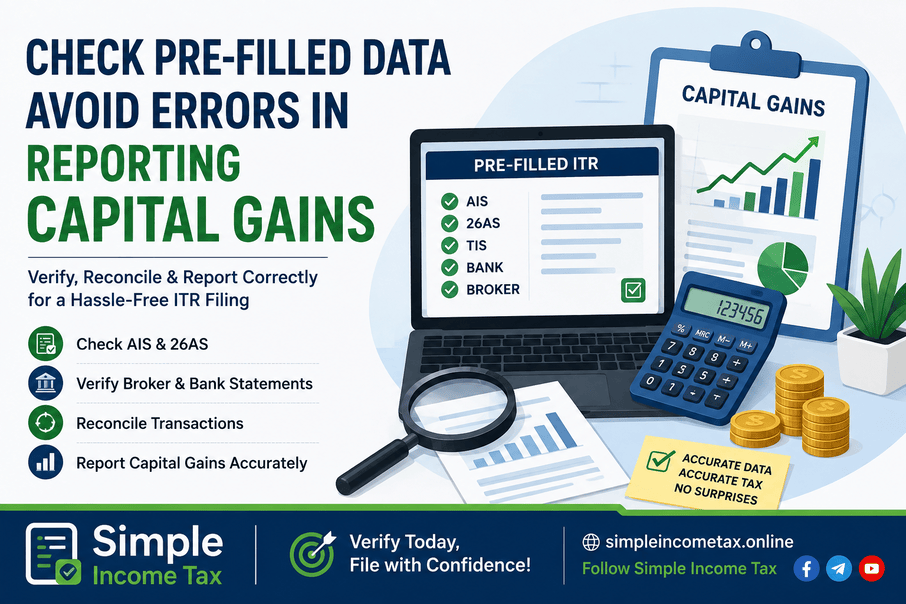

The Income Tax Department has significantly simplified Income Tax Return (ITR) filing by providing pre-filled information through the e-Filing portal. Data from sources such as Form 26AS, the Annual Information Statement (AIS), Taxpayer Information Summary (TIS), banks, stock brokers, mutual funds and other reporting entities is automatically reflected in the return. However, taxpayers should remember that the pre-filled return is only a starting point and not a substitute for verifying their own records. Experts caution that pre-filled data may be incomplete, delayed or contain discrepancies, especially in cases involving capital gains. Failure to verify capital gains before filing the return may lead to incorrect tax computation, delayed refunds, defective return notices or even scrutiny in some cases.
Why Capital Gains Require Special Attention
Unlike salary income or TDS credits, capital gains are often derived from numerous transactions involving shares, mutual funds, immovable property and other capital assets.
The tax liability depends on several factors, including:
- Date of acquisition.
- Date of transfer.
- Cost of acquisition.
- Cost of improvement.
- Expenses incurred in connection with the transfer.
- Applicable tax provisions.
- Availability of exemptions under the Income Tax Act.
Since the Income Tax Department receives transaction information from multiple reporting entities, the pre-filled data may not always reflect the complete or correct picture. AIS is intended to assist taxpayers and facilitate pre-filling, but taxpayers remain responsible for ensuring that the return is accurate.
Common Errors Found in Pre-filled Capital Gains Data
Some common issues include:
- Missing purchase cost.
- Duplicate entries.
- Incorrect sale consideration.
- Missing transactions.
- Incorrect classification of Short-Term and Long-Term Capital Gains.
- Delay in reporting by intermediaries.
- Transactions executed through multiple brokers not appearing completely.
Therefore, taxpayers should never assume that pre-filled capital gains are always correct.
Documents You Should Verify Before Filing
Before reporting capital gains, taxpayers should reconcile the pre-filled information with:
- Broker Capital Gains Statement.
- Demat Account Statement.
- Mutual Fund Capital Gains Statement.
- Contract Notes.
- Annual Information Statement (AIS).
- Taxpayer Information Summary (TIS).
- Form 26AS.
- Bank statements wherever relevant.
These records help ensure that all taxable transactions are correctly reported.
How to Verify Capital Gains Correctly
A systematic approach can help avoid errors.
Step 1 – Download AIS
Check whether all sale transactions are reflected.
Step 2 – Compare with Broker Statement
Your broker’s Capital Gains Statement generally contains the detailed computation of gains and losses. Use it to reconcile the information.
Step 3 – Verify Cost of Acquisition
Incorrect cost of acquisition is one of the most common reasons for wrong capital gains.
Step 4 – Check Holding Period
Ensure that each transaction has been correctly classified as Short-Term or Long-Term.
Step 5 – Verify Exemptions
Where eligible, verify exemptions claimed under the applicable provisions of the Income Tax Act.
Why AIS Alone Should Not Be Treated as the Final Record
AIS is an important compliance tool, but it may contain incomplete or inaccurate information because it aggregates data received from various reporting entities.
Taxpayers can also submit feedback through the AIS portal if they find any incorrect, duplicate or unrelated entries.
Consequences of Incorrect Reporting
Incorrect reporting of capital gains may result in:
- Income Tax notices.
- Defective return notices.
- Additional tax demand.
- Interest liability.
- Delayed processing of refunds.
- Selection for further verification where discrepancies are identified.
The Income Tax Department uses automated data matching between AIS, Form 26AS, broker reports and the information furnished in the return. Significant mismatches can trigger follow-up action.
Best Practices for Taxpayers
To minimise errors:
- Never rely solely on pre-filled data.
- Verify every capital gains transaction.
- Maintain supporting documents.
- Download the latest AIS before filing.
- Report all taxable transactions accurately.
- Retain broker statements and computation sheets for future reference.
Frequently Asked Questions (FAQs)
Is the pre-filled capital gains information always correct?
No. It should always be verified with your own records and supporting documents.
Can AIS contain incorrect information?
Yes. Duplicate entries, missing transactions and incorrect reporting may occur. Taxpayers can submit feedback through the AIS portal where necessary. (Income Tax Department)
Which document should I rely upon for computing capital gains?
The computation should be based on the actual transaction records, broker statements, mutual fund statements and other relevant documents. AIS should be used as a reconciliation tool rather than the sole basis for reporting.
Can incorrect capital gains reporting lead to notices?
Yes. Mismatches between the return and information available with the Department may result in notices or additional verification.
Conclusion
The availability of pre-filled information has undoubtedly made Income Tax Return filing more convenient, but taxpayers should exercise caution while reporting capital gains. Since capital gains computations depend on several factual and legal parameters, blindly accepting pre-filled figures may result in errors and future tax disputes.
Before submitting the return, taxpayers should carefully reconcile all transactions with broker statements, AIS, Form 26AS and other relevant records. A few extra minutes spent verifying the information can help avoid notices, delayed refunds and unnecessary compliance issues.
Related Article on Simple Income Tax
ITR-1 AY 2026-27: Can You File ITR-1 if You Have Income from Two House Properties?
About the Author