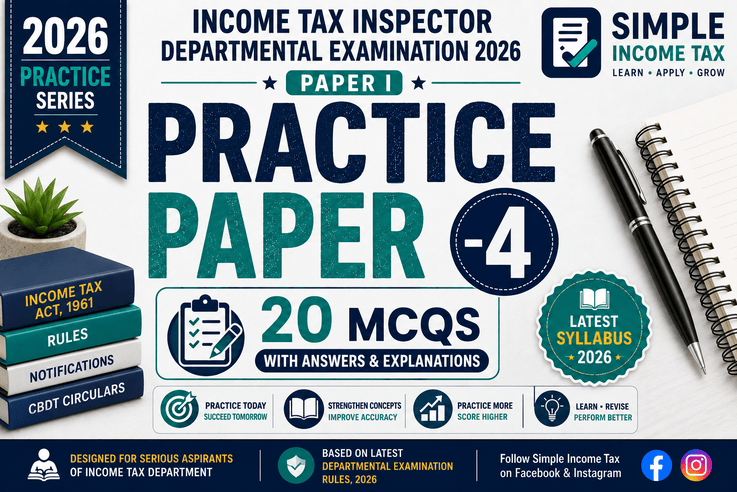

Congratulations on reaching Practice Paper-4 in this Paper I Practice Series. By this stage, you have already covered a significant portion of the syllabus through the previous practice papers. The next step is to continue strengthening your concepts, improve your problem-solving skills, and develop the confidence required to perform well in the Income Tax Inspector Departmental Examination.
This Practice Paper contains 20 original multiple-choice questions (MCQs) prepared strictly in accordance with the latest Departmental Examination Rules, 2026 and the prescribed syllabus. The questions are completely new and are designed to test your conceptual understanding, practical knowledge and analytical ability. Each question is followed by the correct answer and a detailed explanation to help you understand the concept and improve your preparation.
Attempt this Practice Paper in one sitting without referring to the answers. Once you have completed all the questions, review the explanations carefully and analyse your performance. Regular practice, coupled with proper revision, will help you build accuracy, increase speed and enhance your confidence for the departmental examination.
1. Mr. A receives salary income from one employer and interest income from bank deposits. Tax has been deducted at source on both incomes. Which of the following statements is correct?
a) Since TDS has been deducted, filing of return is not required.
b) The taxpayer should determine his tax liability after considering all incomes and claim credit for eligible TDS.
c) TDS deducted by the bank cannot be claimed as tax credit.
d) Interest income should not be disclosed in the return.
Answer: (b)
Explanation:
TDS is only a mode of tax collection. The taxpayer must compute total income, include all taxable incomes and claim credit for eligible TDS while filing the return.
2. Consider the following statements regarding Permanent Account Number (PAN):
Statement I: PAN facilitates linking of various tax-related transactions of a taxpayer.
Statement II: A change in address requires allotment of a fresh PAN.
Choose the correct option.
a) Both statements are true.
b) Both statements are false.
c) Statement I is true but Statement II is false.
d) Statement I is false but Statement II is true.
Answer: (c)
Explanation:
PAN is a permanent unique identifier. Change in address or other particulars requires updating the PAN database and does not require allotment of a new PAN.
3. Which of the following is the primary objective of the Annual Information Statement (AIS)?
a) To replace assessment proceedings.
b) To assist taxpayers in accurate reporting of income by providing information available with the Department.
c) To determine residential status.
d) To compute taxable income automatically.
Answer: (b)
Explanation:
AIS provides taxpayers with comprehensive financial information to facilitate voluntary compliance and accurate return filing.
4. A taxpayer notices that a transaction reflected in AIS does not belong to him. What should he do?
a) Ignore the transaction.
b) Report appropriate feedback through the prescribed facility and retain supporting evidence.
c) File another PAN application.
d) Delete the transaction from the return manually.
Answer: (b)
Explanation:
The AIS portal provides a feedback mechanism through which taxpayers can report incorrect information for appropriate consideration.
5. Consider the following statements:
Statement I: The objective of e-Verification is to authenticate the Income Tax Return electronically.
Statement II: Electronic verification eliminates the need for physical submission of ITR-V in eligible cases.
Choose the correct option.
a) Both statements are true.
b) Both statements are false.
c) Statement I is true but Statement II is false.
d) Statement I is false but Statement II is true.
Answer: (a)
Explanation:
Electronic verification enables completion of the return filing process without sending a signed ITR-V where permitted under the prescribed procedure.
6. Which of the following best describes the role of an Income Tax Inspector in taxpayer services?
a) Passing assessment orders.
b) Assisting taxpayers by providing procedural guidance, verification support and carrying out duties assigned by the Assessing Officer.
c) Hearing appeals against assessment orders.
d) Granting approval for prosecution.
Answer: (b)
Explanation:
Income Tax Inspectors play an important role in taxpayer facilitation, verification of facts, field enquiries and assisting the Assessing Officer in discharge of statutory functions.
7. Consider the following statements regarding digital tax administration:
Statement I: The Income Tax Department promotes paperless communication with taxpayers.
Statement II: Notices issued electronically through the prescribed system have legal significance under the applicable provisions.
Choose the correct option.
a) Both statements are true.
b) Both statements are false.
c) Statement I is true but Statement II is false.
d) Statement I is false but Statement II is true.
Answer: (a)
Explanation:
The Department has adopted digital governance, and electronic communications issued in accordance with the law are legally recognized.
8. Mr. B has paid Advance Tax and TDS has also been deducted from his income. At the time of filing the return, his final tax liability is lower than the taxes already paid. Which of the following is correct?
a) Excess tax paid is forfeited.
b) The taxpayer may become entitled to a refund in accordance with the Income Tax Act.
c) Excess payment is automatically carried forward without filing a return.
d) The taxpayer should not claim the excess amount.
Answer: (b)
Explanation:
Where prepaid taxes exceed the final tax liability, the taxpayer may be eligible for a refund, subject to processing under the Act.
9. Which of the following best reflects the concept of voluntary tax compliance?
a) Paying tax only after receipt of a demand notice.
b) Maintaining proper records, filing returns on time and furnishing accurate information voluntarily.
c) Filing returns only when refund is expected.
d) Responding only after commencement of penalty proceedings.
Answer: (b)
Explanation:
Voluntary compliance is based on honest self-reporting, timely payment of taxes, maintenance of records and compliance with statutory obligations.
10. Consider the following statements:
Statement I: Technology-driven tax administration aims to improve efficiency and transparency.
Statement II: Taxpayer education and awareness contribute to better voluntary compliance.
Choose the correct option.
a) Both statements are true.
b) Both statements are false.
c) Statement I is true but Statement II is false.
d) Statement I is false but Statement II is true.
Answer: (a)
Explanation:
Modern tax administration combines digital initiatives with taxpayer education to encourage voluntary compliance, improve service delivery and reduce disputes.
Great. From Questions 71–80, we’ll move to an expert level with practical scenarios, statement-based questions, and concepts frequently tested in the Income Tax Inspector Departmental Examination.
11. Mr. X files his Income Tax Return after carefully reconciling his books with the Annual Information Statement (AIS). However, one bank transaction appearing in AIS does not belong to him. What is the most appropriate course of action?
a) Exclude the transaction without any action.
b) Pay tax on the transaction to avoid future litigation.
c) Submit appropriate feedback through the AIS portal and retain documentary evidence.
d) Ignore the discrepancy since AIS is not relevant.
Answer: (c)
Explanation:
If any information in AIS is incorrect or does not pertain to the taxpayer, appropriate feedback should be submitted through the AIS functionality, along with supporting records for future reference.
12. Consider the following statements:
Statement I: Every notice issued electronically by the Income Tax Department is invalid unless a physical copy is also served.
Statement II: Electronic communication through the prescribed system has legal validity under the Income Tax Act.
Choose the correct option.
a) Both statements are true.
b) Both statements are false.
c) Statement I is false but Statement II is true.
d) Statement I is true but Statement II is false.
Answer: (c)
Explanation:
Electronic service of notices through the prescribed mode is legally recognized. Physical service is not mandatory in every case.
13. Which of the following best describes the objective of pre-filled Income Tax Returns?
a) To eliminate the taxpayer’s responsibility to verify information.
b) To facilitate accurate and convenient filing by pre-populating available information.
c) To automatically complete assessments.
d) To replace the Annual Information Statement (AIS).
Answer: (b)
Explanation:
Pre-filled returns improve compliance by reducing manual data entry while requiring taxpayers to verify and correct information wherever necessary.
14. Consider the following statements regarding Tax Deduction at Source (TDS):
Statement I: TDS is one of the methods adopted by the Government for early collection of tax.
Statement II: Deduction of TDS determines the final tax liability of every taxpayer.
Choose the correct option.
a) Both statements are true.
b) Both statements are false.
c) Statement I is true but Statement II is false.
d) Statement I is false but Statement II is true.
Answer: (c)
Explanation:
TDS is only a mechanism for collection of tax. Final tax liability is determined after computing total income in accordance with the Income Tax Act.
15. An Income Tax Inspector has been directed by the Assessing Officer to verify the existence of a business concern before completion of assessment. The Inspector should primarily:
a) Pass the assessment order after inspection.
b) Conduct factual verification and submit a report to the Assessing Officer.
c) Issue a demand notice directly.
d) Levy penalty for non-compliance.
Answer: (b)
Explanation:
An Inspector performs verification and enquiry functions and submits factual reports. The statutory assessment order is passed by the Assessing Officer.
16. Consider the following statements regarding the Taxpayers’ Charter:
Statement I: The Department is expected to maintain transparency and accountability.
Statement II: Taxpayers are expected to provide truthful and complete information.
Choose the correct option.
a) Both statements are true.
b) Both statements are false.
c) Statement I is true but Statement II is false.
d) Statement I is false but Statement II is true.
Answer: (a)
Explanation:
The Taxpayers’ Charter establishes reciprocal responsibilities for both the Department and taxpayers to ensure efficient tax administration.
17. Which of the following is the most appropriate purpose of PAN in tax administration?
a) It is used only for filing Income Tax Returns.
b) It acts as a unique identifier linking tax-related and specified financial transactions of a taxpayer.
c) It is required only by business entities.
d) It is issued separately for each source of income.
Answer: (b)
Explanation:
PAN serves as the unique identifier for taxpayers and helps link various tax and specified financial transactions.
18. Consider the following statements:
Statement I: Digital initiatives reduce compliance costs for taxpayers.
Statement II: Online services improve efficiency and transparency in tax administration.
Choose the correct option.
a) Both statements are true.
b) Both statements are false.
c) Statement I is true but Statement II is false.
d) Statement I is false but Statement II is true.
Answer: (a)
Explanation:
Technology-driven services such as e-Filing, e-Verification, AIS and online grievance redressal improve efficiency while reducing compliance costs and enhancing transparency.
19. A taxpayer receives a communication requesting supporting documents for a deduction claimed in the return. Which of the following is the most appropriate response?
a) Ignore the communication until assessment is completed.
b) Furnish the required documents through the prescribed electronic mode within the stipulated time.
c) Visit the office without submitting any online response.
d) Withdraw the deduction immediately without verification.
Answer: (b)
Explanation:
Taxpayers should respond promptly through the prescribed electronic platform and submit supporting evidence within the prescribed time.
20. Consider the following statements:
Statement I: Effective taxpayer services promote voluntary tax compliance.
Statement II: Digital transformation in the Income Tax Department seeks to improve taxpayer experience while strengthening compliance.
Choose the correct option.
a) Both statements are true.
b) Both statements are false.
c) Statement I is true but Statement II is false.
d) Statement I is false but Statement II is true.
Answer: (a)
Explanation:
Modern tax administration focuses on providing efficient digital services, improving taxpayer experience and encouraging voluntary compliance through transparency and ease of compliance.
Congratulations on completing Practice Paper-4! Your consistent effort and dedication are gradually building the knowledge and confidence needed to excel in the Income Tax Inspector Departmental Examination. Carefully review the explanations for every question, particularly those you answered incorrectly, and revise the related topics wherever necessary. Keep your preparation on track by attempting the final Practice Paper in this series. Stay focused, practise regularly and continue learning. Simple Income Tax wishes you success in your examination and a bright professional career.
Disclaimer
This Practice Paper has been prepared by Simple Income Tax solely for educational and self-practice purposes. The questions, answers and explanations are original and based on the latest syllabus and relevant provisions available at the time of publication. This is not an official question paper or answer key issued by the Income Tax Department or any Government authority.
Related Article on Simple Income Tax
- ITI Departmental Examination 2025 (Paper I): Solved Previous Year Question Paper with Answers & Explanations (PART-1)
- ITI Departmental Examination 2025 (Paper I): Solved Previous Year Question Paper with Answers & Explanations (Part-2)
- ITI Departmental Examination 2025 (Paper I): Solved Previous Year Question Paper with Answers & Explanations (Part – 3)
Always refer official website of Income Tax Department
About the Author