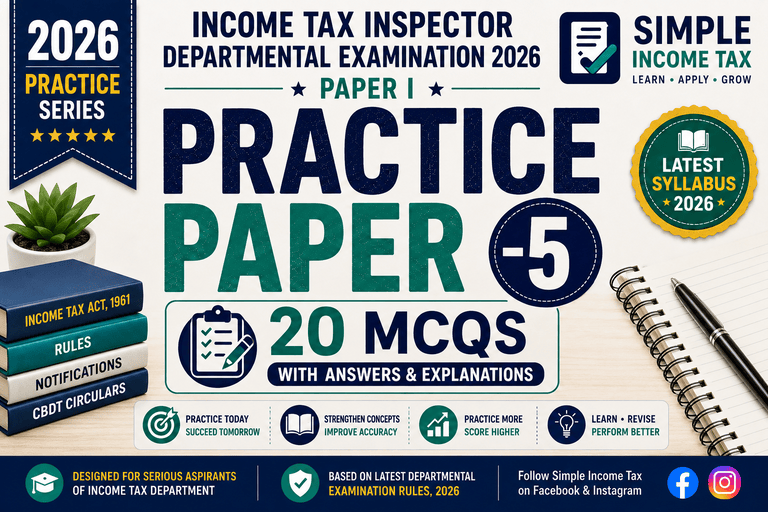

Welcome to Practice Paper-5, the final practice paper in this Paper I series. If you have attempted the previous four practice papers, you have already completed extensive revision of the syllabus and gained valuable Examination practice. This final paper is designed to reinforce your understanding, assess your overall preparation, and help you identify any remaining areas that require revision before the departmental examination.
This Practice Paper contains 20 original multiple-choice questions (MCQs) prepared in accordance with the latest Departmental Examination Rules, 2026 and the prescribed syllabus. The questions are entirely new, concept-oriented and designed to reflect the standard expected in the Income Tax Inspector Departmental Examination. Detailed answers and explanations have been provided to help you understand the reasoning behind every correct option.
Treat this Practice Paper as your final self-assessment. Attempt all the questions in one sitting without referring to the answers, evaluate your performance honestly, and revise the topics wherever necessary. A disciplined approach to practice and revision will significantly improve your confidence and examination readiness.
1. Consider the following statements regarding the Annual Information Statement (AIS):
Statement I: AIS may contain information relating to tax deducted at source, specified financial transactions and other financial information available with the Department.
Statement II: Information appearing in AIS should be verified by the taxpayer before filing the return.
Choose the correct option.
a) Both statements are true.
b) Both statements are false.
c) Statement I is true but Statement II is false.
d) Statement I is false but Statement II is true.
Answer: (a)
Explanation:
AIS is a comprehensive information statement intended to assist taxpayers in filing accurate returns. Taxpayers should reconcile AIS with their own records before filing the return.
2. Mr. A discovers that tax has been deducted from his income, but the corresponding credit is not appearing in Form 26AS. Which of the following is the most appropriate first course of action?
a) Ignore the discrepancy and file the return.
b) Immediately file an appeal before the Commissioner (Appeals).
c) Contact the deductor and request correction of the TDS statement, wherever required.
d) File another PAN application.
Answer: (c)
Explanation:
Where TDS credit is not reflected due to reporting errors, the deductor should be approached to rectify the TDS statement so that the credit is correctly reflected.
3. Consider the following statements:
Statement I: PAN is used for identifying taxpayers and linking specified financial transactions.
Statement II: Every change in address requires allotment of a fresh PAN.
Choose the correct option.
a) Both statements are true.
b) Both statements are false.
c) Statement I is true but Statement II is false.
d) Statement I is false but Statement II is true.
Answer: (c)
Explanation:
PAN remains the same throughout the lifetime of the taxpayer. Changes in address or other particulars require updation of PAN records, not allotment of a new PAN.
4. An Income Tax Inspector has been instructed to conduct a field enquiry regarding the existence of a business concern. Which of the following is the primary responsibility of the Inspector?
a) Complete the assessment.
b) Prepare a factual verification report for the Assessing Officer.
c) Issue penalty proceedings.
d) Determine taxable income.
Answer: (b)
Explanation:
The Inspector performs verification and enquiry functions. Assessment and determination of taxable income are functions of the Assessing Officer.
5. Which of the following best reflects the objective of faceless tax administration?
a) Increasing manual processing.
b) Enhancing transparency, efficiency and accountability by reducing physical interface.
c) Eliminating appellate remedies.
d) Replacing statutory provisions.
Answer: (b)
Explanation:
Faceless tax administration aims to improve governance by leveraging technology and minimizing unnecessary physical interaction.
6. Consider the following statements:
Statement I: Every taxpayer has responsibilities under the Taxpayers’ Charter.
Statement II: Honest compliance and maintenance of proper records are among such responsibilities.
Choose the correct option.
a) Both statements are true.
b) Both statements are false.
c) Statement I is true but Statement II is false.
d) Statement I is false but Statement II is true.
Answer: (a)
Explanation:
The Taxpayers’ Charter not only specifies the Department’s commitments but also outlines taxpayers’ responsibilities, including maintaining records and complying honestly.
7. Which of the following digital initiatives enables taxpayers to electronically authenticate their Income Tax Return without sending a signed ITR-V?
a) e-Verification.
b) AIS.
c) Form 26AS.
d) e-Nivaran.
Answer: (a)
Explanation:
The e-Verification facility allows taxpayers to complete the return filing process electronically through approved authentication methods.
8. A taxpayer receives an e-mail claiming to be from the Income Tax Department asking him to disclose his password and OTP immediately. What should he do?
a) Share the password if the e-mail contains the Department’s logo.
b) Verify the communication through the official e-Filing portal and never disclose passwords or OTPs.
c) Ignore all future communications from the Department.
d) Send scanned copies of all bank statements immediately.
Answer: (b)
Explanation:
The Income Tax Department never requires taxpayers to disclose passwords or OTPs. Taxpayers should verify communications only through official channels and remain alert to phishing attempts.
9. Consider the following statements regarding voluntary tax compliance:
Statement I: Timely filing of returns is one aspect of voluntary compliance.
Statement II: Prompt response to statutory notices also promotes voluntary compliance.
Choose the correct option.
a) Both statements are true.
b) Both statements are false.
c) Statement I is true but Statement II is false.
d) Statement I is false but Statement II is true.
Answer: (a)
Explanation:
Voluntary compliance includes timely filing of returns, payment of taxes, maintenance of records and prompt response to departmental communications.
10. Which of the following best represents the role of technology in modern tax administration?
a) Increasing paperwork.
b) Promoting efficient taxpayer services, transparency and data-driven administration.
c) Eliminating statutory compliance.
d) Reducing the importance of taxpayer education.
Answer: (b)
Explanation:
Technology has transformed tax administration by enabling e-Filing, faceless proceedings, online grievance redressal, digital verification and improved taxpayer services.
11. Consider the following statements regarding the Annual Information Statement (AIS):
Statement I: AIS provides a comprehensive view of financial and tax-related information available with the Income Tax Department.
Statement II: Taxpayer Information Summary (TIS) is a category-wise summary generated from AIS information.
Statement III: Taxpayers can submit feedback on incorrect information reflected in AIS.
Select the correct option:
a) Statements I and II only are correct.
b) Statements II and III only are correct.
c) Statements I, II and III are correct.
d) Statements I and III only are correct.
Answer: (c)
Explanation:
AIS is a comprehensive statement containing tax and financial information. TIS is a summarized category-wise version of AIS, and taxpayers can provide online feedback on incorrect or duplicate information.
12. Mr. A receives salary from two employers during the previous year. TDS has been deducted by both employers. While filing the return, he should:
a) Include only the salary from the employer deducting higher TDS.
b) Include salary from both employers and claim eligible TDS credit.
c) File two separate Income Tax Returns.
d) Include only the salary reflected in Form 26AS.
Answer: (b)
Explanation:
The taxpayer is required to disclose all taxable salary income and may claim credit for eligible TDS while computing the final tax liability.
13. Consider the following statements regarding PAN:
Statement I: PAN is a unique identification number allotted for Income Tax purposes.
Statement II: A person may legally possess more than one PAN if engaged in different businesses.
Statement III: Duplicate PAN, if allotted inadvertently, should be surrendered through the prescribed procedure.
Choose the correct option:
a) Statements I and II are correct.
b) Statements II and III are correct.
c) Statements I and III are correct.
d) All the statements are correct.
Answer: (c)
Explanation:
Only one PAN can be held by a person. If duplicate PANs exist, the additional PAN should be surrendered following the prescribed procedure.
14. Which of the following digital facilities enables taxpayers to submit grievances relating to Income Tax matters electronically?
a) AIS
b) e-Nivaran
c) TAN Portal
d) CPC Processing Utility
Answer: (b)
Explanation:
The e-Nivaran system provides an online platform for grievance redressal and forms part of the Department’s taxpayer service initiatives.
15. Consider the following statements:
Statement I: The Taxpayers’ Charter commits the Department to provide fair and courteous treatment.
Statement II: The Department shall collect only the amount of tax legally due.
Statement III: Taxpayers are expected to maintain accurate records and provide truthful information.
Select the correct option:
a) Statements I and II only.
b) Statements II and III only.
c) Statements I and III only.
d) Statements I, II and III.
Answer: (d)
Explanation:
The Taxpayers’ Charter lays down reciprocal commitments of both the Department and taxpayers, including fairness, lawful collection of tax and honest compliance.
16. An Income Tax Inspector has been directed to verify whether a business concern is functioning at its declared address. His report should primarily contain:
a) Recommendations regarding quantum of assessment.
b) Findings based on factual verification supported by evidence.
c) Proposed additions to income.
d) Penalty to be imposed.
Answer: (b)
Explanation:
The Inspector’s responsibility is to conduct an objective field enquiry and submit a factual report. The Assessing Officer takes statutory decisions regarding assessment.
17. Consider the following statements regarding voluntary tax compliance:
Statement I: Accurate reporting of income promotes voluntary compliance.
Statement II: Timely response to Departmental communications improves tax administration.
Statement III: Maintenance of books and supporting documents is an important compliance responsibility.
Select the correct option:
a) Statements I and II only.
b) Statements II and III only.
c) Statements I and III only.
d) Statements I, II and III.
Answer: (d)
Explanation:
Voluntary compliance includes correct reporting, maintaining proper records and timely compliance with statutory requirements.
18. Which of the following best describes the objective of digital initiatives introduced by the Income Tax Department?
a) To replace statutory provisions.
b) To reduce transparency.
c) To improve efficiency, transparency, accountability and taxpayer convenience.
d) To eliminate taxpayer verification.
Answer: (c)
Explanation:
Digital initiatives such as e-Filing, AIS, TIS, e-Verification, online grievance redressal and faceless proceedings are intended to provide efficient and transparent taxpayer services.
19. Consider the following statements:
Statement I: Information reflected in AIS should always be verified with the taxpayer’s own records.
Statement II: The taxpayer may provide feedback where information appearing in AIS is incorrect.
Statement III: TIS reflects processed and category-wise summarized information.
Choose the correct option:
a) Statements I and II only.
b) Statements II and III only.
c) Statements I and III only.
d) Statements I, II and III.
Answer: (d)
Explanation:
AIS is intended to assist taxpayers in accurate return filing. Incorrect entries may be disputed through the feedback mechanism, while TIS provides category-wise summarized information.
20. Which one of the following best reflects the overall objective of modern Income Tax administration?
a) Maximization of litigation.
b) Collection of maximum possible tax irrespective of law.
c) Promotion of voluntary compliance through transparent, technology-driven and taxpayer-centric administration.
d) Replacement of statutory provisions by digital platforms.
Answer: (c)
Explanation:
The Income Tax Department’s modern approach emphasizes voluntary compliance, digital governance, transparency, accountability and taxpayer-friendly services while ensuring collection of only the tax legally due.
Congratulations on completing the Paper I Practice Series! By attempting all five Practice Papers, you have taken an important step towards strengthening your preparation for the Income Tax Inspector Departmental Examination. Continue revising the important provisions, learn from the explanations provided, and focus on improving your weak areas. Remember, consistent effort and regular practice are the keys to success. We hope this series has added value to your preparation and boosted your confidence. Simple Income Tax wishes you every success in your departmental examination and future career.
Disclaimer
This Practice Paper has been prepared by Simple Income Tax solely for educational and self-practice purposes. The questions, answers and explanations are original and based on the latest syllabus and relevant provisions available at the time of publication. This is not an official question paper or answer key issued by the Income Tax Department or any Government authority.
Related Article on Simple Income Tax
- ITI Departmental Examination 2025 (Paper I): Solved Previous Year Question Paper with Answers & Explanations (PART-1)
- ITI Departmental Examination 2025 (Paper I): Solved Previous Year Question Paper with Answers & Explanations (Part-2)
- ITI Departmental Examination 2025 (Paper I): Solved Previous Year Question Paper with Answers & Explanations (Part – 3)
Always refer official website of Income Tax Department
About the Author