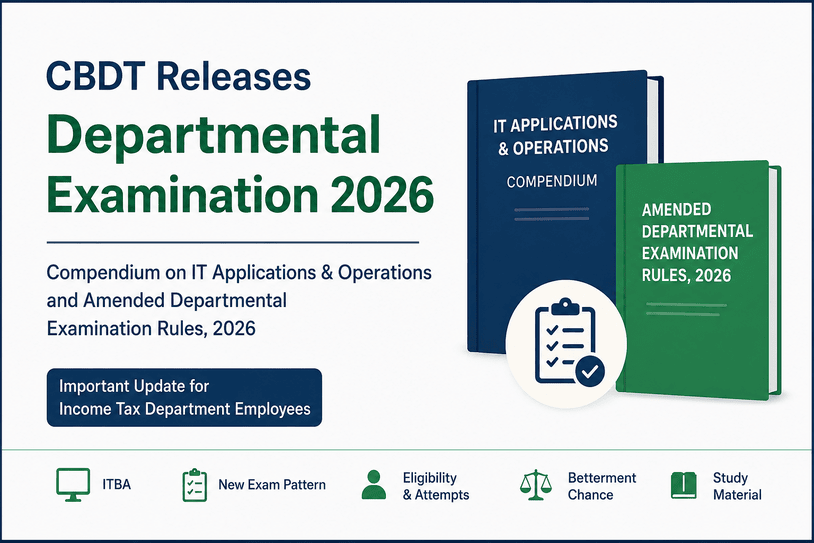

The Central Board of Direct Taxes (CBDT), through the Directorate of Human Resource Development (Examination Division), has issued two significant documents in respect of Departmental Examination Rules, 2026 that are expected to play a crucial role in the preparation of candidates appearing in the Departmental Examination, 2026.
These are:
- Compendium on IT Applications & Operations
- Amended Consolidated Departmental Examination Rules, 2026
While the first document serves as the official study material for the newly introduced IT Applications & Operations paper, the second document lays down the complete framework governing the Departmental Examination for Income Tax Officers (ITOs), Income Tax Inspectors (ITIs), and Ministerial Staff (MS). Together, these publications provide clarity on both “what to study” and “how the examination will be conducted.”
For thousands of departmental employees preparing for the examination, these documents are not just another notification—they represent a major shift towards a more technology-oriented and practical examination pattern that reflects the Department’s digital transformation.
Why These Documents Are Important
Over the last decade, the Income Tax Department has undergone an unprecedented technological transformation. Traditional manual processes have gradually been replaced by integrated digital platforms such as ITBA, CPC, Insight, TRACES, the e-Filing Portal, AIS, and numerous other online applications.
Today’s Income Tax Officer or Inspector is expected not only to possess sound knowledge of the Income Tax Act but also to efficiently work on various departmental applications.
Recognising this transformation, CBDT has revised the Departmental Examination framework and introduced IT Applications & Operations as a dedicated paper. To ensure that candidates have a reliable and standard reference, the Directorate of HRD has also published a comprehensive Compendium covering the prescribed syllabus.
Document 1: Compendium on IT Applications & Operations
The Compendium is an official self-study guide prepared by the Examination Division of the Directorate of HRD specifically for the Departmental Examination 2026.
The document clearly states that it is intended only as a study aid and should not be treated as a substitute for the Income Tax Act, Rules, official ITBA instructions or CBDT Circulars and Notifications, which will prevail in case of any inconsistency. It is also applicable for FY 2025–26 (AY 2026–27) and is intended for the current examination cycle.
Another important point highlighted in the Compendium is that it has been prepared as a combined study material for three cadres—Income Tax Officers, Income Tax Inspectors and Ministerial Staff. Every chapter contains an “Applicable to” marking so that candidates can identify the portions relevant to their respective cadre.
What Does the Compendium Cover?
The study material contains 18 chapters divided into seven parts, covering almost every important digital platform currently used by the Income Tax Department.
Rather than merely listing software names, the Compendium explains:
- what each application is,
- why it was introduced,
- where it fits into departmental work,
- the legal provisions connected with it,
- practical workflows,
- important terminology,
- and examination-oriented key takeaways.
This makes it much more useful than a simple user manual.
Part I – Understanding the ITBA Ecosystem
The first part introduces candidates to the ITBA platform and explains the overall digital ecosystem of the Department.
Some important topics include:
- Introduction to ITBA
- Difference between taxpayer-facing and officer-facing applications
- Evolution from legacy systems
- Login and security architecture
- Worklist concept
- Common Functions Module
- Digital Signature Certificate (DSC)
- Document Identification Number (DIN)
- ITBA modules
- MIS Reports
- Email and Video Conferencing facilities
These chapters help candidates understand the digital backbone of departmental functioning.
Part II – PAN, TAN and TDS Modules
The second part focuses on taxpayer identification systems and TDS administration.
Important areas include:
- PAN structure and allotment
- AO Code
- PAN jurisdiction
- Aadhaar linking
- PAN transfer
- Event marking
- TAN module
- CPC-TDS
- TRACES
- Form 26AS
- AIS/TIS
- Processing under section 200A
- TDS defaults
- Interest and fee provisions
These chapters explain how different systems interact with each other and how officers handle them through ITBA.
Part III – Returns and Assessment
This is perhaps the most practically useful portion for assessment officers.
Topics covered include:
- Income Tax Return processing
- CPC-ITR
- Pre-filled returns
- e-Verification
- Section 143(1)
- Refund processing
- Defective returns
- Rectification
- Assessment Module
- CASS
- e-Proceedings
- Transfer Pricing references
- Valuation references
- Draft orders
- Faceless Assessment
- National Faceless Assessment Centre (NaFAC)
- Assessment Units
- Verification Units
- Technical Units
- Review Units
- Inter-Unit Communication
- Video conferencing
- Adjournment requests
Candidates preparing for Paper IV will find this section highly relevant because it links legal provisions with the actual ITBA workflow.
Part IV – Penalty, Recovery, Audit and Appeals
The fourth part deals with several important post-assessment functions.
It explains:
- Penalty Module
- Faceless Penalty
- Section 270A
- Section 274
- Section 275
- Rectification under section 154
- Order Giving Effect
- Recovery proceedings
- Notice of Demand
- Recovery Module
- Tax Recovery Officer
- Audit Module
- Revenue Audit
- Internal Audit
- Faceless Appeals
- Appeal Register
- CSR
- e-Nivaran
- CPGRAMS
For officers working in recovery, appeals or audit, these chapters provide a structured overview of departmental workflows.
Document 2 – Amended Consolidated Departmental Examination Rules, 2026
The second document is equally important because it contains the legal framework governing the examination itself.
Instead of study material, it prescribes:
- who can appear,
- eligibility conditions,
- examination pattern,
- attempts,
- qualifying criteria,
- transitional provisions,
- betterment chances,
- and administrative procedures.
Eligibility
The amended rules specify that the examination is applicable to eligible:
- Income Tax Inspectors
- Office Superintendents
- Tax Assistants
- Stenographers
The rules also contain special provisions relating to:
- SC candidates
- ST candidates
- Benchmark Persons with Disabilities
- Candidates partially qualified under the previous examination pattern
These transitional provisions are especially important for candidates who had already cleared some papers under the old scheme.
Attempts and Betterment Chances
One of the most discussed aspects of the revised rules is the attempt policy.
The rules provide that:
- Maximum permissible attempts are generally 10.
- Previous attempts under the earlier pattern are also considered while calculating the overall limit.
- Once permission to appear in an examination is granted, that attempt is counted even if the candidate does not actually write the examination.
- Candidates with fewer than three attempts remaining are provided at least three opportunities to clear the newly introduced IT Applications & Operations paper.
- There is no upper age limit for appearing in the Departmental Examination.
The rules also provide betterment opportunities for eligible SC, ST and Benchmark PwBD candidates who wish to improve their performance after qualifying under relaxed standards.
Revised Examination Pattern
The new examination consists of five papers:
| Paper | Subject |
| Paper I | Income Tax Law, Computation & Taxpayer Services |
| Paper II | Accountancy & Book Keeping |
| Paper III | Allied Laws & Office Procedure |
| Paper IV | IT Applications & Operations |
| Paper V | Rajbhasha Hindi |
Each paper carries 100 marks.
Papers I, II, III and IV are objective-type examinations, whereas Rajbhasha Hindi is descriptive. Each paper has a duration of two hours.
What This Means for Candidates
The Departmental Examination is no longer limited to testing knowledge of statutes and rules. Today’s examination increasingly evaluates whether an officer understands the Department’s digital ecosystem and can appreciate how technology supports tax administration.
For candidates, this means that merely reading the Income Tax Act may not be sufficient. Familiarity with departmental applications, workflows and system architecture has become equally important.
The newly released Compendium is therefore expected to become the primary reference for Paper IV preparation.
Our View
The release of these two documents marks one of the most important developments for the Departmental Examination 2026. The Amended Consolidated Departmental Examination Rules, 2026 provide certainty regarding the examination framework, while the Compendium on IT Applications & Operations equips candidates with a structured understanding of the Department’s digital systems.
Download Compendium on IT Applications & Operations here
Download Amended Consolidated Departmental Examination Rules, 2026 here
Related Article on Simple Income Tax
1. Income Tax Act 2025 Explained
2. Salary Provisions Under Income Tax Act 2025 – Part 1
3. Salary Allowances & Perquisites Under Income Tax Act 2025
4. Salary TDS & Deductions Under Income Tax Act 2025
5. Salary Computation Under Income Tax Act 2025
8. TDS Under the Income Tax Act, 2025 (Part 3) : TDS on Business Payments
Always refer official website of Income Tax Department
About the Author